vLLM New Release: DeepSeek Inference Performance Soars 1.9x to 5.3x

vLLM v0.3.1 deeply optimizes DeepSeek, delivering 1.9x speedup at low concurrency and 5.3x at high concurrency, but the official image has a CUDA version conflict bug.
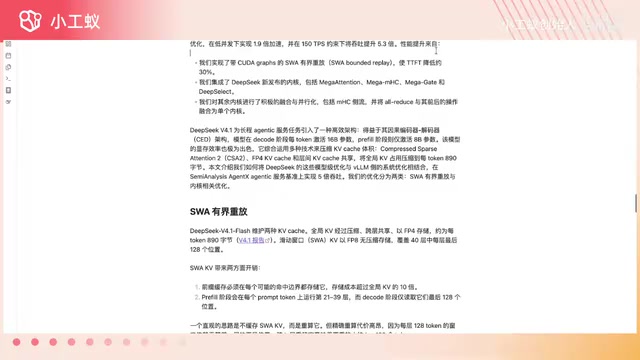
vLLM released v0.3.1 with deep optimizations for DeepSeek series models, achieving 1.9x speedup at low concurrency, 5.3x throughput gain at 150 concurrent requests, and up to 5.8x reduction in Time To First Token (TTFT). The gains come from three main areas: fully implementing DeepSeek's SWA bounded replay mechanism (contributing about 30% of the TTFT reduction), integrating official high-performance kernels like MegaTension/MegaMHC/MegaGate, and fusing and parallelizing multi-step operations. However, a serious bug was found in practice: the official image is built on CUDA 12.9 but mixes in CUDA 13 low-level libraries, causing an immediate startup error. The solution is to rebuild the Docker image based on CUDA 12.9 and reinstall the Torch libraries. The article recommends that enterprises using vLLM to deploy DeepSeek evaluate upgrading soon, as the performance benefits are enough to cover the migration cost.
The open-source inference engine vLLM recently released a new version (v0.3.1), an update that has sparked widespread attention in the AI community. According to hands-on testing shared by a Bilibili creator, this version delivers deep optimizations for the DeepSeek series of models, achieving astonishing inference performance gains—1.9x speedup in low-concurrency scenarios and a throughput surge of 5.3x under high concurrency.
The Core Numbers Behind the Performance Gains
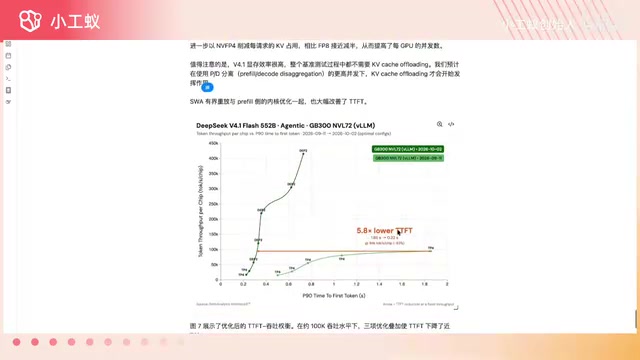
According to the official vLLM blog, this performance leap is reflected in two key metrics. In terms of Time To First Token (TTFT), the new version achieves up to a 5.8x reduction, meaning the latency users experience waiting for the model to start responding is significantly shortened. On the throughput side, when concurrent requests reach 150, overall system throughput can increase to 5.3x the original.
Simply put, if you previously had one machine running DeepSeekAd models, after upgrading vLLM it's as if you got several additional machines of equivalent performance for free. This kind of hardware efficiency improvement through software optimization is hugely significant for enterprises looking to reduce AI deployment costs.
Time To First Token (TTFT) is a core metric for measuring the quality of large model inference services. It refers to the latency from when a user sends a request to when the model outputs its first token. Unlike total generation time, TTFT only reflects the efficiency of the "prefill" stage—that is, the process by which the model processes the entire input prompt and builds the KV cache. In interactive scenarios such as chatbots, code completion, and agent tool calls, users are extremely sensitive to TTFT: the longer the TTFT, the more the model subjectively feels "stuck."
TTFT is mainly affected by input sequence length, model size, memory bandwidth, and batch scheduling strategy. vLLM's 5.8x TTFT reduction essentially compresses the computation and memory access overhead of the prefill stage through techniques like SWA bounded replay and kernel fusion, thereby dramatically speeding up the moment "the first character appears." For long-context, high-concurrency enterprise-grade inference services, improvements in TTFT often translate more directly into user retention than throughput gains do.
Analysis of Three Major Technical Optimizations
SWA Bounded Replay Mechanism
According to the creator, the SWA (Sliding Window Attention) bounded replay feature introduced in DeepSeek models has now been fully implemented by vLLM. This mechanism contributes significantly to reducing TTFT—official data shows a roughly 30% drop in TTFT. For interactive application scenarios requiring fast responses, this optimization directly improves the user experience.
SWA (Sliding Window Attention) is a sparse attention variant: in standard self-attention, each token needs to attend to all preceding tokens, and computation and memory usage grow quadratically with sequence length; SWA only lets each token attend to neighbors within a fixed window ahead of it, reducing complexity to approximately linear. DeepSeek series models adopt SWA in some layers to support ultra-long contexts and lower inference costs.
The so-called "bounded replay" means that when the inference engine processes SWA layers, it doesn't need to retain a complete KV cache for every token, but only replays the limited history within the window range. After vLLM fully implements this mechanism, it both avoids wasting memory on historical tokens outside the sliding window and reduces redundant computation during the prefill stage, thus contributing roughly 30% to lowering TTFT. It is also a key technical prerequisite for understanding this performance leap.
DeepSeek New Kernel Integration
DeepSeek recently open-sourced several compute kernels optimized for NVIDIA hardware, including MegaTension, MegaMHC, MegaGate, and DeepSeekLact. The vLLM team integrated these new kernels into the inference engine, further improving underlying computational efficiency.
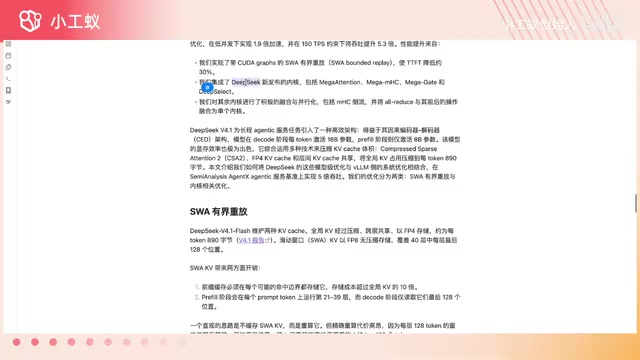
A compute kernel is the smallest executable compute unit running on a GPU, and a single Transformer layer is often split into dozens of kernels executed in sequence. The more kernels there are and the more frequently they're launched, the more the GPU "idles" on scheduling and data movement, and the lower the actual compute utilization. Therefore, merging multiple small kernels into larger, fuller kernels (kernel fusion) is a general approach to inference optimization.
The MegaTension, MegaMHC, MegaGate, DeepSeekLact, etc. mentioned in the article are high-performance kernels hand-written and open-sourced by DeepSeek for NVIDIA hardware characteristics (such as Tensor Cores and shared memory), corresponding to different computational modules like attention, MoE routing, and gating. vLLM directly integrates these kernels into the inference engine, effectively replacing generic implementations with "officially tuned components," thereby pushing computational efficiency up a notch at the underlying level.
Fused Operations and Parallelization
vLLM also fused and parallelized multi-step operations, combining operations that originally needed to be executed step by step into a single step. This system-level optimization strategy reduces computational overhead and memory access counts overall.
Real-World Pitfalls During the Upgrade
Despite the significant performance gains, the creator discovered a serious bug in the official image during actual deployment. When the system environment uses CUDA 12.9, vLLM fails to start with a direct error, preventing any models from running properly.
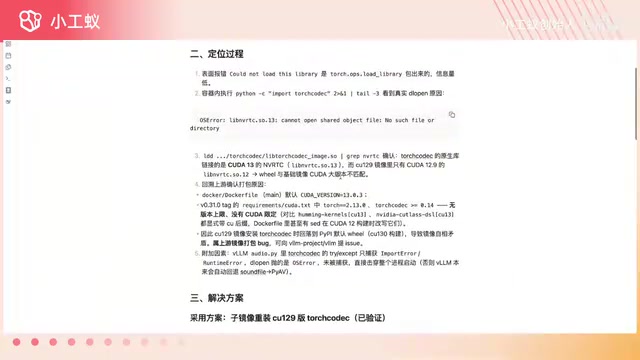
The root cause lies in version confusion in the official image's dependency management: the image itself is built on CUDA 12.9, but when installing a low-level library related to audio processing, it mistakenly pulled in CUDA 13 components, causing a version conflict.
The solution is to rebuild the image. Users need to write a Dockerfile based on the original image and reinstall the Torch-related libraries against CUDA 12.9. Once the fix is complete, models can start normally and enjoy the performance benefits of the new version.
CUDA version conflicts are one of the most common and trickiest problems in deep learning deployment. CUDA is NVIDIA's GPU computing platform, and frameworks like PyTorch and vLLM need to be compiled for a specific CUDA version. When PyTorch in an image is built for CUDA 12.9 but a dependency (such as an audio processing library) pulls in components compiled for CUDA 13, the runtime crashes outright because it can't find matching libcuda/libcudart symbols.
What makes these problems insidious is that the Docker image build stage usually doesn't report errors—they only surface when models are actually loaded and the GPU is invoked. So when troubleshooting, it's recommended to first use nvidia-smi to confirm the CUDA upper limit supported by the driver, then check via pip list | grep cuda or conda list whether the CUDA compile versions of all libraries are consistent, and finally rebuild the image by reinstalling the Torch series dependencies against CUDA 12.9 as described in the article.
Recommendations for Enterprise Users
With their outstanding cost-effectiveness and open-source strategy, DeepSeek series models have become the top choice for many enterprises. And vLLM, as a mainstream open-source inference engine, has further unlocked hardware potential with this deep optimization for DeepSeek.
For enterprises currently using vLLM to deploy DeepSeek models, it's advisable to evaluate upgrading to the new version as soon as possible. Although image compatibility issues may arise during the upgrade, the 1.9x to 5.3x performance gains are more than enough to cover the migration cost. At a time when AI compute is still expensive, tapping the potential of existing hardware through software optimization is an effective path to improving return on investment.
One-line Summary
vLLM v0.3.1 delivers deep optimizations for DeepSeek, with 1.9x speedup at low concurrency and 5.3x at high concurrency, but the official image has a CUDA version conflict bug.
Paragraph Summary
vLLM released v0.3.1 with deep optimizations for DeepSeek series models: 1.9x speedup at low concurrency, 5.3x throughput gain at 150 concurrent requests, and up to 5.8x reduction in Time To First Token (TTFT). The gains come mainly from three areas: full implementation of DeepSeek's SWA bounded replay mechanism (contributing about 30% of the TTFT reduction), integration of official high-performance kernels like MegaTension/MegaMHC/MegaGate, and fusing and parallelizing multi-step operations. However, in practice a serious bug was found in the official image: it's built on CUDA 12.9 but mixes in CUDA 13 low-level libraries, causing an immediate startup error. The solution is to rebuild the Docker image based on CUDA 12.9 and reinstall the Torch libraries. The article recommends that enterprises using vLLM to deploy DeepSeek evaluate upgrading soon, as the performance benefits are enough to cover the migration cost.
Related articles

Gaussian Process Bandit Optimization: Exploration Strategies and Inference Regret Guarantees
Cumulative regret guarantees in Bayesian optimization fail to reflect final recommendation quality. This article examines a new study that provides inference regret guarantees for Gaussian process bandit optimization through exploration query strategies and fill distance analysis, validated on hyperparameter optimization and control tasks.

The Most Detailed Codex Guide on Bilibili: From Installation to Real-World Practice
The most detailed Codex guide on Bilibili: from app store installation to daily work mode configuration, with a real coffee shop project demonstrating file organization, data extraction, dashboard creation, and other practical tasks. Learn to use Plan Mode and desktop pets to leverage Codex efficiently.

Appearance Compensation in Volume Rendering: Why RGB Accuracy Cannot Guarantee Density Correctness
Volume rendering research reveals that volumetric data perfectly reproducing external RGB views may still contain density errors: appearance compensation can double central density and keep external rays unchanged even when L2 error exceeds 14.52%. Density recovery depends on appearance capacity, spatial resolution, and measurement design.