vLLM proto 0.6.0 Released: Prototype Iteration of the Inference Engine

vLLM prototype repository vllm-proto releases version tag 0.6.0, suggesting significant changes in prototype code.
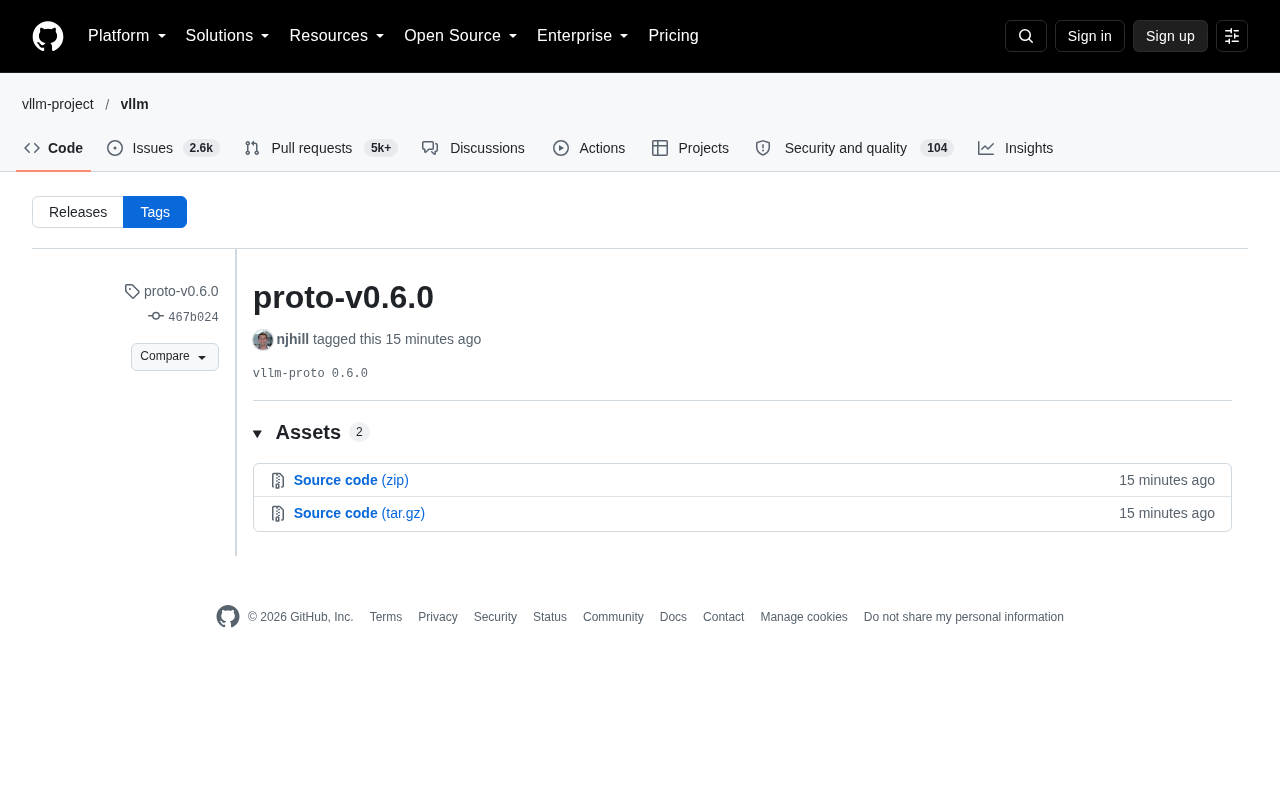
vLLM project member njhill tagged the proto repository with vllm-proto 0.6.0. The proto repository is vLLM's technology incubator, where frontier optimizations such as new scheduling strategies and quantization schemes are often validated first and then merged into the main repository once mature. The minor version increase from 0.5.x to 0.6.0 typically implies non-backward-compatible changes or larger-scale refactoring, rather than mere bug fixes. Currently, the tag page does not display a changelog or release notes, and specific changes need to be confirmed by comparing commit history. For production users, the stable version of the main repository remains the first choice; proto is more suitable as an observation window for judging project activity and the pace of technical evolution.
A Low-Key Version Release
vLLM project member njhill tagged vllm-proto 0.6.0 on the code hosting platform. This is a routine version iteration, but for developers focused on large model inference performance, every version change in the proto repository may signal the future technical direction of the main vLLM project.
The Role of the proto Repository
vLLM has become one of the most watched open-source projects in the field of large language model inference services, with its core selling point PagedAttention significantly improving memory utilization and throughput. The proto repository typically plays the role of a technology incubator—early experiments with new features, new scheduling strategies, or underlying optimizations are often validated here, and once mature, merged into the main repository.
Therefore, proto 0.6.0, although just a tag, represents continuous accumulation from 0.1.0 all the way to now. Each minor version jump signifies progress in stability or functional boundaries of the prototype code.
Core Mechanism of PagedAttention: Traditional attention mechanisms require pre-allocating contiguous KV Cache memory for each sequence during inference, leading to severe internal and external fragmentation. PagedAttention borrows the idea of virtual memory paging from operating systems, dividing the KV Cache into fixed-size blocks, and establishing a mapping from logical sequences to physical blocks through a block table. This allows memory to be allocated on demand and stored non-contiguously, compressing memory waste from several times down to less than 4%, while also supporting sharing of physical blocks between different sequences (such as in parallel sampling and beam search scenarios), thereby significantly improving throughput.
Relationship Between the proto Repository and the Main Repository: proto can be understood as vLLM's "frontier experimental field," with its version number evolving independently of the main project. New scheduling algorithms, quantization formats, or distributed communication optimizations often land here first, and after the interface stabilizes and testing is sufficient, they are merged into the main repository. Therefore, a minor version jump in proto often corresponds to a larger adjustment in underlying abstractions, rather than simply stacking patches.
Signals Behind the Version Number
From 0.5.x to 0.6.0, a minor version increase typically implies non-backward-compatible changes or a larger-scale refactoring, rather than just bug fixes. For downstream teams relying on proto for secondary development, this means they need to pay attention to interface-level changes before upgrading.
However, the tag page currently does not display a detailed changelog or release notes. The specific changes need to be confirmed by further comparing commit history.
Special Meaning of Semantic Versioning in an Incubator Repository: According to SemVer specifications, a minor version increase represents backward-compatible new features, while a major version indicates incompatible changes. However, as a prototype repository, proto does not strictly follow this convention—its 0.x-phase minor jumps often mix interface refactoring, default behavior adjustments, and even removal of experimental APIs. The leap from 0.5.x to 0.6.0 should be interpreted more as "a phased convergence in the prototype stage" rather than a promise of backward compatibility. Downstream teams should focus on reviewing differences in public interfaces of key modules such as schedulers, samplers, and distributed executors before upgrading.
Reference Value for Developers
If you use vLLM in a production environment, the stable version of the main repository is still the first choice. However, if you are following the frontier optimization directions of inference engines—such as more aggressive batching strategies, new quantization schemes, or improvements in distributed inference—the proto repository is worth adding to your watch list.
Version iterations alone are not sufficient reason for production upgrades, but they are an important observation window for judging project activity and the pace of technical evolution.
One-line Summary
vLLM prototype repository vllm-proto releases version tag 0.6.0, suggesting significant changes in prototype code.
Paragraph Summary
vLLM project member njhill tagged the proto repository with vllm-proto 0.6.0. The proto repository is vLLM's technology incubator, where frontier optimizations such as new scheduling strategies and quantization schemes are often validated first and then merged into the main repository once mature. The minor version increase from 0.5.x to 0.6.0 typically implies non-backward-compatible changes or larger-scale refactoring, rather than mere bug fixes. Currently, the tag page does not display a changelog or release notes, and specific changes need to be confirmed by comparing commit history. For production users, the stable version of the main repository remains the first choice; proto is more suitable as an observation window for judging project activity and the pace of technical evolution.
Related articles

Amphibious Transforming Drone: Beyond 100x Power Savings, What Are the Real Needs?
Is the amphibious transforming drone just a gimmick? Starting from the 100x power difference of the M4 Morphobot, explore real application scenarios and thesis topic ideas, analyzing boundary conditions where pure drones and pure ground robots both fail.

Warhound Raises $200 Million: Genetically Engineered "War Dogs" Paired with Anduril Gear
Warhound raises $200M, backed by Ben Lamm and Palmer Luckey, to genetically engineer dogs for military and law enforcement use and equip them with Anduril gear. This article analyzes its technology direction, funding logic, and ethical controversy.

Claude API Comes to Google Cloud: IAM Integration and SDK Access Guide
Anthropic hosts the full Claude API on Google Cloud with IAM-controlled permissions and unified billing. This guide covers the Vertex AI and Anthropic-hosted entry points, IAM role configuration, and SDK access.