vLLM Releases v0.34.0rc2: Adjusting GPU Memory Configuration

vLLM releases v0.34.0rc2, with the core change being to stop defaulting gpu_memory_utilization in most extensible scenarios.
vLLM released the v0.34.0rc2 candidate version, tagged by contributor njhill on November 12. It is a maintenance-focused release with no new features. The core change is to stop automatically setting the `gpu_memory_utilization` parameter in most extensible scenarios. This parameter was originally used to control the proportion of GPU memory pre-allocated when loading the model (default about 0.9). After removing the automatic assignment, the decision-making power over the memory budget is returned to the upper-level caller, avoiding conflicts with other processes sharing the GPU or external orchestration logic. However, developers using the Python API without explicitly passing the parameter should check their configuration to prevent unexpected memory allocation after upgrading. The change also updates documentation and tests, with relatively little impact on command-line users. The article recommends reading the complete release notes before upgrading and verifying memory-related paths in a test environment.
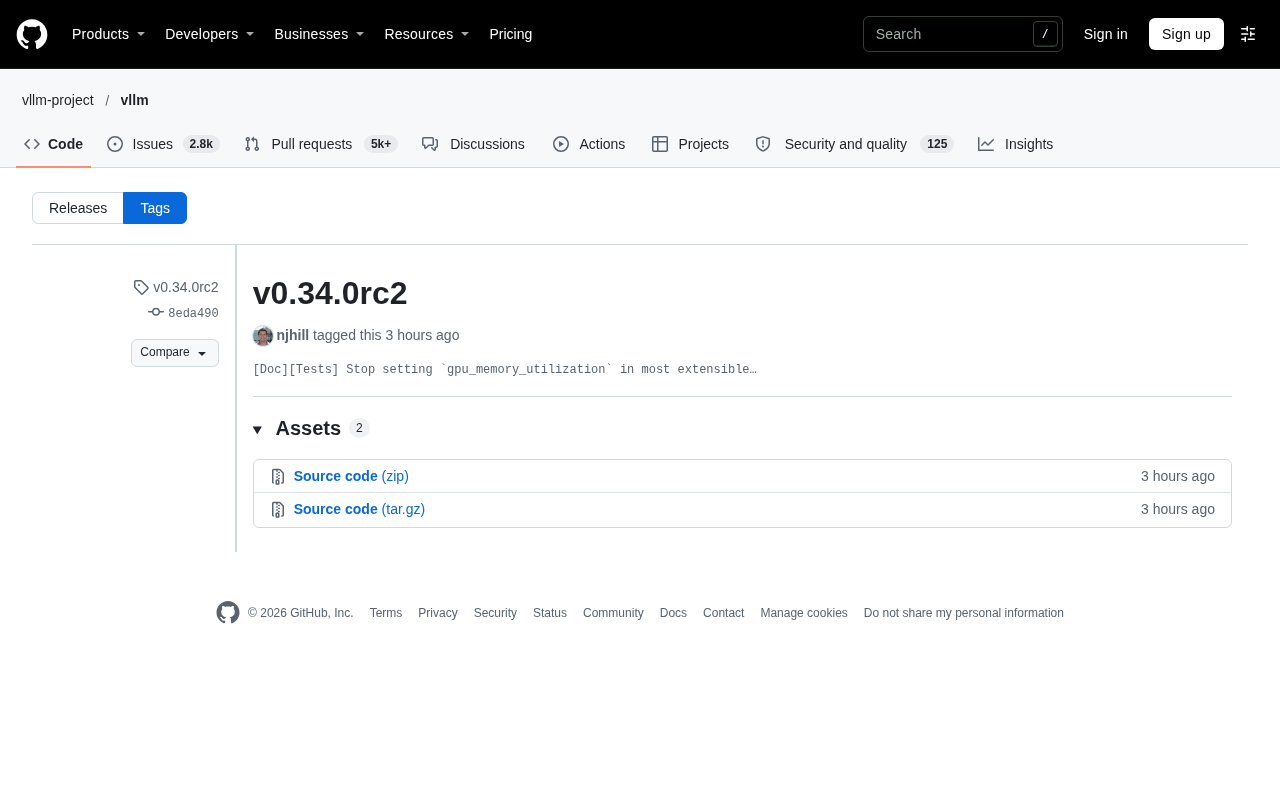
The vLLM project has released the v0.34.0rc2 candidate version. This update primarily includes adjustments to documentation and tests, with the core change being to stop setting the gpu_memory_utilization parameter by default in most extensible scenarios. This change may seem minor, but it could affect how developers manage GPU memory when deploying inference services.
Release Overview
According to the tag information on GitHub, v0.34.0rc2 was tagged by contributor njhill on November 12. Judging from the commit records, this candidate version focuses on maintainability improvements to the codebase rather than introducing new features. The release page shows that this version includes several asset files, but the specific contents are not detailed in the summary.
A candidate version usually means that features are essentially frozen and the project has entered the testing and bug-fixing phase. For production environment users, rc versions are not recommended for direct deployment, but they can learn about the direction of changes in advance.
Core Change: No Longer Setting gpu_memory_utilization by Default
The title of this commit clearly indicates the scope of the change: stop setting gpu_memory_utilization in most extensible scenarios. In vLLM, this parameter controls the proportion of GPU memory pre-allocated when loading the model, with a typical default value of 0.9.
Previously, vLLM automatically assigned a value to this parameter during initialization, simplifying user configuration. However, automatic assignment can also cause problems: when users want fine-grained control over memory allocation, or when the runtime environment needs to share the GPU with other processes, a hardcoded default value can be disruptive. After removing the automatic setting, users need to explicitly specify this parameter or rely on the underlying framework's default behavior.
Impact on Developers
For developers using the vLLM Python API directly, if gpu_memory_utilization is not explicitly passed in the code, the behavior may change after upgrading. It is recommended to check existing configurations and explicitly set this parameter to avoid unexpected memory allocation due to the missing default value.
For users starting services via the command line, the impact is relatively small, as command-line tools typically provide default values. However, the relevant examples in the documentation may need to be updated accordingly, which is also why this commit involves both documentation and tests.
PagedAttention and KV Cache Memory Usage
To understand the role of gpu_memory_utilization, one must first understand vLLM's PagedAttention mechanism. Traditional inference frameworks need to reserve contiguous KV Cache space for each request during the generation phase, which easily leads to memory fragmentation and waste. PagedAttention borrows the idea of virtual memory paging from operating systems, dividing the KV Cache into fixed-size blocks that are allocated on demand and stored non-contiguously, thereby significantly improving memory utilization and concurrent throughput. For this reason, vLLM must know the approximate upper limit of available GPU memory at startup to calculate how many blocks it can hold and how large a concurrent batch it can support. gpu_memory_utilization is precisely the input to this budget: it tells vLLM what proportion of total GPU memory can be used to store model weights and KV Cache blocks. If set too high, it may compete for memory with other processes on the same GPU and cause OOM; if set too low, the number of KV Cache blocks is insufficient, compressing concurrency capacity. Therefore, this parameter is not an ordinary hyperparameter but a key configuration that directly determines service capacity planning.
Meaning of Extensible Scenarios
The "extensible scenarios" mentioned in the commit refer to usage patterns where vLLM allows users to replace or extend its internal components, such as custom executors, integration with third-party schedulers, or multi-process/distributed deployments where an external framework manages memory allocation. In these scenarios, vLLM is no longer the sole manager of GPU memory. If a default gpu_memory_utilization is still forcibly written, it would override the memory budget already planned by the caller and could even cause duplicate reservations. Stopping the default setting essentially returns the decision-making power over the memory budget to the upper-level orchestration logic, consistent with the design principle that "a library should not make global resource decisions on behalf of the caller." This also explains why the change is labeled as intended for extensible scenarios rather than uniformly removing all default values.
Synchronized Documentation and Test Adjustments
The [Doc][Tests] prefix in the commit message indicates that the change involves not only code logic but also documentation updates and test case updates. This synchronized adjustment reflects good engineering practice: documentation reflects the new behavior, and tests ensure that the change does not break existing functionality.
According to the asset list on the release page, this version includes two asset files, but the specific contents are not shown in the captured information. Interested developers can visit the GitHub release page to view the complete changes.
Observations on Version Iteration Cadence
As a popular open-source project in the field of large model inference, vLLM iterates frequently. The appearance of rc2 suggests that rc1 may have already gone through a round of test feedback, and a second candidate version was released after fixing several issues. This rapid small-step iteration model helps respond quickly to user feedback, but it also requires users to pay attention to changelogs and adjust integration code in a timely manner.
For teams relying on vLLM to build services, it is recommended to read the complete release notes before upgrading and verify critical paths in a test environment. This is especially important for parts involving memory configuration, as behavior may differ across GPU models and model sizes.
The Role of Release Candidates (rc) in Semantic Versioning
rc stands for release candidate, the final verification stage before an official release. By common convention, entering rc means new features are frozen, and only bug fixes and documentation patches are accepted thereafter. A version number like 0.34.0rc2 indicates the second candidate for the official 0.34.0 release. Compared with alpha and beta, rc is closer to production quality, but it still does not guarantee final stability of APIs and behavior; once the official version is released, behavior changes during the rc phase are considered part of the official semantics. For users, the value of rc lies in exposing compatibility issues early, especially changes like this one that alter default behavior—discovering and reporting issues during the rc phase costs far less than an emergency rollback after the official release.
Summary
v0.34.0rc2 is a maintenance-focused candidate version, with the core change being to stop automatically setting gpu_memory_utilization in most scenarios. This adjustment gives developers clearer control but also requires users to actively manage memory parameters. Before the official release, it is advisable to follow feedback and fixes in subsequent rc versions.
Related articles

ChatGPT Plus Subscription Pitfall Guide: Go/Plus/Pro Tier Comparison and Quick Activation
A complete ChatGPT Plus subscription guide based on a Bilibili tutorial: from registering an account, comparing Go/Plus/Pro tiers, to the practical steps for quickly completing your subscription.

GPT-6.2 Sol/Astra Released! A Step-by-Step ChatGPT Plus Subscription Guide and Tier Comparison
GPT-6.2 Sol/Astra is out—here's a ChatGPT Plus subscription guide: register an account, compare Go/Plus/Pro tiers, and subscribe in a minute.

Comparing Three Channels for Subscribing to GPT Plus in China: Is Website Top-Up the Easiest?
How to subscribe to GPT Plus in China? This article compares website top-up, credit card, and mobile top-up channels—process, cost, and risk—with steps and tips to help you choose wisely.