vLLM Toronto Meetup Announced: Co-hosted by Cohere and NVIDIA

vLLM is hosting a free Toronto meetup on Oct 15 with Cohere, NVIDIA AI, and Inferact to discuss the framework's future direction.
vLLM has announced a free in-person technical meetup in Toronto on October 15, co-organized with enterprise LLM company Cohere, hardware ecosystem leader NVIDIA AI, and inference services provider Inferact. The core agenda centers on a technical talk about vLLM's future roadmap, along with dedicated time for face-to-face conversations with team members. The organizer lineup spans the full stack from hardware to inference framework to model deployment, underscoring vLLM's hub role in the LLM inference ecosystem — and making it a valuable opportunity for practitioners to gain first-hand insights and build industry connections.
vLLM Community Comes to Toronto
vLLM officially announced on social media that it will host an in-person technical meetup in Toronto on October 15. The event is co-organized by the vLLM team alongside Cohere, NVIDIA AI, and Inferact, and is free and open to developers and practitioners interested in large model inference optimization.
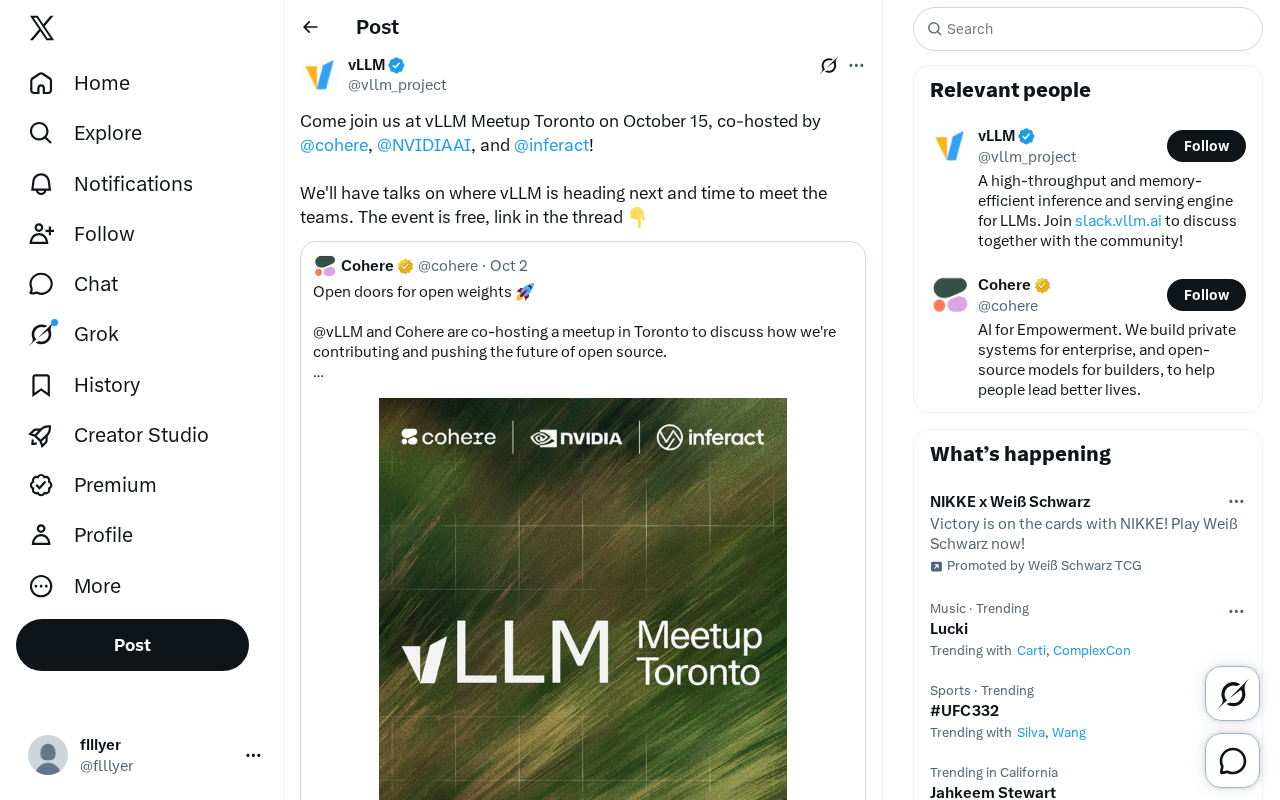
According to the official announcement, the core agenda will focus on the future direction of vLLM, while also giving attendees the opportunity to connect face-to-face with teams from all co-organizing partners. The event is free to attend, with the registration link shared in the original post's reply thread.
Why This Event Is Worth Noting
vLLM is one of the most widely followed open-source LLM inference and serving frameworks today. Thanks to core innovations like PagedAttention, its throughput and memory utilization performance have made it a mainstream choice for deploying LLM services in production. In-person events hosted directly by the framework team typically signal first-hand roadmap disclosures.
The lineup of co-organizers also speaks to the event's significance. Cohere is an enterprise-focused large language model company; NVIDIA AI represents the hardware ecosystem underpinning inference acceleration; and Inferact brings a production inference services perspective to the mix. Together with vLLM, the three partners span the full stack — from hardware and framework to model deployment. This combination reflects vLLM's central role as a hub in the broader inference technology ecosystem.
What is PagedAttention? PagedAttention is vLLM's core innovation, originally proposed by the UC Berkeley team. Inspired by virtual memory and paging mechanisms from operating systems, it addresses a key inefficiency in traditional LLM inference: conventional frameworks pre-allocate contiguous KV Cache (key-value cache) memory for each request, resulting in significant memory fragmentation and waste. PagedAttention instead splits the KV Cache into fixed-size "pages" that are dynamically allocated and freed on demand, allowing physical memory blocks to be shared across different requests. This design enables vLLM to handle significantly more concurrent requests on the same hardware — with benchmarks showing throughput improvements of several times over solutions like Hugging Face Transformers — and is the technical foundation behind vLLM's rapid rise as a mainstream inference framework.
Agenda Highlight: What's Next for vLLM
Officially, the event will feature a technical talk on "where vLLM is headed next." For developers who closely follow the project, official roadmap presentations like these tend to be more actionable than documentation — they often offer early signals about upcoming features, performance optimization directions, and ecosystem partnership plans.
Beyond the technical talks, the event also includes dedicated time for direct conversation with team members. For engineers currently using or evaluating vLLM in production environments, the ability to ask questions directly to core developers and partners in person is a form of value that online channels simply can't replicate.
About Inferact Inferact is a company focused on the commercial productization of LLM inference services, playing an engineering and production deployment role within the vLLM ecosystem. Unlike framework teams that primarily serve research and open-source communities, inference service companies like Inferact typically accumulate deep practical experience from real production environments — covering engineering details such as batching strategies, latency vs. throughput trade-offs, and multi-tenant isolation. Their participation in this event means attendees won't just hear about framework-level roadmap updates, but will also gain access to hands-on production feedback. This makes it especially valuable for engineers assessing the feasibility of deploying vLLM at scale.
Event Details
- Date: October 15
- Location: Toronto, Canada (in-person)
- Organizers: vLLM team, Cohere, NVIDIA AI, Inferact
- Cost: Free
- Registration: See the link in the original post's reply thread
For readers based in Toronto and the surrounding area who work on large model inference deployment or are interested in open-source AI infrastructure, this kind of in-person gathering — bringing together the framework team alongside hardware vendors and model companies — is a rare opportunity to stay on top of industry developments and build meaningful connections.
Related articles

Gaussian Process Bandit Optimization: Exploration Strategies and Inference Regret Guarantees
Cumulative regret guarantees in Bayesian optimization fail to reflect final recommendation quality. This article examines a new study that provides inference regret guarantees for Gaussian process bandit optimization through exploration query strategies and fill distance analysis, validated on hyperparameter optimization and control tasks.

The Most Detailed Codex Guide on Bilibili: From Installation to Real-World Practice
The most detailed Codex guide on Bilibili: from app store installation to daily work mode configuration, with a real coffee shop project demonstrating file organization, data extraction, dashboard creation, and other practical tasks. Learn to use Plan Mode and desktop pets to leverage Codex efficiently.

Appearance Compensation in Volume Rendering: Why RGB Accuracy Cannot Guarantee Density Correctness
Volume rendering research reveals that volumetric data perfectly reproducing external RGB views may still contain density errors: appearance compensation can double central density and keep external rays unchanged even when L2 error exceeds 14.52%. Density recovery depends on appearance capacity, spatial resolution, and measurement design.