vLLM v0.31.0rc3 Released: Model Runner V2 Introduces Randomized Dummy Inputs

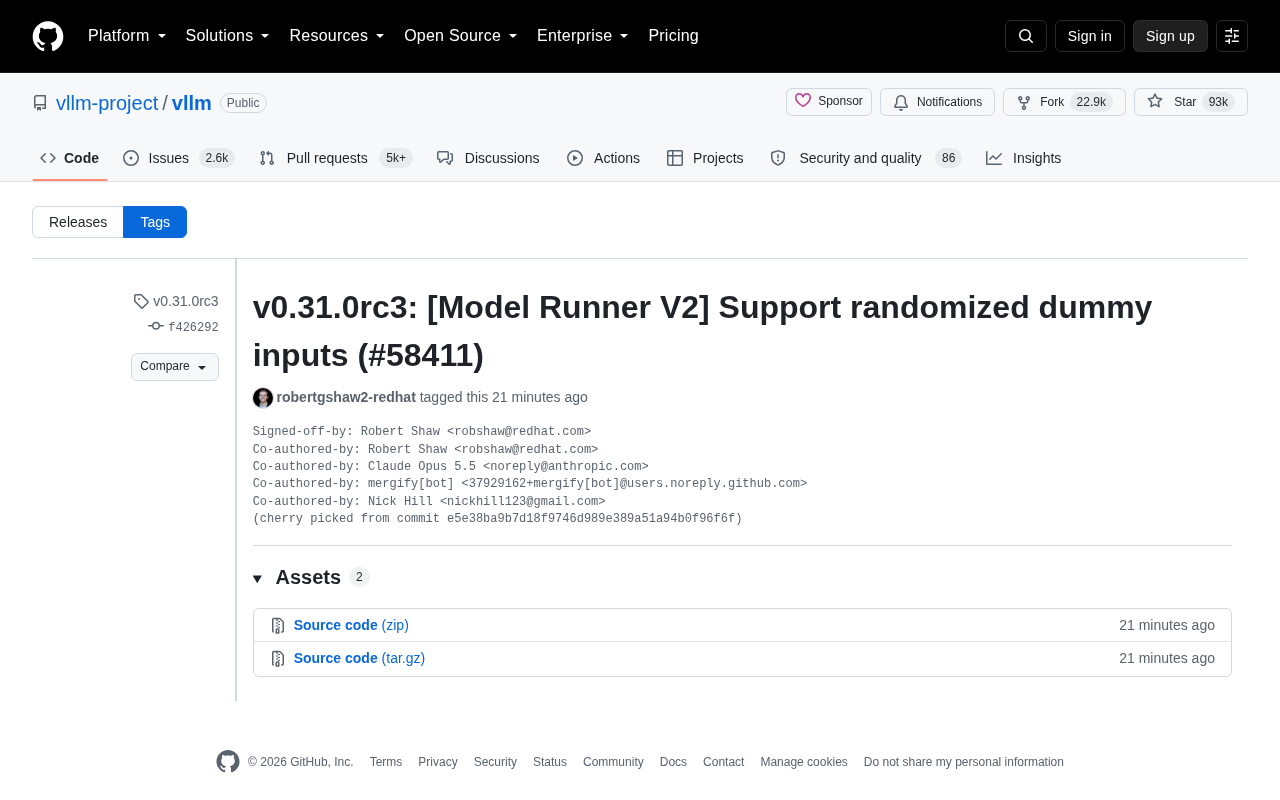
vLLM v0.31.0rc3 adds randomized dummy inputs to Model Runner V2 for more accurate memory profiling and CUDA warm-up.
vLLM has released v0.31.0rc3 as a release candidate, with the core change being the addition of Randomized Dummy Inputs support to the refactored Model Runner V2 execution layer. Dummy inputs are used during model startup for memory pre-allocation, CUDA kernel warm-up, and performance profiling. Traditional zero-padding approaches can cause estimation errors in quantization or sparse computation paths; randomized data makes the warm-up phase's memory distribution and operator execution paths more representative of real inference, reducing OOM risks and memory waste in production deployments. This is a release candidate — production environments should await the stable release, while interested developers can validate it on non-critical workloads and report findings to the community.
vLLM v0.31.0rc3 Release Overview
vLLM has recently released v0.31.0rc3 (a release candidate), with the core highlight being the introduction of Randomized Dummy Inputs support for Model Runner V2. As one of the most popular inference and serving frameworks for large language models, vLLM has accumulated over 93,000 stars and 22,900 forks on GitHub, making every release update a topic of keen interest within the community.
This version was collaboratively developed by contributors including Red Hat's Robert Shaw, with commit records also crediting AI collaborators such as Claude Opus — reflecting the emerging trend of human-AI collaboration in open-source development. This update was merged into the main branch via cherry-pick and represents a candidate stage ahead of the official stable release.
The Significance of Model Runner V2
The Model Runner is the core component within vLLM's inference engine responsible for executing the model's forward computation. V2 represents a major architectural refactor of vLLM's execution layer, designed to improve scheduling flexibility and execution efficiency, and to better support key mechanisms such as continuous batching and PagedAttention.
What Are Randomized Dummy Inputs
Dummy inputs serve an important purpose in inference frameworks. During model loading, memory pre-allocation, and performance profiling phases, the framework needs to construct a batch of "fake" input tensors to perform a dry run of the computation graph. This allows it to determine peak memory usage, warm up CUDA kernels, and verify the correctness of execution paths.
The traditional approach typically uses fixed or zero-padded dummy data, which can cause two issues in certain scenarios: first, it may fail to accurately reflect the actual runtime memory distribution; second, some operators that depend on the numerical distribution of inputs (such as certain quantization paths or sparse computation) may behave differently during the dummy run compared to real inference. By introducing randomized dummy inputs, the framework can use random tensors that more closely approximate real data distributions for warm-up and profiling, resulting in more accurate memory estimation and performance measurement.
Continuous Batching is the core scheduling mechanism that sets vLLM apart from traditional static batching: rather than waiting for all requests in a batch to complete simultaneously, the inference server dynamically removes completed requests and inserts new ones after each decoding step. This significantly improves GPU utilization and overall throughput. PagedAttention draws inspiration from operating system virtual memory paging, storing and dynamically allocating the KV Cache (key-value cache) in non-contiguous fixed-size blocks, fundamentally eliminating memory fragmentation and waste caused by pre-reserving maximum sequence lengths in traditional approaches. One of the goals of the Model Runner V2 refactor is to provide a more robust execution layer for these two mechanisms under increasingly complex scheduling scenarios.
CUDA Kernel Warm-up is an engineering detail that cannot be overlooked in GPU inference. CUDA kernels require JIT compilation, autotuning, and other time-consuming operations on their first execution, causing the first batch of inferences to exhibit abnormally high latency. By pre-running the computation graph with dummy inputs during service startup, these initialization processes are triggered in advance, allowing subsequent real inference to enjoy stable low latency from the very first request. Quantized models (such as INT4/INT8 quantization) and sparse computation paths are particularly sensitive to the numerical distribution of inputs — for example, certain dynamic quantization algorithms dynamically adjust scaling factors based on the actual value range of inputs. If all-zero tensors are used during warm-up, quantization operators may follow entirely different code paths compared to real inference, leading to distorted memory usage estimates. Randomized dummy inputs are introduced specifically to cover these edge cases.
Impact on Developers and Deployers
For engineering teams deploying vLLM in production environments, more accurate memory profiling means being able to set GPU memory utilization ceilings more safely, reducing the risk of OOM (out-of-memory) errors caused by estimation inaccuracies, or avoiding overly conservative memory waste. This is particularly critical in scenarios where large models are run on limited GPU resources with a focus on maximizing throughput.
For model developers and framework contributors, the continued refinement of Model Runner V2 also lays the groundwork for future support of more model architectures and more complex scheduling strategies. Randomized dummy inputs are one piece of this foundational capability-building effort — invisible to end users, yet fundamental infrastructure for ensuring inference stability and predictable performance.
Recommendations for Using the Release Candidate
It is important to note that v0.31.0rc3 is a Release Candidate, not a stable official release. RC versions are typically used for the community to pre-test new features and identify potential issues. For production environments, it is recommended to continue using officially tagged stable releases and upgrade once the stable version of this series is published.
Developers interested in trying it early can install this release candidate via pip by specifying the version number, and validate the behavior of Model Runner V2-related features on non-critical workloads. Any issues encountered should be reported to the project's GitHub Issues to help the project reach stability faster.
Summary
Based on the commit contents, this is a typical infrastructure-level optimization targeting internal framework correctness and profiling accuracy, rather than a visible feature change for end users. However, it is precisely these seemingly unassuming low-level improvements that continuously reinforce vLLM's engineering quality as a high-performance inference engine. As the Model Runner V2 architecture gradually matures, vLLM can be expected to maintain its leading advantage in performance and usability for large model inference.
Related articles

macOS Is No Longer UNIX: Apple Didn't Renew Certification, But the Technology Is Unchanged
Apple did not renew macOS's UNIX certification, and the Open Group has removed Apple's entry. This article analyzes the technical reality behind the expiration, Apple's possible intentions, and the practical impact on developers.

Building Stateful Multi-Agent Systems with Azure Cosmos DB
Based on the official Azure Cosmos DB tutorial, this article explains how to use the Agent Memory Toolkit to add shared persistent memory to a multi-agent travel planner, covering short-term, long-term, episodic, and semantic memory plus cross-session state continuity.

Production AI Agent Operations: A Three-Step Framework for Observing, Evaluating, and Optimizing
Azure Cosmos DB team proposes a three-step framework for production AI Agent operations: observe trace tracking, evaluate with LLM as a judge and regression testing, optimize cost across RU, retrieval, memory, and LLM layers.