vLLM v0.33.0rc0 Released: CUDA Profiling Fix and MRV2 Optimization

vLLM releases v0.33.0rc0 candidate, fixing MRV2 cost profiling under CUDA.
The vLLM project has released the v0.33.0rc0 release candidate, with the commit verified via GitHub GPG signature. This update is a targeted bugfix whose core change is to make MRV2 skip the adaptive verification cost profiling logic on the CUDA backend, reducing potential runtime overhead or compatibility issues on the GPU inference path. Since rc0 is a candidate version and public information is limited (the commit message is truncated), the complete change list, performance data, and test results remain unclear, making it impossible to determine the specific impact on throughput and latency. The article recommends that ordinary users wait for the official version, while developers troubled by related issues or needing to verify compatibility in advance can keep an eye on this version, with the official release page and complete commit diff as the final reference.
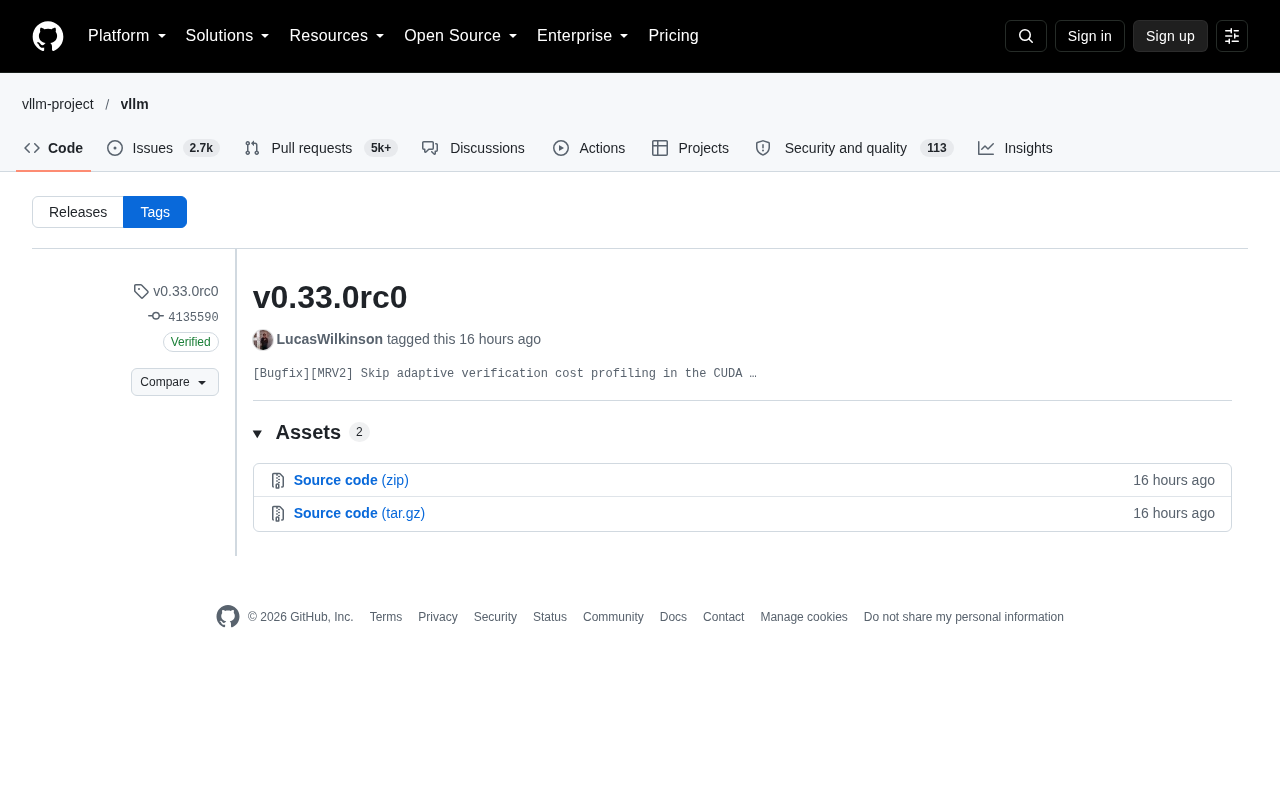
The vLLM project has released the v0.33.0rc0 release candidate. This version was committed on GitHub with a verified signature (GPG key ID: B5690EEEBB952194) and tagged by contributor LucasWilkinson. Based on the commit message, this update focuses on an issue with adaptive verification cost profiling for MRV2 (presumably Multi-step Reasoning V2 or a related inference module) in the CUDA environment, and is a targeted bugfix.
Core Change: Skipping Adaptive Verification Cost Profiling under CUDA
The most clearly stated change in this rc release is [Bugfix][MRV2] Skip adaptive verification cost profiling in the CUDA …. Because the original commit message is truncated at this point, the full scope cannot be fully confirmed, but what is certain is that the fix aims to stop MRV2 from executing the adaptive verification cost profiling logic on the CUDA backend.
This kind of fix usually appears in two scenarios: either the profiling mechanism introduces unnecessary overhead or compatibility issues on CUDA, or the profiling results are unreliable in the CUDA environment and continuing to execute it actually interferes with normal inference. Either way, skipping this step means vLLM's inference path on GPUs becomes more direct, removing a layer of potential runtime burden.
For teams deploying inference services with vLLM, this kind of low-level path adjustment is worth paying attention to in the full release notes before upgrading, to confirm whether it affects their own MRV2 configuration or performance baseline.
About vLLM: vLLM is currently one of the most mainstream open-source large language model inference and serving frameworks. Its core innovation is PagedAttention, which borrows the idea of virtual memory paging from operating systems to manage the KV Cache, greatly reducing GPU memory fragmentation and waste and thereby significantly improving inference throughput. vLLM supports Hugging Face weights, multi-GPU tensor parallelism, continuous batching, and other features, and is widely used for online inference services in production environments. Understanding the framework's positioning helps in judging the practical significance of such low-level path changes for deployment and performance baselines.
About CUDA: CUDA is the GPU parallel computing platform and programming model provided by NVIDIA. vLLM's high-performance inference relies heavily on the CUDA backend, achieving acceleration through custom kernels, cuBLAS, and memory management. So-called "skipping a piece of logic on the CUDA backend" usually means that the logic depends on specific operators, CPU-GPU synchronization, or performance counter sampling, which may introduce additional overhead or compatibility issues on the GPU execution path.
Version Number and Release Cadence
The rc0 in v0.33.0rc0 indicates that this is a release candidate, not the final stable version. vLLM uses this approach to collect feedback before the official release, so the code corresponding to this tag may still be adjusted afterward. The tag comparison feature on the GitHub page failed to load properly at the time of capture, indicating that this version was tagged only recently and that surrounding metadata (such as the full diff against the previous version) is not yet stably presented on the static page.
From the release process perspective, the contributor first submits a signed commit, and then a maintainer applies the tag. This Git workflow ensures the traceability of the code's origin. The signature verification status is Verified, indicating that the commit indeed comes from a trusted key.
About rc (Release Candidate): A release candidate is a test release that precedes the official version in software development. It usually already contains the planned features and fixes, but still needs community trial use to discover regression issues. rc versions are generally not recommended for direct use in critical production environments, and may be followed by rc1, rc2, or even adjustments in the official version. When installing via pip, you can explicitly specify pre-release parameters; otherwise, pip skips rc versions by default.
About GPG signature verification: GPG (GNU Privacy Guard) is a signing tool based on public-key cryptography. GitHub's signature verification of commits (shown as Verified) can confirm the committer's identity and prove that the code has not been tampered with since it was committed, and is an important means for open-source projects to ensure supply chain security.
Practical Impact on Users
For ordinary users installing vLLM via pip or from source, it is usually advisable to wait for the official version rather than an rc version. However, for developers who need to verify compatibility in advance or who are currently troubled by MRV2-related issues on CUDA, this rc provides a clear entry point for the fix.
It should be noted that the public information available this time is very limited—the commit message is truncated, and the complete change list, performance data, and test results are not reflected in the source material. Therefore, it is impossible to determine the specific impact of this fix on metrics such as throughput and latency, nor to confirm whether there are other unlisted changes. It is recommended to rely on the official GitHub release page and the complete commit diff.
Conclusion
v0.33.0rc0 is a release candidate focused mainly on bugfixes, with the core change centered on the adaptive verification cost profiling logic of MRV2 in the CUDA environment. The information is limited, but the direction is clear: reducing unnecessary profiling overhead on the GPU inference path. For teams concerned about vLLM inference performance and stability, it is worth tracking the subsequent official release of this version.
Related articles

T3 Code: The Open-Source AI Coding Assistant's Comeback Story
T3 Code is an open-source AI coding assistant that unifies subscriptions like Codex and Claude, with powerful remote control and parallel task management.

Never Elected, Yet Ruled New York for 30 Years: The Ultimate Case Study in the Mechanics of Power
Robert Caro's biographies reveal how unelected Robert Moses ruled New York for 30 years through legal drafting and public authorities, and how Lyndon Johnson built leverage as a "powerless" Senate Majority Leader. Unpacking the underlying logic of accumulating and sustaining power.

The CPython 3.10 Recursion Trap and Synthetic Recovery in TokenGuard, an LLM Circuit Breaker
TokenGuard's author recounts a recursion crash caused by OrderedDict.pop in CPython 3.10 and introduces v0.3.0's Loop Nudge synthetic recovery, inline DLP scanning, and other new LLM agent circuit-breaker capabilities.