Vortex Code: One Prompt, an AI Software Team That Delivers

Vortex Code claims one prompt can drive an AI team to deliver software end to end, but its capability boundaries remain unverified.
On Hacker News, Vortex Code proposed "one prompt, an AI software team that ships," upgrading AI coding products from code completion and conversational refactoring to a multi-role collaborative end-to-end delivery model. The article argues this narrative captures the coordination-cost pain points of indie developers and small teams in requirements decomposition, architecture decisions, testing, and delivery, repackaging value from efficiency gains to replacing part of the engineering organization. But the headline's ambition raises scrutiny: whether context scale can carry complex requirements, whether "ships" means prototype or production code, and whether output is maintainable—none of these boundaries are disclosed. With little community discussion, it remains an early-stage product best watched rather than adopted.
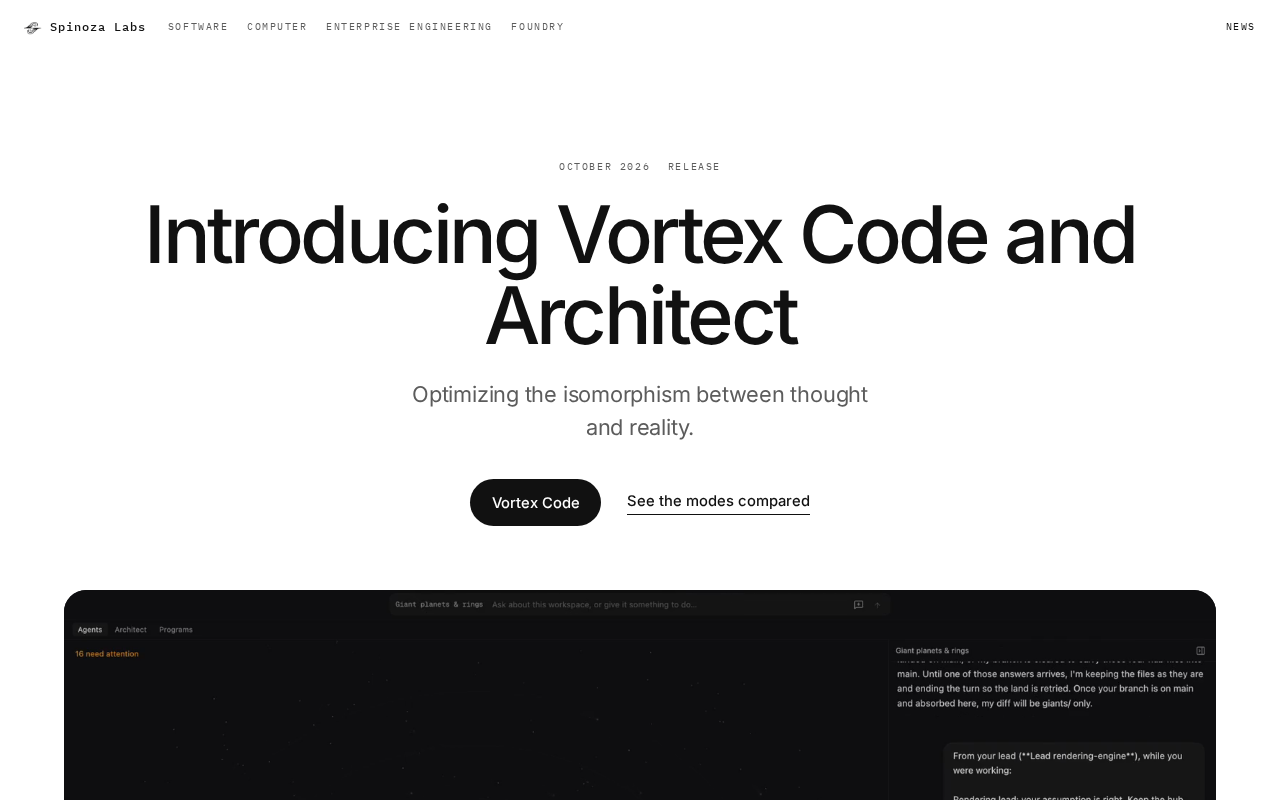
In the evolution of AI coding tools from "code completion" to "end-to-end delivery," Vortex Code has appeared on the Hacker News discussion list with a fairly radical claim: one prompt, an AI software team that ships.
The Narrative Upgrade from "Assistant" to "Team"
Over the past two years, the core selling points of AI coding products have centered on completion, conversational refactoring, and single-file generation. Vortex Code's headline pushes its positioning directly to the "team" level—not helping you write functions, but collaborating across multiple roles to produce a deliverable software artifact end to end.
This framing of "one sentence driving a team" essentially repackages the product's value from "efficiency gains" to "replacing part of the engineering organization." For independent developers and small teams, this hits a real pain point: what they lack is not the speed of writing code, but the coordination costs of requirements decomposition, architecture decisions, testing, and delivery.
However, the ambition of the headline also raises the bar for scrutiny. The Hacker News discussion has only a handful of comments, indicating that the entry is still in an early exposure stage and has not yet formed community consensus. In the absence of public technical details, judging its real capabilities requires caution.
Multi-agent collaborative AI coding (multi-agent coding) is an architectural approach that has emerged in recent years: assigning requirements analysis, architecture design, coding, testing, and other stages to different AI agents, which divide the work, collaborate, and review each other. Unlike a single large model generating code in one pass, this approach attempts to replicate the process division of human software teams to reduce the complexity of a single generation. Common implementations include planning-execution-verification loops based on large language models, as well as having different agents take on roles such as "developer" and "reviewer." Its advantages lie in decomposing complex tasks and facilitating parallelism and error correction, but the challenges lie in communication costs between roles, context consistency, and final integration quality. Most products today are still in the prototype validation stage.
The Capability Boundaries Behind "One Prompt"
Common skepticism about such products in the industry centers on three points:
- Context and scale: Can a one-shot prompt carry enough requirement information, or will it degrade into multiple rounds of manual intervention on complex projects?
- Verifiability of delivery quality: Does "ships" mean generating a runnable prototype, or production code that passes tests and can go live? The gap between the two is enormous.
- Maintainability: Can the code structure produced by the AI team withstand subsequent human takeover?
The original article does not answer these questions. For an early-stage project, this is an information gap rather than a factual error, but it directly determines whether the product is "demo-level impressive" or "engineering-grade usable."
A context window refers to the maximum number of tokens a large language model can process in a single inference, which directly determines how much requirement information, project background, and existing code a "one prompt" can carry. Current mainstream models have context windows ranging from tens of thousands to hundreds of thousands of tokens, but for medium-to-large software projects, the complete codebase, dependencies, and design documents often far exceed this capacity. Therefore, when generating complex software end to end, systems usually need to rely on retrieval-augmented generation (RAG), code indexing, or phased summarization to compress and filter context. Otherwise, the model tends to miss key constraints, causing the produced code to become inconsistent or degraded as scale expands, requiring multiple rounds of manual correction.
The gap between a "runnable prototype" and "production-grade code" is the core dividing line for evaluating AI coding tools. A prototype usually only needs to run the main flow in an ideal environment, while production code also requires: comprehensive error handling and edge cases, unit and integration test coverage, security (such as input validation and dependency vulnerabilities), performance and scalability, observability, and documentation that conforms to team standards. In addition, production delivery involves CI/CD pipelines, environment configuration, and rollback mechanisms. Whether an AI team can automatically generate and pass these validations determines whether the product remains at the demo stage or truly achieves engineering usability.
What It Means for Developers
If the model described by Vortex Code holds, the most directly affected parties are not large-company engineering teams, but independent developers, outsourcing teams, and early-stage startups. They can quickly validate ideas at lower coordination costs and concentrate manpower on product judgment and differentiation.
Conversely, this also means that "being able to orchestrate a software team with AI" will itself become a new skill: prompt engineering, defining acceptance criteria, and the ability to review AI-generated code will all become new dividing lines.
At a time when community discussion has not yet fully unfolded, treating it as a direction worth watching is more prudent than treating it as a mature solution. The signals truly worth tracking are: whether there are public end-to-end cases, whether there is a reproducible delivery process, and actual feedback from third-party developers.
One-line Summary
Vortex Code claims that a single prompt can drive an AI team to deliver software end to end, but its capability boundaries remain to be verified.
Paragraph Summary
On Hacker News, Vortex Code proposed "one prompt, an AI software team that ships," upgrading AI coding products from code completion and conversational refactoring to a multi-role collaborative end-to-end delivery model. The article argues that this narrative captures the coordination-cost pain points of independent developers and small teams in requirements decomposition, architecture decisions, testing, and delivery, repackaging the product's value from efficiency gains to replacing part of the engineering organization. However, the ambition of the headline also raises the bar for scrutiny: whether context scale can carry complex requirements, whether "ships" refers to a prototype or production code, and whether the generated code is maintainable—none of these three capability boundaries are disclosed in the original article. With little community discussion, the product is still in an early exposure stage, lacking public cases and consensus, and should be treated as a direction worth watching rather than a mature solution.
Related articles

From Photons to Production: An Open-Source Computer Vision Engineering Reading Path
Reddit user open-sources a computer vision engineering reading path with 16 chapters from image formation to production deployment, emphasizing primary sources, dependency order, and reproducible benchmarks to help engineers understand why models fail and build reliable vision systems.

Prompt Failures? The Truth About Why AI Agents Struggle in Production—and How to Fix It
A Reddit developer built Agents with Copilot and Gemini but faced unstable behavior. This article analyzes three gaps in prompt engineering for Agent scenarios and offers three practical paths to reliable Agent deployment, including structured prompts, workflow-first approaches, and building an evaluation loop.

Tesla Robotaxi to Open Private Vehicle Access Next Year: Promise or Pipe Dream?
At its Q3 earnings call, Tesla said owners can add their cars to the Robotaxi fleet next year. We analyze the technical basis, Musk's missed deadlines, business logic, and competition.