Voyage Labs Raises $12M to Build a Specialized AI Travel Assistant

A Google Maps-background team founded Voyage Labs, raising $12M to bet on a specialized travel-planning agent.
Voyage Labs, founded by a member with a Google Maps background, has raised $12 million to focus on building a specialized travel-planning agent. The article notes that general-purpose AI assistants doing travel planning are essentially generating text rather than making decisions, making it hard to ensure the accuracy and consistency of real-time constraints like flights, hotels, opening hours, distances, and budgets. Voyage Labs' specialization route may build differentiation in data sources, constraint solving, and executability. The funding also reflects the AI application layer's shift from general assistants to vertical specialized agents, with travel planning as a typical sample.
Travel planning has long been one of the most popular demo scenarios for personal AI assistants. From Muse to Gemini and more than a dozen other products on the market, nearly every company uses "plan a trip for me" to showcase the capabilities of general-purpose agents. But the problem is that these demos often stop at "can generate an itinerary" — still far from truly reliable, executable travel decisions.
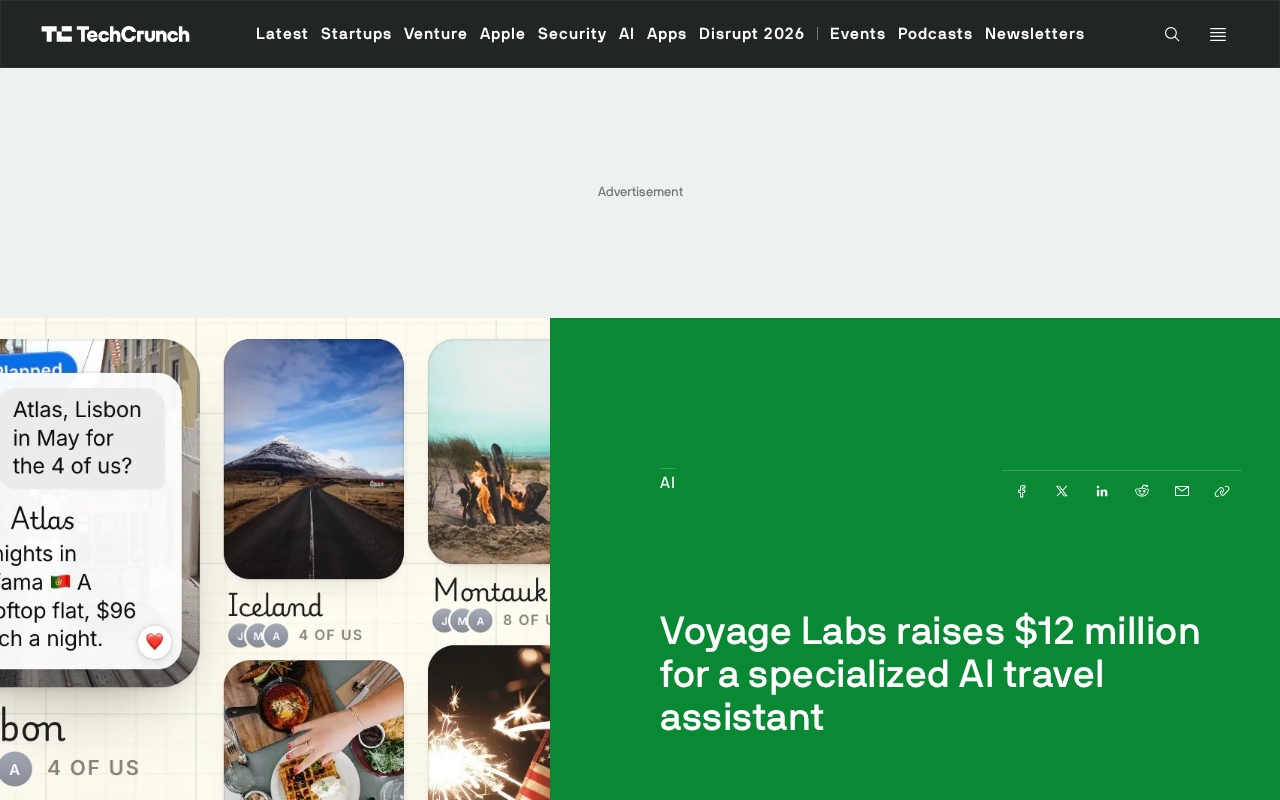
Voyage Labs, a new company founded by a veteran from Google Maps, is trying to fill that gap with a dedicated travel-planning agent, and has already raised $12 million in funding.
Why general-purpose assistants aren't enough for travel planning
The typical approach for general-purpose personal AI assistants in travel scenarios is: the user inputs a destination, number of days, and preferences, and the model generates an itinerary including attractions, restaurants, and transportation suggestions. The advantage of this approach is that it's quick to get started and broad in coverage, but the shortcomings are also obvious — it is essentially "generating text," not "making decisions."
Travel planning involves a large amount of real-time, structured, and mutually constraining information: flight schedules, hotel inventory, attraction opening hours, reservation rules, geographic distances, and budget caps. General-purpose assistants typically rely on the model's internal knowledge or limited web search, making it difficult to guarantee the accuracy and consistency of this information — let alone trade-offs among multiple constraints.
Voyage Labs' judgment is that travel planning requires more than just a stronger model; it needs a product logic built specifically around travel decisions. This is also where "specialized agents" and "general-purpose agents" part ways.
Constraint Solving is the core capability that distinguishes specialized travel-planning agents from general-purpose text generation. Every arrangement in a trip is subject to multiple conditions: attractions must be within opening hours, restaurants must match budget and taste, transportation connections must satisfy timetables, and hotels must have inventory and a reasonable location. Computationally, this is a classic constraint satisfaction problem (CSP), requiring a search over a discrete set of candidates for a solution that satisfies all hard constraints while optimizing soft constraints (such as total cost and walking distance) as much as possible. General-purpose language models excel at generating "plausible-looking" text, but lack systematic search and backtracking capabilities, making them prone to producing itineraries with time conflicts or geographic jumps. Specialized agents typically model the itinerary as a solvable structured problem, using rule engines, optimization algorithms, or tool calls to progressively validate each arrangement, thereby ensuring the final plan is executable in the real world.
Founding team background and product direction
Voyage Labs was founded by a member with a Google Maps background. This background is worth noting: Google Maps' core capabilities are precisely place data, route computation, and local information organization — exactly the parts of travel planning that are hardest to get right.
Based on currently public information, Voyage Labs' product positioning is a "professional travel assistant," rather than yet another general-purpose chatbot. Although specific technical details have not yet been disclosed, the specialization route means it may invest more deeply in data sources, itinerary constraint solving, and executability, rather than treating travel as a demo use case for general capabilities.
The $12 million funding size is a typical early-stage round for AI application-layer startups, sufficient to support the team's investment in product refinement and data integration for some time.
The Google Maps data and capability stack is key to understanding this startup background. Google Maps is not merely a map-rendering product; under the hood it integrates a points-of-interest (POI) database, road network topology and real-time traffic, route planning algorithms (such as engineered variants of Dijkstra and A*), business hours and review data, as well as geocoding and place disambiguation capabilities. These capabilities constitute the hardest-to-standardize parts of travel planning: the same attraction name may correspond to multiple locations, and a ten-minute walk versus a ten-minute drive means completely different things in an itinerary. Teams from this system typically have direct experience with place data cleaning, cost models for route computation, and the organization of local information, which makes it easier for them to treat "geographic feasibility" as a first-class constraint of the product when building a specialized travel agent, rather than a detail to be patched up afterward.
Signals of differentiation in the travel AI赛道
Voyage Labs' funding reflects a broader trend: the AI application layer is differentiating from "general-purpose assistants" toward "vertical specialized agents." Travel planning is a typical sample of this differentiation — it has clear demand, is information-intensive, has relatively clear user willingness to pay, and is complex enough to demonstrate the value of specialized products.
For users, this means that when choosing travel AI tools in the future, the evaluation criterion will shift from "can it generate an itinerary" to "can the itinerary be used directly." For entrepreneurs, the long-tail scenarios covered by general-purpose assistants are being dismantled one by one by a group of teams focused on single domains.
Whether Voyage Labs can stand its ground against general-purpose products like Muse and Gemini depends on whether it can turn "specialization" into a perceptible experience gap. Funding is only the starting point; product implementation is the real test.
Vertical AI Agent refers to an AI product deeply customized for a specific domain, as opposed to a general-purpose chat assistant. Its value proposition is: on specific tasks, through specialized data sources, domain toolchains, and targeted evaluation criteria, it achieves reliability that general-purpose models find hard to reach. Vertical agents typically adopt a combined architecture of "model + tool calling + domain knowledge base," using the large model as the reasoning and interaction layer, and delegating deterministic computation (such as inventory queries, price calculations, and constraint validation) to external systems. This route has been practiced in fields such as law, healthcare, finance, and travel. Its challenges lie in the high cost of acquiring and maintaining domain data and the need to establish quantifiable performance benchmarks; its advantage is that differences in user experience can be directly perceived — for travel scenarios, that means whether an itinerary can be directly executed rather than merely used as a reference.
One-line Summary
A team with a Google Maps background founded Voyage Labs, raising $12 million to bet on a specialized travel-planning agent.
Paragraph Summary
Voyage Labs, founded by a member with a Google Maps background, has raised $12 million and focuses on building a specialized travel-planning agent. The article points out that general-purpose AI assistants doing travel planning are essentially generating text rather than making decisions, making it difficult to guarantee the accuracy and consistency of multiple real-time constraints such as flights, hotels, opening hours, geographic distances, and budgets. Voyage Labs has chosen the specialization route, potentially building differentiation in data sources, itinerary constraint solving, and executability. This funding also reflects that the AI application layer is differentiating from general-purpose assistants toward vertical specialized agents, with travel planning serving as a typical sample due to its clear demand, information intensity, and clear willingness to pay. In the future, users' criteria for evaluating travel AI will shift from "can it generate an itinerary" to "can the itinerary be used directly," and whether Voyage Labs can turn "specialization" into a perceptible experience gap still depends on product implementation.
Related articles

GTA 6 Multiplayer Racing Gameplay: Fun Times with Friends
YouTube friends' multiplayer gameplay: six new GTA 6 racing maps, custom vehicle disputes, puzzle track design, planes vs. scooters asymmetric showdown, plus player feedback on network sync and controls.

GNOME Moves to Ban All AI Contributions, Open Source Community Faces Split
GNOME Foundation proposes a draft policy banning all AI contributions across code, docs, translations, and more. Community reaction is split, accelerating divisions in open source.

From Cloud to Local: A Complete Guide to Full Control of AI Coding Workflows
From Claude Code cloud baseline to OpenCode+OpenRouter to LM Studio local models, this course uses one app to show how AI coding workflows progressively reclaim control. It compares sub-agent splitting, large/small model division of labor, and cost/privacy trade-offs, plus key engineering techniques for making small models work.