Voyage Model ID Refactor: Capability Catalog Improves AI SDK Maintainability

@ai-sdk/voyage 2.0.76 refactors model ID logic into a model catalog, preserving behavior while improving maintainability.
@ai-sdk/voyage released patch 2.0.76 with a single commit that refactors Voyage model ID parsing into a unified model catalog. The catalog centrally declares model capabilities and provider options and auto-generates provider capability docs. Official notes confirm request behavior is unchanged, so existing code needs no changes—a low-risk upgrade. The article notes this change addresses hardcoding issues like missed multi-location edits and doc/code drift, exemplifying data-driven design amid rapid model iteration, and provides a unified entry point for future model additions and cross-provider consistency.
A seemingly mundane patch update hides the long-term maintenance logic of AI SDKs
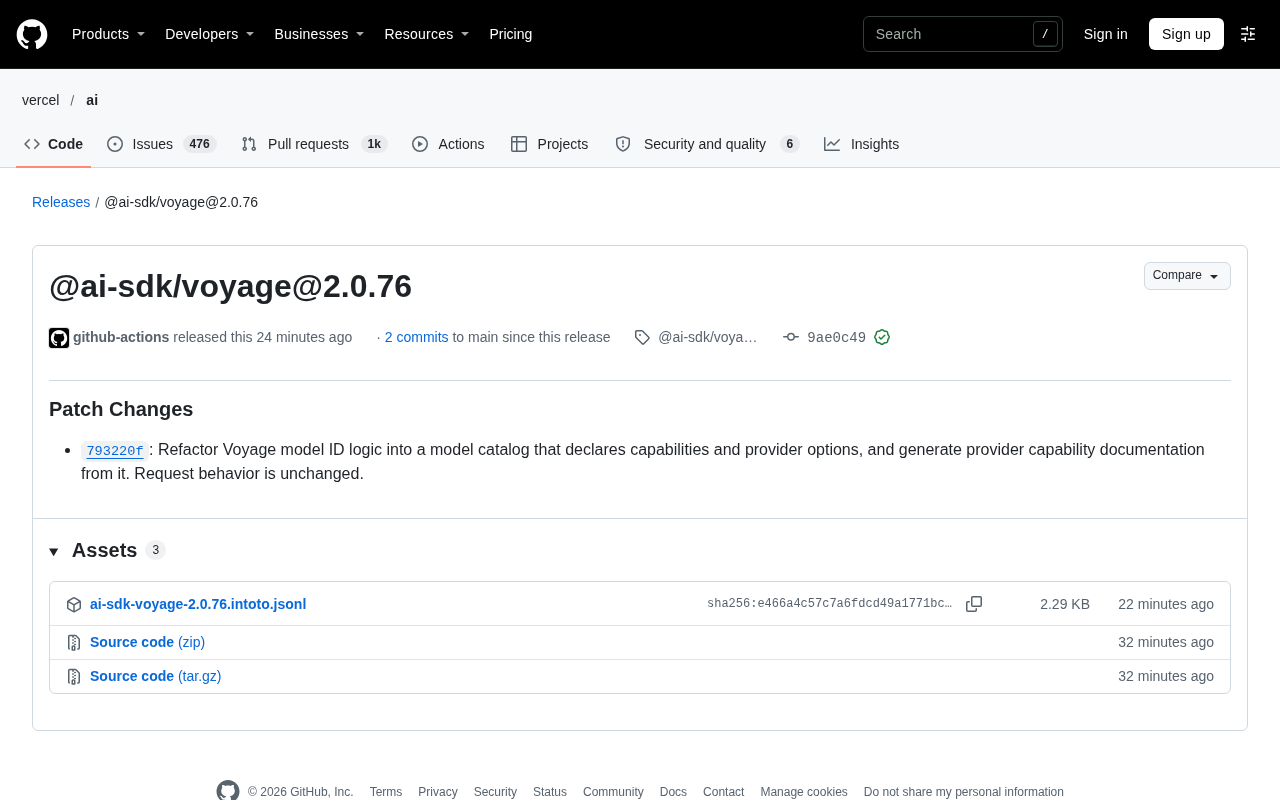
@ai-sdk/voyage has released version 2.0.76. Judging from the GitHub release notes, this is a patch-level update containing only a single commit (793220f), and the core change can be summed up in one sentence: refactor the Voyage model ID logic into a model catalog, where this catalog uniformly declares model capabilities and provider options, and generates provider capability documentation from it. The official statement explicitly says that request behavior remains unchanged.
For most users, nothing perceptible will change after upgrading. But this kind of change is often more worth paying attention to than feature updates—it determines whether an SDK can remain clear as the number of models continues to grow.
What problem does a model catalog solve?
Model IDs move from hardcoding to centralized declaration
In the early days, AI SDKs integrated with a limited number of models, and model ID parsing logic could be scattered throughout the code. As providers like Voyage offer more types of models, hardcoding brings two direct problems: first, adding or adjusting models requires changes in multiple places, making omissions easy; second, documentation and code can easily drift apart—the docs may say a model supports a certain capability, but the code may not be consistent.
A model catalog merges these two concerns: model IDs, capability descriptions, and provider options converge in one place, and code and documentation are generated from the same source. This is a typical data-driven design, and it is highly valuable in an AI toolchain where models iterate frequently.
Model catalog in the context of AI SDKs refers to a centralized, declarative data structure (usually a TypeScript object or JSON configuration) used to describe metadata for all available models under a provider. Typical fields include: the model ID string, context window size, supported input modalities (text/image/audio), whether tool calling or structured output is supported, and provider-level options specific to that model (for example, some models require specific API parameters).
The difference from traditional hardcoding lies in the "single source of truth": model capabilities are no longer scattered across if/else branches in various call paths, but are first declared and then read by the SDK runtime to drive behavior. The direct benefit is that adding a model only requires appending a record to the catalog rather than modifying parsing logic; at the same time, the catalog itself can serve as a machine-readable specification for generating documentation, type definitions, and even test cases. In an AI ecosystem where model versions iterate on a weekly basis, this design significantly reduces maintenance costs.
The significance of automatically generated capability documentation
Automatically generated documentation is the hidden benefit of this refactor. Manually maintained provider capability tables almost inevitably lag behind when models update quickly. Generating documentation from the catalog means that as long as the catalog is updated correctly, the documentation is accurate. For teams that build secondary development on top of the SDK, this reduces debugging costs caused by documentation drift.
Provider capability documentation usually refers to a table or structured list that lays out the feature matrix supported by each model under a provider, such as "whether streaming output is supported," "maximum output tokens," and "supported embedding dimensions." In AI SDKs, this kind of documentation serves two kinds of readers: developers who consult the docs directly, and IDEs that surface capabilities through type hints.
The key to automatic generation is treating documentation as a build artifact rather than handwritten content. A common approach is to use the model catalog as input, render Markdown or JSON Schema through scripts in CI, and publish it in the same repository and with the same version as the code. In this way, when a model's capability field changes in the catalog, the documentation is synchronized in the next build, avoiding the discrepancy where "the docs say it is supported but the code does not." For teams doing secondary development, this eliminates a class of hidden integration failures: calling code written against outdated documentation often only reveals at runtime that parameters are not recognized.
Practical impact on developers
Request behavior unchanged, low upgrade risk
The official statement says request behavior has not changed, which means existing calling code does not need adjustment. For projects using @ai-sdk/voyage in production, this is a low-risk upgrade. The patch version number also confirms this: it is not a feature release, but an internal structural adjustment.
Patch version in Semantic Versioning (SemVer) corresponds to the Z position in x.y.Z, and by convention is used for backward-compatible bug fixes that introduce no new features and do not break existing APIs. @ai-sdk/voyage 2.0.76 falls into this position, meaning the maintainers judged this change to be transparent to external callers: function signatures, request parameters, and return structures have not changed.
It is worth noting that SemVer describes the stability of the "external contract," not the "internal implementation." Although the model ID logic refactor does not change request behavior, it may affect internal export paths or the shape of debug logs. Therefore, in production environments, even if a patch upgrade is low-risk, it is still advisable to run integration tests after updating the lockfile to confirm that model resolution results match those before the upgrade, especially for code that performs string concatenation or regex matching on model IDs.
Room for future expansion
Once a model catalog is established, adding new models and declaring new capabilities has a unified entry point. This lays the foundation for capability alignment at the provider level and makes it easier for the SDK to maintain behavioral consistency across different providers. For developers building multi-model applications, this consistency directly affects switching costs.
Conclusion
@ai-sdk/voyage 2.0.76 does not bring new features, but it organizes the model ID logic into a model catalog that can be declared and used to generate documentation. This kind of infrastructure-level cleanup looks like a patch in the short term, but in the long term it is a prerequisite for the SDK's sustainable evolution. Developers following the AI SDK ecosystem can treat it as an observational sample: model catalogs are becoming a common pattern in AI toolchains.
Related articles
 Tech Frontiers
Google Omni 1.2 Flash: 15-Second AI Video at Just $0.07 per Second
Google DeepMind releases Gemini Omni 1.2 Flash: 15-second video, 720p at $0.07/sec (30% cheaper), multi-turn editing without regeneration, draft upscaling to 4K.
 Tech Frontiers
No AI Ghostwriting: Writer's Quarter Reinvents Novel Writing with a Visual Workbench
The Writer's Quarter is an AI-free novel writing and planning tool that unifies character building, story planning, and manuscript writing in one visual workbench. This article analyzes its positioning, target users, and differentiated value amid the rise of AI writing tools.
 Tech Frontiers
Fleeep: A Unified Inspiration Collection Notes App for Creatives
Fleeep is a notes app for creatives that unifies screenshots, bookmarks, saved posts, and inspiration into one calm, cross-device, offline-capable space. This article analyzes its positioning, differentiation, and target users.