Vulcan Rocket's First Launch Failure Destroys 40 Amazon Leo Satellites

ULA's Vulcan rocket fails for the first time, destroying 40 Amazon Leo satellites and intensifying the challenge of catching up with Starlink.
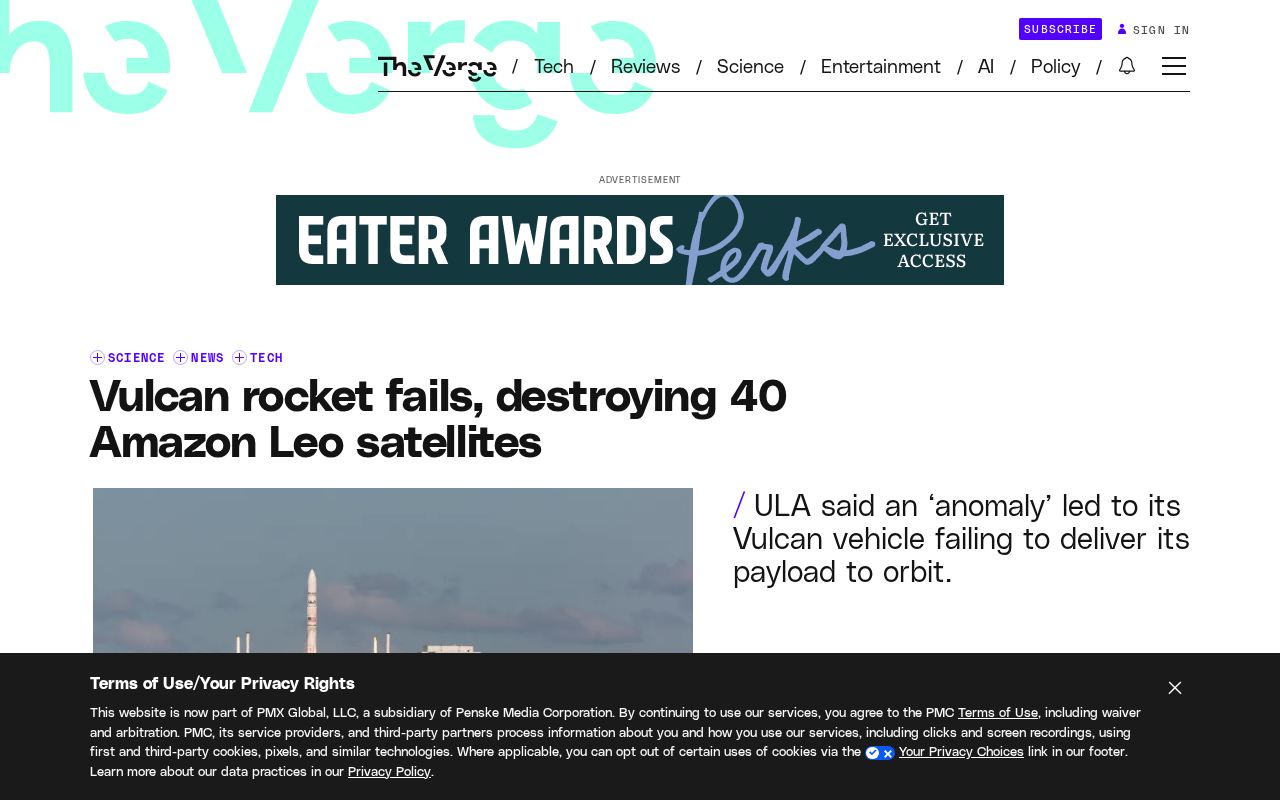
United Launch Alliance's (ULA) Vulcan rocket failed to deliver 40 Amazon Leo satellites into their intended orbit, marking the mission as a failure. This is ULA's first mission failure in its 20-year history, breaking its long-held success record. Amazon Leo is Amazon's satellite internet project modeled after SpaceX's Starlink, but deployment has been slow. The loss of 40 satellites in a single event not only causes direct economic loss but also delays constellation deployment progress, potentially affecting subsequent launch plans and regulatory milestones. For ULA, Vulcan carries dual expectations for commercial and national security launches, and the first failure may trigger a reliability review and affect orders. The cause of the failure has not yet been disclosed, and subsequent investigations and corrective actions will determine whether both parties can recover.
A Historic Failure
United Launch Alliance's (ULA) Vulcan rocket failed to deliver 40 Amazon Leo satellites into their intended orbit during a recent launch mission, marking the mission as a failure. This is said to be the first mission failure ULA has suffered in its 20-year history, breaking its long-held launch success record. For Amazon, which is working hard to catch up with SpaceX's Starlink, this accident is undoubtedly a heavy blow.
United Launch Alliance (ULA) is a launch services provider founded in 2006 as a joint venture between Lockheed Martin and Boeing. It has long been responsible for U.S. national security launches, NASA science missions, and commercial satellite launches, with its primary rockets including Delta IV and Atlas V. Vulcan is a next-generation rocket developed by ULA to replace Atlas V and eliminate dependence on the Russian-made RD-180 engine, using Blue Origin's BE-4 liquid oxygen methane engine. ULA had previously maintained a near-perfect launch success rate, making Vulcan's first failure a landmark event.
Amazon Leo's Road to Catch Up
Leo is Amazon's satellite internet project modeled after SpaceX's Starlink, aimed at providing global broadband service through a low-Earth-orbit satellite constellation. However, the project has progressed slowly since its inception, with only a small number of satellites deployed so far—far from the scale needed to compete with Starlink. The loss of 40 satellites in a single event not only delays constellation deployment progress but may also affect subsequent launch plans and regulatory milestones.
The Dual Impact of the Launch Failure
For ULA, Vulcan is its new-generation primary rocket, carrying dual expectations for both commercial and national security launches. The first failure may trigger a review of the rocket's reliability and affect future orders. For Amazon, the satellite destruction means direct economic loss and deployment delays, further weakening its competitiveness in the satellite internet market.
Low-Earth-orbit satellite internet constellations typically refer to deploying hundreds or thousands of satellites in orbits approximately 500 to 1,200 kilometers above the ground to provide broadband access with low latency. SpaceX's Starlink has already deployed thousands of satellites, holding a first-mover advantage. Amazon's Leo project (formerly named Kuiper) must complete a certain percentage of satellite deployment within regulatory deadlines to retain its spectrum and orbital resource licenses, so each launch failure can create cascading pressure on regulatory and time-window fronts.
Competitive Landscape and Future Challenges
SpaceX's Starlink has deployed thousands of satellites and has a large user base, while Amazon Leo remains in its early stages. This failure intensifies the difficulty of Leo's catch-up efforts and raises external doubts about ULA's launch cadence. However, neither ULA nor Amazon has yet disclosed the cause of the failure, and subsequent investigations and corrective actions will determine whether both parties can recover.
Industry Implications
The high-risk nature of space launches is once again highlighted—even experienced launch service providers cannot entirely avoid failure. For the satellite internet sector, reliable, high-frequency launch capability is key to successful constellation deployment. Amazon needs to work closely with ULA to identify the cause as quickly as possible and resume launches; otherwise, the gap with Starlink may widen further.
The standard post-failure process includes: establishing an accident investigation committee, analyzing telemetry and debris data, identifying the fault tree, and verifying through a return-to-flight after corrective actions. This process often takes months or longer, directly affecting subsequent launch schedules. For satellite constellation projects dependent on a single rocket model, return-to-flight delays can compress deployment timelines and may also affect contract performance and insurance claims with launch service providers.
One-line Summary
ULA's Vulcan rocket fails for the first time, destroying 40 Amazon Leo satellites and intensifying the challenge of catching up with Starlink.
Paragraph Summary
United Launch Alliance's (ULA) Vulcan rocket failed to deliver 40 Amazon Leo satellites into their intended orbit, marking the mission as a failure. This is the first mission failure ULA has suffered in its 20-year history, breaking its long-held success record. Amazon Leo is Amazon's satellite internet project modeled after SpaceX's Starlink, but deployment has been slow. The loss of 40 satellites in a single event not only causes direct economic loss but also delays constellation deployment progress, potentially affecting subsequent launch plans and regulatory milestones. For ULA, Vulcan carries dual expectations for commercial and national security launches, and the first failure may trigger a reliability review and affect orders. The cause of the failure has not yet been disclosed, and subsequent investigations and corrective actions will determine whether both parties can recover.
Related articles

Snapchat Opens AI Assistant Lens Building: Supports Claude Code and Cursor
Snapchat lets Lens creators describe AR filters in natural language, with AI assistants like Claude Code and Cursor handling the full build process, greatly lowering the AR creation barrier.
Is the Planck Length the Smallest Distance? Why Physicists Are Skeptical
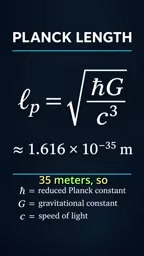
The Planck length is often called the smallest distance in the universe, but science videos point out this claim has never been experimentally confirmed. This article explains the origins of the Planck length, the obstacles of microscope thought experiments, and what it really tells us—the scale at which quantum gravity becomes unavoidable, not spacetime pixels.

AI Agents Drive Spend Management: Payhawk Raises $280M
Payhawk raises $280M at a $2B valuation. The 2018-founded enterprise finance platform uses AI agents to track and manage expenses and procurement. This article analyzes its product evolution, valuation signals, and impact on the spend management space.