WAIC Industry Insights: AI Deployment Now Demands ROI — How Enterprises Can Pick the Right First Task

WAIC 2026 shows AI moving from model wars to production ROI — here's how enterprises should start.
2026 WAIC signals that AI competition has shifted from model benchmarks to production system deployment. This article analyzes the compute, Agent, and embodied intelligence layers of the AI value chain, offering enterprises a practical ROI framework, five characteristics of a good first AI task, an incremental permission expansion strategy, and policy context to help them start with one task they can clearly measure.
AI Competition Enters the Production System Phase
2026 WAIC (World Artificial Intelligence Conference) sent a clear signal from its enterprise and industry tracks: AI competition has moved beyond model benchmarking into the production system building phase. It's no longer about who has the most parameters or the highest benchmark scores — it's about whether AI can truly embed itself into an enterprise's production chain and create measurable value.
According to observations from Bilibili content creator Solomon at the WAIC venue, the entire AI deployment value chain can be broken down into clear layers: compute infrastructure gets the models running, enterprise data and processes tell AI what to do, Agents start calling systems to execute tasks, and robots bring execution capabilities into factories, warehouses, and pharmacies.
Ultimately, enterprises measure the value of all this against four things: Has cost gone down? Has delivery sped up? Have errors decreased? Has revenue increased? This straightforward ROI framework represents the most noteworthy mindset shift on the enterprise side at this year's conference — AI is no longer a flashy exhibit but a production tool that needs to justify its costs.
Compute Infrastructure: From Buying Chips to Buying Systems
At this year's conference, compute infrastructure underwent a fundamental transformation — enterprises are no longer buying individual chips but complete computing capacity systems.
Huawei brought the physical Atlas 950 SuperPoD to the venue for the first time. The demo version consisted of multiple compute cabinets. According to Huawei's disclosed data, its FP8 computing power reaches the EFLOPS scale, with unified memory up to 256TB. Two key metrics need explanation here: FP8 (8-bit floating point) is a low-precision numerical format specifically designed for deep learning. Compared to traditional FP32 (32-bit floating point), it dramatically improves computational throughput and reduces power consumption with only a minor sacrifice in precision, making it the mainstream precision choice for current large model training and inference. EFLOPS stands for exaFLOPS — quintillions of floating-point operations per second — representing the top tier of compute power for today's supercomputers and AI clusters. The SuperPod itself is an ultra-large-scale compute unit that integrates NPUs/GPUs, high-speed interconnects, large-capacity unified memory, and liquid cooling into one package. Its design goal is to let enterprises acquire full AI training and inference capabilities as if purchasing a single complete device, rather than assembling and debugging hardware themselves. However, the product is still at the debut stage, with customer deployment pricing and delivery timelines not yet disclosed.
Another approach comes from Sugon, which has built a fully domestically produced super cluster — officially described as a 100,000-card cluster that has been constructed and connected to the National Supercomputing Internet. However, key operational data such as utilization rates, customer workloads, and service levels have not been made public. This means the infrastructure has indeed been built, but how much commercial workload it can actually handle still requires more operational data to substantiate.
Looking at both products together, a consensus emerges: chips, networking, storage, cooling, scheduling software, and model adaptation are all indispensable — missing any single component makes it difficult to translate paper specifications into business outcomes. For most small and medium enterprises, the more practical choice is to purchase cloud compute, tokens, mature Agent platforms, or opt for private deployment based on compliance requirements.
AI Agents Enter the Scene: Connecting to Enterprise Systems and Business Processes
Compute infrastructure determines whether models can run; Agents determine whether tasks can be completed. The most important change at this year's conference is that Agents are beginning to truly connect to enterprise knowledge, business systems, and operational tools.
To understand the significance of this shift, we need to clarify the concept of AI Agents: an AI Agent is an AI system capable of perceiving its environment, autonomously planning, and calling external tools to complete tasks. Unlike traditional conversational large language models, Agents possess a closed-loop capability of "perceive-reason-act" — they can not only answer questions but also proactively call APIs, read and write databases, and operate enterprise software. When connecting to enterprise systems, Agents typically rely on technical standards like MCP (Model Context Protocol) or Function Calling, enabling the large model to understand descriptions of available tools and invoke them as needed. Multi-Agent collaboration refers to multiple Agents each handling different sub-tasks (such as data collection, document generation, and approval routing), coordinated through an orchestration engine to complete complex end-to-end business processes.
Take WPS's Co-mate as an example — it has evolved from simple knowledge Q&A into an organization-level collaboration hub. It can connect to enterprise knowledge, data, systems, and processes, supporting skill packs, multi-Agent workflows, permission management, and private deployment. It's already a purchasable product.
Here's a scenario any enterprise can relate to: preparing a monthly business report used to require employees to export orders from ERP, look up customers in CRM, cross-check data in spreadsheets, and finally write it up as a document and create a presentation. A few core enterprise systems mentioned here are worth explaining: ERP (Enterprise Resource Planning) is a comprehensive system managing procurement, inventory, finance, production, and other core resources; CRM (Customer Relationship Management) is used to manage sales leads, customer interactions, and after-sales service; MES (Manufacturing Execution System) connects production plans with shop floor equipment, tracking work orders, processes, and quality data in real time. Once an Agent connects to these systems, it can handle data collection, cross-checking, and draft generation first, with business owners confirming the conclusions afterward. The value enterprises get comes from how many repetitive steps are eliminated from a single task. But it's also important to recognize that every additional system an Agent connects to increases the complexity of data security and permission governance.
The execution chain in industrial settings is even longer. COSMOPLAT demonstrated industrial Agents that can break production tasks into code generation, simulation verification, and production line deployment. However, it's important to note that content generated by industrial Agents is just the starting point — it still needs to go through simulation, approval, equipment adaptation, and safety verification. When evaluating Agents, enterprises should keep asking: Which systems are connected? What permissions are granted? How many tasks are successfully completed per month? How many times does a human need to intervene?
AI Deployment Advice: Start with a Task Where You Can Do the Math
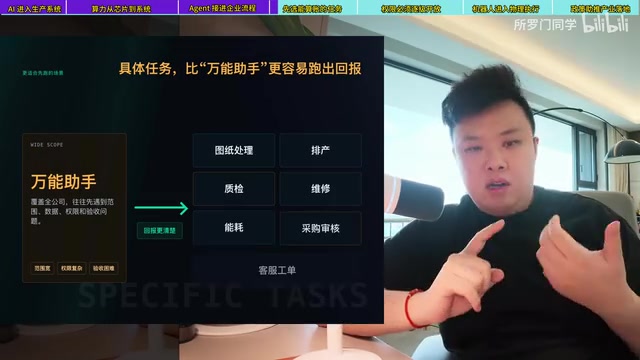
Where should enterprises actually begin? The content creator's advice is pragmatic: first find a task that meets five conditions.
Five Characteristics of a Good Task
- High frequency: Only with sufficient frequency can you amortize transformation costs;
- Digitizable inputs and outputs: Making it easy for Agents to read and produce;
- Verifiable results: You can determine right from wrong;
- Reversible failures or human fallback: Controlling the downside risk;
- Calculable time savings: You can clearly compute the ROI.
Scenarios like drawing processing, production scheduling, quality inspection, maintenance, energy consumption monitoring, procurement review, and customer service tickets are all more likely to deliver returns than an "all-purpose assistant" covering the entire company. The reason is simple: preparing data, setting permissions, and evaluating results are all easier, and whether the investment was worthwhile is much clearer to calculate.
Three Maturity Levels and Incremental Permission Expansion
Project maturity can be divided into three levels: POC proves the model works on test data; Pilot requires connecting to real data and systems, running within one team or one production line; Scale-up requires replication across multiple departments or factories, with permission governance, cost accounting, log tracing, and long-term ownership in place.
It's worth understanding the special significance of POC (Proof of Concept) in AI projects. POC is a standard step in enterprise technology procurement, using limited test data and controlled environments to verify the feasibility of a technical solution. However, there's a massive gap between POC and final scaled deployment — commonly known in the industry as the "Valley of Death from Demo to Production." Many AI projects show impressive results during POC, but once connected to real-world dirty data, complex permission hierarchies, and volatile business scenarios, accuracy and stability drop significantly. Therefore, the three maturity levels actually correspond to progressive leaps in data quality, system integration depth, and organizational management capability — none of which can be skipped.
The most critical step is that permissions must be opened incrementally:
- Level 1: Only allow the Agent to read data, search materials, identify anomalies, and organize orders/tickets — no writing to business systems;
- Level 2: Allow the Agent to propose production scheduling, procurement, or sales follow-up plans, subject to human approval;
- Level 3: After human approval, allow the Agent to enter ERP, MES, CRM, and other systems to place orders, modify schedules, and notify customers;
- Level 4: Only then open limited autonomous execution within defined boundaries, with caps on amounts, whitelists, logging, rollback capabilities, and human override.
Interestingly, relevant implementation guidelines from China's Cyberspace Administration also explicitly emphasize: Users retain ultimate decision-making authority, and Agents must not exceed their authorized scope. Since 2025, the Cyberspace Administration and other departments have successively issued a series of documents including the "Measures for the Management of AI-Generated Content" and "Implementation Opinions on Accelerating AI Empowerment of Economic and Social Development." Core principles include: AI systems must follow the "Human-in-the-Loop" principle, with users retaining final decision-making authority over AI outputs; AI Agent operations must not exceed explicit user authorization; AI applications involving critical decisions must maintain complete logs for auditing. This means the "incremental permission expansion" strategy described here is not only an engineering best practice but also a hard regulatory compliance requirement. This step-by-step delegation approach lets enterprises first gain efficiency improvements, then increase permissions based on real results — every level-up requires data to prove its worth.
Embodied Intelligence: Bringing AI Execution into the Physical World
If software Agents bring execution into enterprise systems, then Embodied Intelligence (Physical AI) brings it into the physical world.
Embodied Intelligence refers to endowing physical entities (such as robots) with AI perception and decision-making capabilities, enabling them to perform operational tasks in the real world. Unlike pure software AI, embodied intelligence faces the high uncertainty of the physical world: lighting changes, object deformation, collision safety, and other issues all require real-time handling. Key technologies currently driving this field include: Vision-Language-Action models (VLA) that let robots understand tasks through natural language instructions and generate action sequences; tactile sensing that provides force feedback for precision grasping; and digital twins with simulation environments (such as NVIDIA Isaac and MuJoCo) used to generate training data at scale in virtual scenarios, dramatically reducing the cost and safety risks of real-robot training.

Robot tasks that are more likely to create value in the near term typically focus on pharmacy dispensing, factory quality inspection and machine loading/unloading, warehouse logistics, power and chemical plant inspection, and delivery and transport assistance in healthcare facilities.
Shanghai's smart pharmacies have already been deployed in some stores, with three robots of different form factors sharing a single embodied model, collaborating around order receiving, drug locating, picking, and delivery. This is exactly the "one brain driving multiple bodies" paradigm the industry is pursuing — adapting a single general-purpose foundation model to different robot embodiments to reduce the cost of training from scratch for each new robot type. However, store count, per-store costs, failure rates, and payback periods have not been fully disclosed, and widespread rollout still requires more data.
For enterprises, the criteria for evaluating robot projects are equally straightforward: Can it continuously complete tasks throughout a shift? How many human interventions are needed? How much does installation and maintenance cost? How long until the investment is recouped?
For startups, the content creator is more bullish on "last 20 meters" opportunities — getting robots adapted to a specific production line, shelf system, or inspection point, then taking on installation, operations, and safety responsibilities. Three startup directions worth watching are: vertical process Agents and governance tools, tactile/simulation data, and robot leasing, operations, and private deployment.
Policy Support: Lowering the Cost of an Enterprise's First Experiment
The policy landscape is providing clear direction.

According to disclosed information, Shanghai distributes approximately 1 billion yuan annually in compute vouchers, model vouchers, and data vouchers combined, while launching a 60 billion yuan national AI fund and establishing a 22.5 billion yuan Shanghai AI Pioneer Industry Fund. The related implementation plan proposes that by 2027, the goals include attracting 100 industry-leading enterprises, deploying 100 major innovative application scenarios, promoting 100 internationally leading products, with core industry scale exceeding 50 billion yuan.
These policies can lower the cost of a startup's first development and delivery cycle. But there's an important caveat: the initial application windows for some vouchers and programs have already closed, and entrepreneurs shouldn't treat planning targets as subsidies available today. Policies can reduce the cost of experimentation, but customer renewals are what truly validate a business model.
Conclusion: Whoever Builds a Continuous Learning Mechanism First, Wins
The most important signal from the enterprise track at 2026 WAIC is: AI has entered the production system building phase.
Enterprises need appropriate compute to run models, data and rules to teach them the business, Agents to connect to systems, and permissions, approvals, evaluations, and logs to manage risk — while robots bring this execution capability into factories, warehouses, and pharmacies.
What enterprises should do right now is pick a task where the ROI is clear, and use scale and time to prove it works. Once proven, crystallize the experience employees gain from correcting the Agent into skills, rules, and workflows, then replicate it to the next process. Whoever builds this continuous learning and reuse mechanism first will have the best chance of turning AI into genuine new production capability.
Related articles

Video Multilingual Dubbing API in Practice: A Selection and Cost Guide for Localization at Scale
An in-depth analysis of video multilingual dubbing APIs — covering voice cloning, audio separation, lip sync, and cost comparisons of ElevenLabs, HeyGen, and Rask AI for scalable video localization.

Localdock: $9 One-Time Payment, Turn Local Projects into HTTPS Public URLs Instantly
Localdock assigns real HTTPS addresses to local development projects, supports cross-device access with zero client installation. One-time $9 payment, ideal for indie developers and small teams to quickly share local projects. Detailed comparison with ngrok and competitors.

German Court Rules Emails Must Be End-to-End Encrypted: What It Means for Enterprise Compliance
A German court ruled emails must use end-to-end encryption in certain contexts. We analyze the GDPR connection, compliance impact, technical challenges, and industry trends.