Wand: Build Software at the Speed of Thought by Talking Instead of Typing
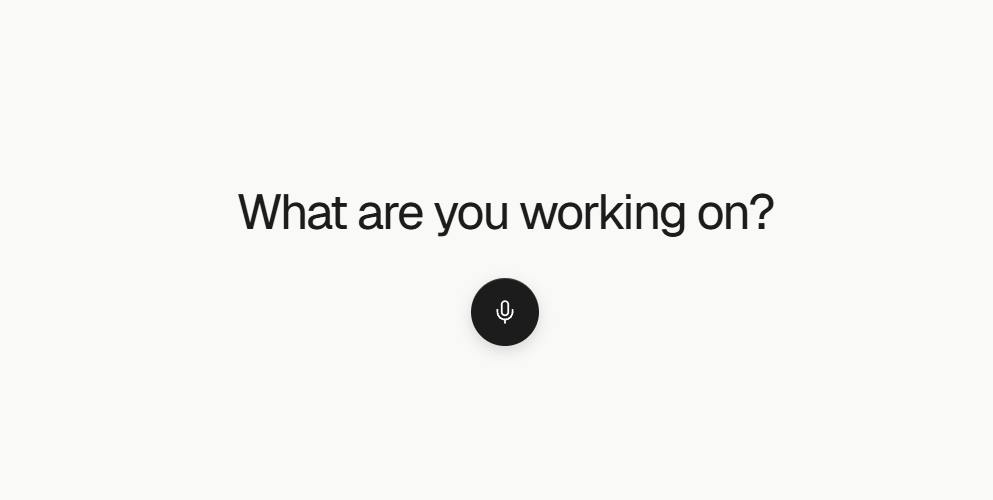
Wand replaces keyboard typing with voice input so developers can build software at the speed of thought.
Wand is a new AI coding tool that debuted on Product Hunt with 65 upvotes, built around the premise that the keyboard is a bottleneck in software development. It lets developers express ideas through rambling, real-time reactions, and mid-sentence pivots — unstructured as natural speech — while the tool converts those inputs into actual software without requiring polished prompts. Wand positions itself as a gateway to the "post-keyboard era," but questions around accuracy, noise tolerance, complex project applicability, and workflow integration remain to be tested in practice.
When the Keyboard Becomes the Bottleneck
Wand launched on Product Hunt and debuted at #12 on the daily leaderboard with a provocative claim: the keyboard is becoming a bottleneck in software development. For developers whose thinking far outpaces their typing, translating ideas into structured prompts is itself a friction that slows everything down.
Wand's slogan cuts straight to the ambition — "Build software at the speed of thought." Its core premise isn't about making you type faster; it's about letting you stop typing altogether: speak your ideas and let the tool keep up.

From "Translating Ideas" to "Direct Expression"
Traditional AI coding assistants — whether code completion or conversational generation — require developers to first distill vague intentions into clear, structured text instructions. This "translation" step sounds trivial, but for creators with active minds and rapid-fire ideas, it means constantly breaking flow.
Wand's core differentiator is precisely its tolerance for unstructured expression. According to the official description, you can:
- Ramble: No need to organize your thoughts into complete logic — just say whatever comes to mind
- React: Give immediate feedback the moment you see results
- Change your mind mid-sentence: Pivoting halfway through is perfectly fine
Wand claims it can "keep up" — matching this jumping, iterative, even self-contradictory thinking style and converting spoken ideas into actual software. This stands in sharp contrast to tools that demand precise input.
The concept of Flow, introduced by psychologist Mihaly Csikszentmihalyi, describes a state of deep focus where creativity and efficiency peak. For developers, any interruption — switching windows or organizing phrasing — can break that state, requiring minutes to recover. Research suggests programmers need roughly 15–20 minutes to regain deep focus after an interruption. Wand targets precisely this kind of cognitive friction caused by "language organization": when you're forced to compress intuitive ideas into structured prompts, the continuity of thought is already compromised. Voice input theoretically bypasses this barrier, since spoken expression (~125–175 words per minute) far exceeds average typing speed (~40–60 words per minute) and more closely mirrors how the brain naturally organizes thoughts.
Positioning Itself in the "Post-Keyboard Era"
Wand describes itself as a gateway to the "post-keyboard era." This framing is a deliberate product philosophy: as large language models improve their natural language understanding, the primary interface for human-computer interaction may shift away from precise text input toward voice and dialogue that more closely mirrors human thinking.
This direction isn't unique to Wand. Voice-driven programming and conversational development environments have been gaining traction as hot areas of AI tooling exploration. What sets Wand apart is that it doesn't treat voice merely as an input method — it attempts to understand "unformed" thinking, including hesitation, correction, and leaps in logic. This places much higher demands on underlying intent recognition and context retention capabilities.
Intent Recognition is a core subtask of natural language processing, responsible for extracting the user's true purpose rather than just the literal meaning of their input. Traditional intent recognition relies on predefined intent categories and keyword matching, making it poorly suited for the ambiguity of spoken language. Large language models (LLMs) have significantly advanced this capability, enabling systems to infer actual intent across broader context windows. Context Retention refers to the ability to maintain consistent understanding across multiple dialogue turns — when a user says "change that to blue," the system needs to know what "that" refers to. For Wand's described "change your mind mid-sentence" scenario, both capabilities must work in tandem: recognizing new intent while correctly updating — rather than discarding — previously established context. This remains technically challenging.
Key Questions Worth Watching
As a product that just appeared under Vercel Day-related categories, Wand is still primarily conveying a vision — its real-world capabilities will take time to validate. Several key questions are worth monitoring:
The balance between accuracy and noise tolerance. Allowing users to ramble and change their minds means the tool must extract genuine intent from a lot of noise. Avoiding "over-interpretation" or "misunderstanding" is the central challenge for this type of product.
Applicable project complexity. Building software at the speed of thought is compelling for prototypes and small tools, but how far pure voice-driven development can go when facing complex engineering logic, dependency management, and long-term maintenance remains an open question.
Integration with existing workflows. Real-world development is rarely a solo performance starting from scratch. How Wand integrates with existing codebases, version control, and team collaboration will determine whether it's a toy or a genuine productivity tool.
Wand's appearance under Vercel Day categories is no coincidence. Vercel is a platform focused on frontend and full-stack deployment, with a user base that skews toward rapid prototyping and indie developers — an audience that aligns closely with the "build software at the speed of thought" positioning. These users tend to have more relaxed engineering standards but higher sensitivity to interaction experience, making them an ideal early validation audience for voice-driven development tools. However, this also means Wand's current user feedback may not fully reflect its performance in enterprise or complex engineering contexts. Figuring out how to maintain a "low barrier to entry" brand image while gradually expanding support for complex scenarios will be a significant challenge for its product roadmap.
Conclusion
Wand represents an interesting trend in AI coding tools: lowering the interaction threshold from "write precise instructions" to "just talk." Its initial reception of 65 upvotes suggests it's hitting a genuine pain point for many developers — the keyboard really does often lag behind the brain. Whether it can truly deliver on the promise of "building software at the speed of thought" is still to be determined by real-world product execution and user experience. For anyone tracking the frontier of AI-assisted development, this is a product worth keeping an eye on.
Related articles

WorkBuddy Full Tutorial: Build an AI Office Automation Agent from Scratch
A complete WorkBuddy tutorial: installation, three working modes, multimodal picture book video practice, expert team agent building, and workflow configuration for low-cost AI office automation.

WorkBuddy Agent Complete Guide: From Beginner to Automation in 7 Days
Based on Bilibili's 256-episode WorkBuddy masterclass, this systematically breaks down Tencent's AI office workbench core capabilities: Agent principles, Skill encapsulation, cross-platform connectors, scheduled automation, knowledge bases, and zero-code development, with learning path recommendations.

8 AI Accounts, 7 Failed: An Honest Review of Using AI to Get Work Done
Only 1 of 8 AI-run Bilibili accounts succeeded. We break down the real difference between "performing AI" and "using AI to get work done."