WanderBench: Can Video World Models Explore Dynamic Worlds?

WanderBench reveals long-horizon exploration weaknesses of video world models; the training-free WanderLand framework improves consistency.
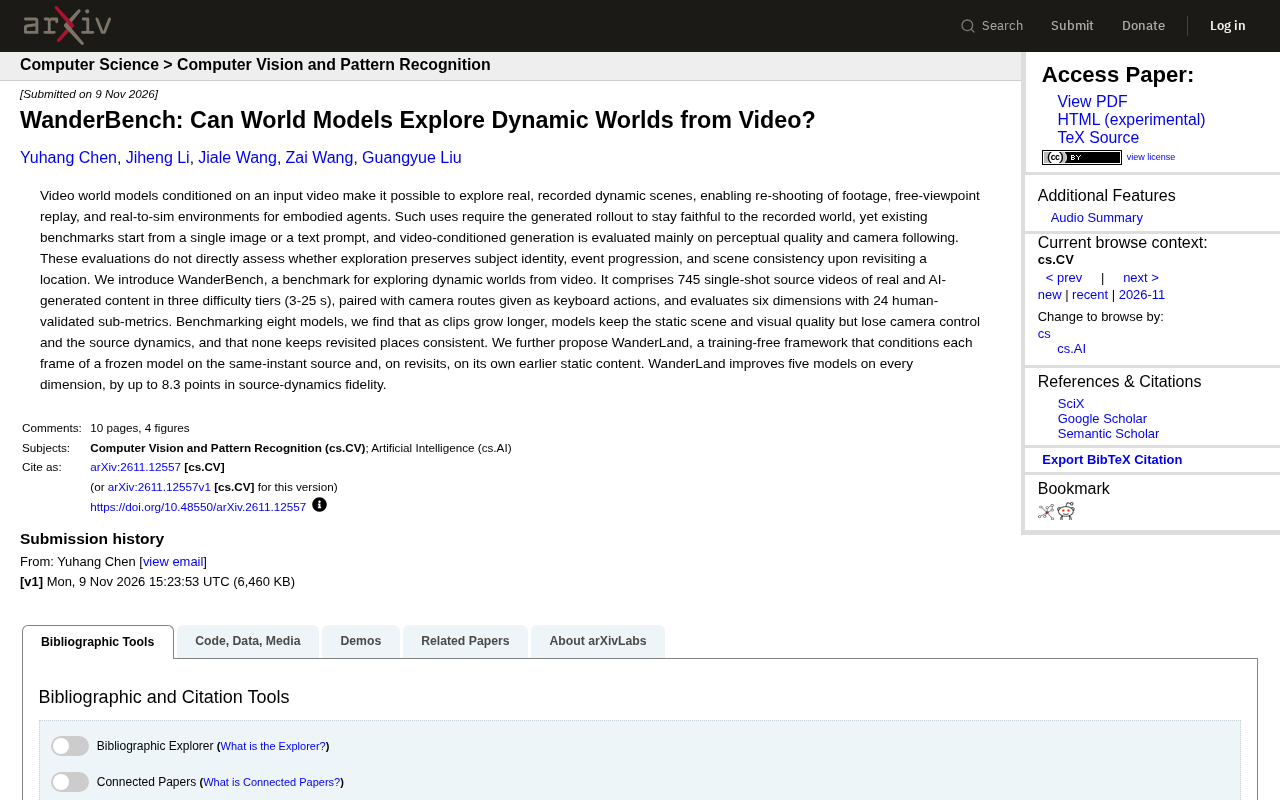
WanderBench is the first evaluation benchmark focused on video-conditioned dynamic world exploration, containing 745 single-shot videos across three difficulty tiers and using 24 human-verified sub-metrics to assess fidelity across six dimensions. Tests on eight models show that as clips get longer, models maintain static scenes and visual quality reasonably well but suffer declines in camera control and source dynamic fidelity, and none can maintain scene consistency when revisiting locations. To address this, researchers propose the training-free framework WanderLand, which conditions on same-moment source video and on its own static content during revisits, improving all five models across the board, with source dynamic fidelity improving by up to 8.3 points. This work shifts evaluation focus from perceptual quality to dynamic consistency and scene memory, providing a reproducible measuring stick and a low-cost improvement path for applications such as real-to-sim.
Video world models are moving from single-image or text prompts toward video-conditioned exploration of dynamic scenes, but is the existing evaluation ecosystem sufficient to measure their fidelity? The new benchmark WanderBench provides an answer.
The New Battleground for Video World Models: From Static Generation to Dynamic Exploration
Video world models conditioned on input video make it possible to explore real recorded dynamic scenes. Such models support re-shooting, free-viewpoint replay, and building real-to-sim environments for embodied agents. But to be truly useful, the generated rollouts must remain faithful to the world state at the time of recording.
Yet most existing benchmarks start from a single image or text prompt, and evaluations of video-conditioned generation mostly stay at the level of perceptual quality and camera following. These metrics cannot directly answer a key question: during exploration, are subject identity, event progression, and consistency upon revisiting a scene preserved?
WanderBench was proposed precisely to fill this gap. It focuses on the task of exploring dynamic worlds from video, shifting the evaluation focus from "does it look good" to "is the world consistent."
Video World Model refers to a class of generative models that take video as input or output and aim to simulate the evolution of dynamic environments. Unlike models that generate only a single frame or a short video clip, video world models emphasize modeling object motion, camera motion, and causal relationships between events in a scene, thereby supporting interactive exploration. Their typical capabilities include: given a real recorded video, the model can generate a "re-shoot" of the same scene from a new viewpoint, or allow an agent to move freely within the generated virtual environment. Such models are particularly important in the field of Embodied AI, because building real-to-sim environments requires faithfully transferring real-world dynamic processes into simulation.
Real-to-sim refers to the process of converting real-world collected data (such as video, depth maps, sensor readings) into interactive simulation environments. Traditionally, this relies on manual modeling or 3D reconstruction, which is costly and struggles to capture dynamic elements. Video world models offer a data-driven shortcut: directly learning the mapping from video to explorable dynamic scenes. In real-to-sim, fidelity requires not only visual realism but also physical plausibility and temporal consistency; otherwise, agent policies trained in simulation are difficult to transfer back to the real world. WanderBench targets exactly this need, shifting the evaluation focus from image quality to consistency of world state.
WanderBench Design: Multiple Difficulty Levels, Multiple Dimensions, Human Verification
WanderBench contains 745 single-shot source videos, covering both real footage and AI-generated content, and is divided by duration into three difficulty tiers ranging from 3 seconds to 25 seconds. Each video is paired with a camera route defined by keyboard actions, used to guide the model's exploration path in the dynamic world.
The evaluation system covers six dimensions and 24 human-verified sub-metrics. These dimensions systematically examine whether the model can maintain subject identity, event progression, and scene consistency over long-horizon exploration. Human verification ensures the validity of the metrics and avoids the biases that purely automatic metrics may introduce.
Eight Models Tested: Long Videos Expose Weaknesses, Revisit Consistency Fails Across the Board
The researchers benchmarked eight models and found a clear trend: as clips get longer, models can maintain static scenes and visual quality but gradually lose the ability to control the camera, while dynamic information from the source video also degrades. More critically, none of the models can maintain scene consistency when revisiting the same location.
This result reveals the core bottleneck of current video world models—they are good at "looking real" but not at "remembering and reconstructing." Exploring dynamic worlds requires not only generating smooth video but also understanding the persistent structure of a scene and outputting consistent content when visiting the same location at different points in time.
Revisit Consistency is a key metric for evaluating the memory capability of world models, referring to whether the model can generate visually and semantically consistent scene content when it visits the same geographic location multiple times during an exploration path. In dynamic world exploration, the camera may loop around and return to the starting point, or pass through the same room along different paths. Ideally, regardless of when it is revisited, the static structure of that location (such as walls and furniture) and dynamic elements (such as the positions of people) should remain reasonably consistent. However, existing models often gradually "forget" previously seen scenes during long-horizon generation, leading to disappearing objects, changed layouts, or texture drift upon revisiting. WanderBench incorporates revisit consistency as a core evaluation dimension and finds that all tested models fail on this item, revealing a widespread deficiency in current video generation models: the lack of persistent scene memory. This metric is crucial for real-to-sim applications, because agents in simulation need reliable spatial memory to plan paths and manipulate objects.
WanderLand: A Training-Free Framework That Improves Five Models Across the Board
To address the above problems, the researchers proposed WanderLand, a training-free framework. Its core idea is: for each frame generated by a frozen model, condition on the source video frame at the same moment; when the model revisits a location, condition on its own previously generated static content.
This dual-conditioning mechanism significantly improves exploration fidelity without retraining the model. Across five models, WanderLand brings improvements in every evaluation dimension, with source dynamic fidelity improving by up to 8.3 points.
This result shows that the exploration capability of video world models does not have to rely solely on larger-scale training; clever inference-time conditioning design can also unlock potential. For embodied AI research that requires real-to-sim environments, this training-free approach lowers the barrier to deployment.
Training-free Framework refers to methods that improve generation quality through inference-time conditioning design, prompt engineering, or external memory mechanisms without updating model parameters. Such methods are low-cost and plug-and-play, especially suitable for large models that have already been deployed. The dual-conditioning mechanism adopted by WanderLand belongs to this category: for each frame generation, it simultaneously conditions on the source video frame at the same moment and the model's own previously generated static content, thereby enhancing temporal consistency and scene memory without retraining. The core challenge of training-free methods lies in designing conditioning signals that provide sufficient information without interfering with the model's original generation capability. WanderLand's success shows that inference-time conditioning design can be an effective lever for improving the exploration capability of video world models, providing a practical path for researchers and developers with limited resources.
Significance for the Industry: Evaluation First, Pushing World Models Toward Controllability
The value of WanderBench lies not only in providing a new benchmark but also in redefining the evaluation criteria for video world models. As the industry shifts from pursuing visual realism to pursuing world consistency, the design goals of models will adjust accordingly.
From an application perspective, free-viewpoint replay, re-shooting, and real-to-sim environments all require models to have persistent memory of scenes. WanderLand's training-free approach provides a low-cost improvement path for existing models, while WanderBench provides a reproducible measuring stick for subsequent research.
The next breakthrough for video world models may not lie in generating prettier images, but in whether they can uphold the rules of the world during exploration.
One-line Summary
WanderBench reveals the long-horizon exploration weaknesses of video world models, while the training-free framework WanderLand improves consistency.
Paragraph Summary
WanderBench is the first evaluation benchmark focused on video-conditioned dynamic world exploration, containing 745 single-shot videos divided into three difficulty tiers, using 24 human-verified sub-metrics to evaluate fidelity across six dimensions. Tests on eight models show that as clips get longer, models can still maintain static scenes and visual quality reasonably well, but camera control and source dynamic fidelity degrade, and none can maintain scene consistency when revisiting locations. To address this, the researchers proposed the training-free framework WanderLand, which conditions on same-moment source video and on its own static content during revisits, improving all five models across the board, with source dynamic fidelity improving by up to 8.3 points. This work shifts the evaluation focus from perceptual quality to dynamic consistency and scene memory capability, providing a reproducible measuring stick and a low-cost improvement path for applications such as real-to-sim.
Related articles

GLM-5.4 vs. Opus and Neon: How Far From the Top?
No official benchmarks for GLM-5.4. Based on a YouTube deep test and developer trials, we analyze its gap vs. Claude Opus 5.5 and Gemini Neon, the speed bottleneck from marathon-style thinking, and its real position in enterprise agent scenarios.

From Gobbler to Sloppy Joe: The Hit-Making Playbook of a New Jersey Deli Institution
NYT Cooking visits Milburn Deli in New Jersey to break down the hit logic behind the Gobbler turkey sandwich and the local Sloppy Joe: bread sliced to order, house-made sauces, a group shout culture, and customer co-creation behind six locations.
In the Age of AI Programming, When Do You Still Need to Write Code by Hand?
Is handwritten code still valuable once AI programming agents are widespread? This article outlines three scenarios where handwriting is essential—learning, style development, and prototype validation—and provides a division-of-labor framework between AI and humans to help developers balance efficiency and skill growth.