Wanna NOVA21 Dexterous Hand Global Launch: 21-DOF Direct-Drive Design

Wanna Robotics launched the 21-DOF fully active rotary direct-drive dexterous hand NOVA21 in Hong Kong, targeting research and development.
Wanna Robotics released the dexterous hand NOVA21 at the Hong Kong Electronics Fair (Autumn Edition), aimed at robotics research and development teams. It features a 21-DOF fully active rotary direct-drive design, with 5 DOFs in the thumb and 4 in each of the other four fingers, and dimensions close to an adult human hand. Performance includes fingertip force ≥20N, four-finger grip force ≥200N, fingertip repeat accuracy ±0.2mm, and 520°/s no-load bending speed. It has 16 force sensors with 0.1N resolution. Its foundation is a self-developed direct-drive rotary actuator with dual encoders. Interfaces support RS485/CAN-FD/EtherCAT/TCP-IP, OTA upgrades, and a quick-change wrist, targeting research, industrial validation, and service exploration.
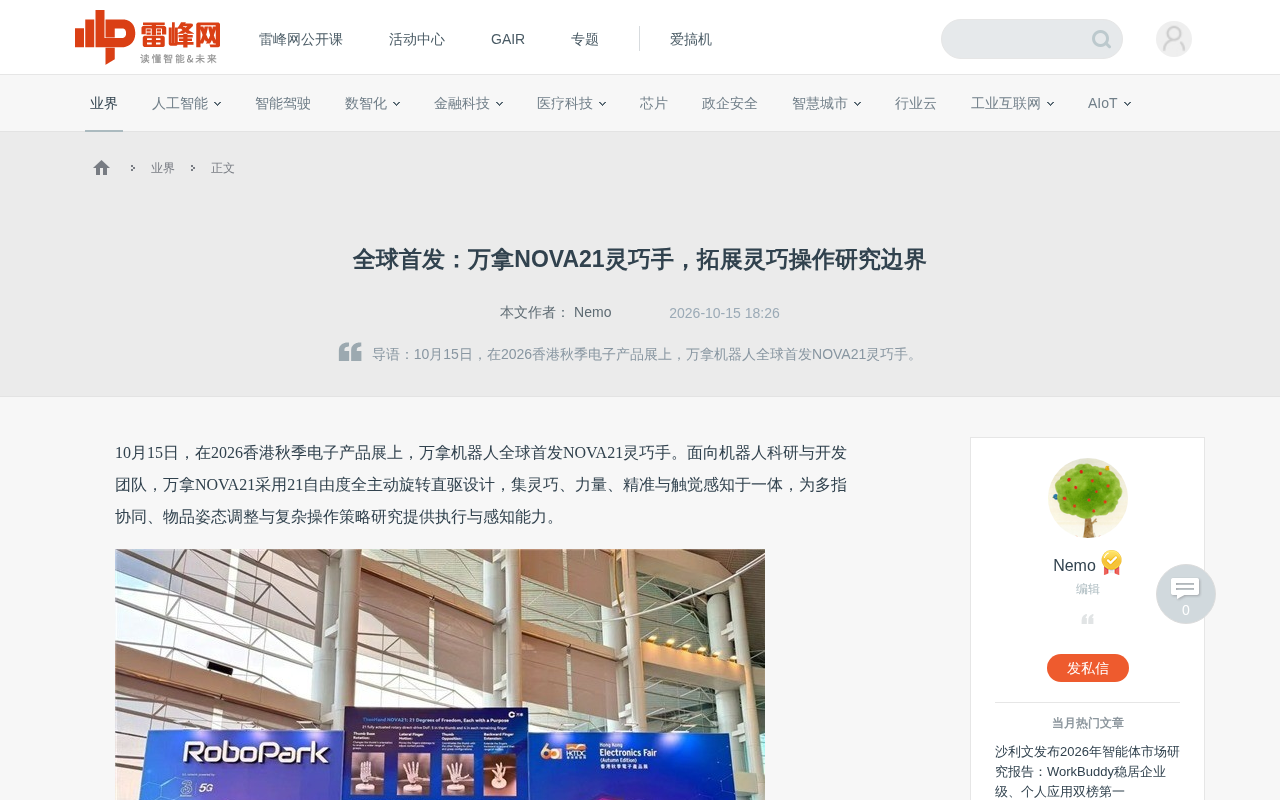
At the Hong Kong Electronics Fair (Autumn Edition), Wanna Robotics unveiled its new dexterous hand, the NOVA21. Aimed at robotics research and development teams, the product adopts a 21-DOF fully active rotary direct-drive design, seeking a balance between dexterity, force output, and tactile perception.
21-DOF Fully Active Rotary Direct Drive, Redefining Multi-Finger Coordination
The DOF configuration of a dexterous hand directly determines how complex an operation it can perform. NOVA21 adopts an anthropomorphic layout, with overall dimensions of 195×105×71mm, close to the size of an adult human hand. In terms of finger allocation, the thumb has 5 active DOFs, while the other four fingers each have 4 active DOFs.
The key point is that all 21 DOFs use a rotary direct-drive scheme. Compared with traditional tendon-driven or linkage mechanisms, direct drive means each joint can be independently and actively controlled without transmitting power through mechanical coupling. The thumb's base rotation, opposition, finger abduction, and extension provide richer motion options for fingertip micromanipulation and post-grasp object pose adjustment.
For teams studying multi-finger coordination, the significance of this design is that different fingers can execute completely independent motion strategies, making experimental variables easier to decouple.
Tendon-driven transmission is currently the scheme adopted by most dexterous hands: motors are concentrated in the palm or forearm, and power is transmitted to distal joints through cables running through knuckle pulleys. This approach can shift weight backward and reduce finger volume, but the elastic deformation of the cables, friction losses, and routing paths create coupling between joints, requiring compensation algorithms during control, and tension drift after long-term use affects consistency. Linkage mechanisms use rigid rods to directly push joints, offering good stiffness and fast response, but their range of motion is constrained by geometry, and knuckle layouts often cannot be fully anthropomorphic. Rotary direct drive places motors or geared actuators directly on each joint axis, so there is no mechanical coupling between joints—commands equal motion, the control model is simple, and homing is accurate—at the cost of making finger weight and volume harder to compress. NOVA21's ability to fit 21 direct-drive DOFs into a hand close to human size relies on self-developed micro actuators that make each joint module smaller and lighter.
Balancing Force and Precision
Research scenarios often place more demanding requirements on dexterous hands than industrial scenarios—they need enough grasping force to complete real tasks, as well as millimeter-level repeat positioning to ensure experimental repeatability.
NOVA21 provides specific figures in these two dimensions: maximum fingertip force per finger ≥20N, maximum four-finger grip force ≥200N, and support for force control and backdriving. The no-load angular speed of four-finger bending reaches 520°/s, and fingertip repeat positioning accuracy is ±0.2mm.
These parameters mean it can both complete grasp-and-hold tasks requiring a certain amount of force and support continuous motion transitions and motion sequence debugging. For experiments that require repeated verification of manipulation strategies, ±0.2mm repeat accuracy is the foundation for ensuring data comparability.
Tactile Perception: 0.1N Resolution and 16 Force Sensors
Tactile feedback is an unavoidable part of dexterous manipulation research. Without accurate contact force information, algorithms cannot determine whether a grasp is stable or whether the force is appropriate.
NOVA21 is equipped with 16 force sensors, combining three-dimensional tactile sensing at the fingertips and finger pads with a palm normal force array. The normal Fz sensing range is 0-25N, tangential Fxy is ±10N, and tactile resolution reaches 0.1N.
The value of these data lies in this: 0.1N resolution is enough to capture subtle changes in contact force, allowing R&D teams to analyze the direction of contact force and its trends, and to compare the execution effects of different force adjustment strategies. The combination of tactile data, finger motion, and task results provides a quantifiable basis for multi-finger coordinated control and manipulation strategy optimization.
Three-dimensional tactile sensing means the sensor can simultaneously measure normal force Fz and two tangential force components Fxy, rather than only the magnitude of pressure. The significance of tangential force lies in judging slip: when a finger pinches a cup and the tangential force approaches the friction limit, the object is about to slip, and the controller needs to increase grip force in time. A sensor with only normal force cannot perceive this trend. The palm normal force array is used to determine the contact position and distribution between the object and palm surface; when grasping large items or requiring full-palm contact, this information determines whether the pose is stable. Common implementations of force sensors include resistive strain gauge, capacitive, and piezoresistive types, each with trade-offs in range and drift characteristics. 0.1N resolution is roughly equivalent to the gravity produced by a 10-gram object, enough to distinguish changes in clamping force for lightweight fragile items, but finer contact forces (such as skin-level fingertip tactile perception) still require higher-sensitivity solutions.
Self-Developed Actuators: Collaborative Optimization from Core Components to the Whole Hand
The technical foundation of NOVA21 is Wanna Robotics' self-developed direct-drive rotary actuator. Around the motion and force requirements of the whole hand, the team collaboratively designed micro actuators, mechanical structures, and control systems, seeking to balance force output and motion space within a compact layout.
At the control level, NOVA21 adopts a dual-encoder scheme, with drive module angle repeat accuracy of 0.2-0.5°. Independent R&D from core actuators to whole-hand structure and control brings the advantage that component performance and whole-hand requirements can be collaboratively optimized, leaving room for subsequent iteration and task adaptation.
Interfaces and Integration: Bringing Manipulation Strategies into Real-Machine Validation
No matter how good an algorithm is, it needs to be validated on real hardware. NOVA21 considers the integration needs of different control systems in its interface design: the 2-pin interface supports RS485 or CAN-FD, and the 4-pin interface supports EtherCAT or TCP/IP.
It also supports OTA online upgrades and a quick-change wrist, making it convenient for R&D teams to complete version updates and whole-hand installation and replacement. As the hand execution end, NOVA21 can work with external teleoperation, algorithms, and acquisition systems for motion mapping and real-machine validation. R&D teams use external acquisition systems to record status information and motion processes provided by the communication interface, and combine tactile force data and task results to analyze contact changes and strategy performance during motion execution.
RS485 and CAN-FD are both differential serial buses with strong interference resistance and simple wiring, commonly used in robot joints and sensor networks. CAN-FD raises the data segment rate to several Mbps on the basis of classic CAN, making it suitable for multi-node real-time communication. EtherCAT is an industrial Ethernet protocol that adopts a master-slave architecture and an on-the-fly data frame processing mechanism, with cycle times that can be compressed to the microsecond level, mostly used for multi-axis control requiring high synchronization accuracy. TCP/IP is a general-purpose network interface, convenient for connecting to host computers and acquisition systems for data logging, but its real-time performance is weaker than EtherCAT. A dexterous hand providing these interfaces at the same time means it can be driven at high frequency by a real-time controller or directly connected to a PC for algorithm debugging. OTA online upgrades allow R&D teams to update firmware without disassembling the hand, and the quick-change wrist solves the adaptation problem for different robotic arm end flanges—these two points are especially practical for research teams that need to frequently change experimental platforms.
Application Validation in Three Directions
NOVA21 is clearly aimed at three types of scenarios: research and development, industrial validation, and service exploration.
Research and development focuses on multi-finger coordination, object pose adjustment, and contact force research, exploring different finger roles, motion combinations, and force adjustment methods, and comparing the execution performance of manipulation strategies through real-machine experiments.
Industrial validation centers on tasks such as tool picking and connector insertion, validating the adaptability of grasping methods, contact positions, and operation steps within specific workflows.
Service exploration focuses on items with different packaging and placement poses, conducting research on pick-and-place, delivery, and continuous motion transitions, and exploring how item differences and pose changes affect manipulation strategies.
From the perspective of product layout, the release of NOVA21 enriches Wanna Robotics' dexterous hand product line for research and development, and also demonstrates its technical collaboration capabilities from core component R&D to whole-hand product design. For teams engaged in embodied intelligence dexterous manipulation research, this product's parameter configuration and interface openness are worth attention—whether it can truly become an effective tool for manipulation strategy research still needs to be verified in actual tasks.
One-line Summary
Wanna Robotics launched the 21-DOF fully active rotary direct-drive dexterous hand NOVA21 in Hong Kong, aimed at research and development scenarios.
Paragraph Summary
Wanna Robotics released the dexterous hand NOVA21 at the Hong Kong Electronics Fair (Autumn Edition), aimed at robotics research and development teams. The product adopts a 21-DOF fully active rotary direct-drive design, with 5 DOFs in the thumb and 4 DOFs in each of the other four fingers, and overall dimensions close to an adult human hand. In terms of performance, maximum fingertip force per finger is ≥20N, maximum four-finger grip force is ≥200N, fingertip repeat positioning accuracy is ±0.2mm, and the no-load angular speed of four-finger bending is 520°/s. For tactile sensing, it is equipped with 16 force sensors, integrating three-dimensional tactile sensing at fingertips and finger pads with a palm normal force array, with resolution reaching 0.1N. Its technical foundation is a self-developed direct-drive rotary actuator using a dual-encoder scheme. Interfaces support RS485/CAN-FD/EtherCAT/TCP-IP, with OTA upgrades and a quick-change wrist, targeting three scenarios: research and development, industrial validation, and service exploration.
Related articles

"Black October": Did AI Uncover 3% of All Critical Vulnerabilities Ever?
A Reddit post claims 3% of all critical software vulnerabilities ever were found in the past month, dubbed 'Black October.' We break down the statistical issues, how AI-assisted code auditing accelerates discovery, and how developers should respond.

Microsoft Project Gecko: Using AI to Bridge Language Gaps for African Farmers
Microsoft's Project Gecko launches PharmaChat, letting African farmers ask questions in their native language and get precise video clips and farming book chapters via AI. The project also releases three interactive manuals to advance inclusive AI.

Musk's Space Dominance: How Starlink Throttling Undermines Ukraine's Defense
SpaceX's Starshield throttling disabled Ukraine's high-speed interceptor drones, exposing how Musk's private control over low Earth orbit communications affects battlefield dynamics and national security, and highlighting the risks of commercial space militarization and space governance dilemmas.