WARD Benchmark Reveals: The Evidence-to-Action Gap in Clinical Agents
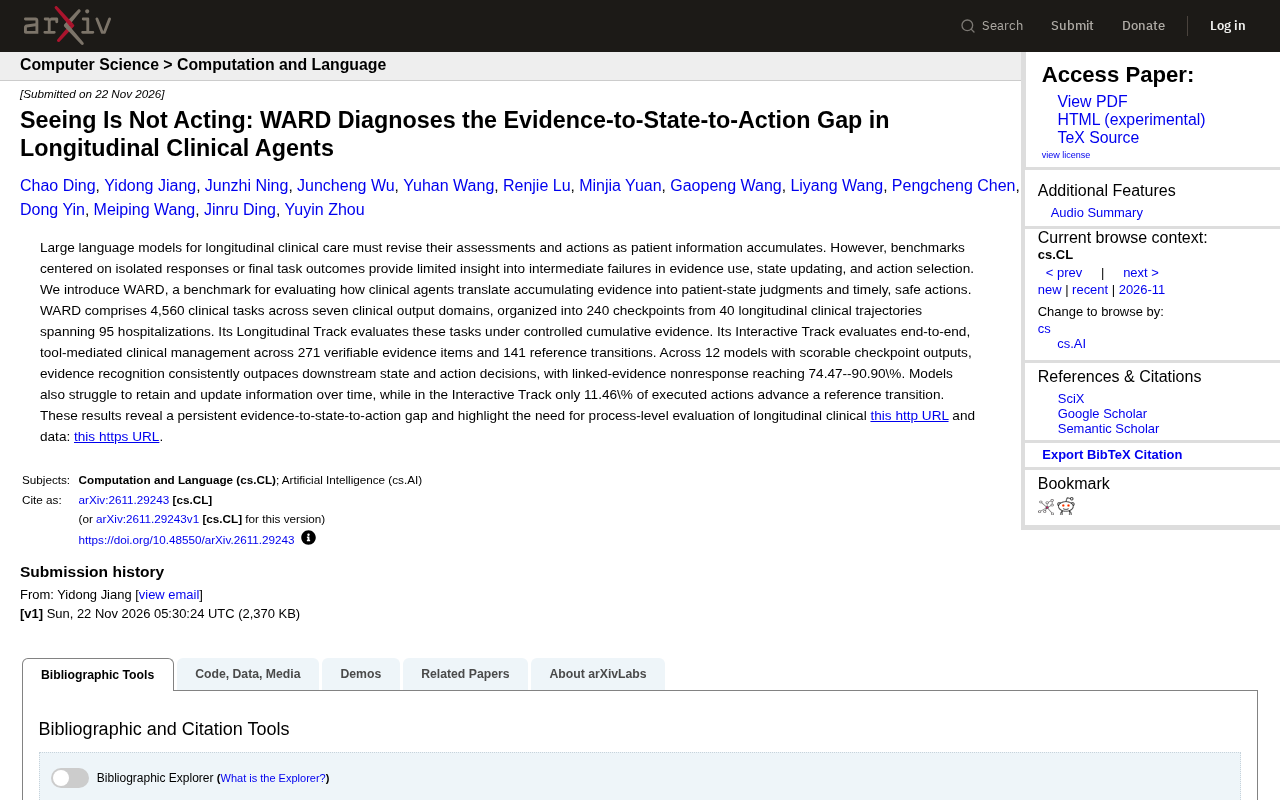
WARD benchmark reveals clinical LLMs excel at evidence identification but lag in state updating and action decisions in longitudinal care.
The WARD benchmark includes 4,560 clinical tasks, 240 checkpoints, and 141 reference transitions across 40 longitudinal trajectories and 95 admissions, designed to diagnose intermediate failures in the "evidence–state–action" chain. Evaluation of 12 models shows evidence identification systematically outperforms downstream state judgment and action selection, with high associated-evidence non-response rates and very few actions advancing reference transitions. Models struggle to retain and update information over time, and early evidence is easily forgotten or overwritten. WARD advocates process-level evaluation for clinical agents, offering developers a diagnostic tool to identify weak points rather than just a final accuracy score.
When Models "See" but "Can't Do"
Large language models in longitudinal clinical care need to continuously revise assessments and actions as patient information accumulates. However, existing benchmarks mostly focus on isolated responses or final task outcomes, making it difficult to reveal failures in intermediate steps such as evidence use, state updates, and action selection. The WARD benchmark was proposed precisely to diagnose the gaps in this "evidence–state–action" chain.
According to the paper, WARD contains 4,560 clinical tasks spanning seven clinical output domains, organized around 240 checkpoints across 40 longitudinal clinical trajectories and involving 95 hospital admissions. Its longitudinal track evaluates these tasks under controlled accumulating evidence; the interactive track evaluates end-to-end, tool-mediated clinical management, covering 271 verifiable evidence items and 141 reference transitions. This design allows researchers to observe whether models, as information gradually accumulates, truly translate evidence into accurate judgments of patient state and ultimately select timely, safe actions.
Longitudinal clinical trajectories refer to the continuous care records of a patient from admission to discharge (or a longer period), including test results, diagnoses, treatments, and changes in condition over time. Unlike single-turn question answering, longitudinal trajectories require models to integrate old and new information at multiple time points and adjust judgments accordingly. Checkpoints are selected key decision moments within a trajectory, used to evaluate whether the model's evidence use, state update, and action selection at that moment are correct. The interactive track simulates real clinical workflows, where the model must invoke tools (e.g., retrieval, calculation, order entry) and produce verifiable action sequences. Together, these designs constitute a fine-grained diagnosis of the model's process capabilities.
Evidence Identification Leads, State and Action Lag Behind
Across 12 models with scorable checkpoint outputs, a consistent pattern emerged: evidence identification capability systematically outperforms downstream state judgment and action decision-making. According to the paper, the associated-evidence non-response rate falls in a relatively high range (see the paper for the specific range reported), meaning that even when models identify relevant evidence, they often fail to link it to subsequent state updates or action selection.
This gap is not incidental. It points to a deeper problem: models may be good at extracting facts from text but poor at maintaining and revising patient state along a timeline, and even worse at making safe decisions based on the updated state. WARD's checkpoint design precisely captures this intermediate failure, which traditional outcome-oriented benchmarks often mask.
Associated-evidence non-response rate is an evaluation metric introduced by WARD, referring to the proportion of cases where the model correctly identifies evidence snippets relevant to the current problem but does not use them in subsequent reasoning to update patient state or select actions. A high non-response rate indicates an "identification–utilization" gap: evidence is extracted but never enters the decision chain. This metric differs from traditional recall or accuracy—it focuses on the actual utility of evidence in the reasoning process, not merely whether it was found.
The Challenge of Information Retention and Updating Over Time
The core challenge of longitudinal clinical care lies in information accumulating over time. WARD's results show that models have significant difficulty retaining and updating information. As checkpoints progress, earlier evidence may be forgotten or incorrectly overwritten, causing state judgments to deviate from the true trajectory.
In the interactive track, the consequences of this problem are more direct: according to the paper's data, only a very low proportion of executed actions (see the paper for the specific percentage) actually advanced a reference transition. In other words, the vast majority of actions taken by models in tool-mediated clinical management failed to move patient state toward the reference path. This suggests that failures in action selection stem not only from single-step decision errors but also from persistent drift in state tracking.
Reference transitions refer to the correct evolution path of a patient's state from one checkpoint to the next, predefined by clinical experts in the interactive track (e.g., from "suspected infection" to "confirmed infection and initiation of antibiotics"). If the sequence of actions executed by the model aligns with the direction of the reference transition, it is considered advancing; otherwise, it is ineffective or deviating. This metric measures the contribution of an action sequence to the evolution of patient state, rather than the local correctness of individual steps.
Why Process-Level Evaluation Is Needed
WARD's conclusions point to a methodological call: for longitudinal clinical agents, process-level evaluation is essential. Looking only at whether the final task was completed cannot distinguish "accidentally correct" from "step-by-step correct reasoning." Through 240 checkpoints and 141 reference transitions, WARD lowers the evaluation granularity to specific stages of evidence identification, state updating, and action selection.
This process-level perspective has practical significance for clinical AI development. Developers can pinpoint where the model breaks down—whether it fails to identify key evidence, fails to update state after identification, or has correct state but makes the wrong action choice. Targeted improvements are more effective than blindly scaling up model size or data volume.
Implications for Clinical Agent Development
The "evidence–state–action" gap revealed by WARD places clear requirements on the design of clinical agents. Models need explicit state-tracking mechanisms rather than relying solely on implicit memory within the context window. Evidence linking must be structurally incorporated into the reasoning process, not left at the extraction level. Action selection should be tightly coupled with state updates, ensuring that every action is based on the latest judgment of patient state.
In their conclusion, the paper's authors emphasize that these results highlight the necessity of process-level evaluation for longitudinal clinical agents. WARD's code and data are publicly available on GitHub, providing a reproducible evaluation foundation for future research. For teams focused on deploying clinical AI, WARD offers a diagnostic tool to help identify weak points of models in real longitudinal scenarios, rather than merely providing a vague accuracy number.
One-line Summary
The WARD benchmark reveals a gap in clinical LLMs during longitudinal care: strong evidence identification but weak state updating and action decision-making.
Paragraph Summary
The WARD benchmark comprises 4,560 clinical tasks, 240 checkpoints, and 141 reference transitions, covering 40 longitudinal trajectories and 95 hospital admissions, designed to diagnose intermediate failures in the "evidence–state–action" chain. Evaluation of 12 models found that evidence identification capability systematically outperforms downstream state judgment and action selection, with a high associated-evidence non-response rate and only a very low proportion of actions advancing reference transitions in the interactive track. Models struggle to retain and update information over time, and early evidence is easily forgotten or incorrectly overwritten. WARD calls for process-level evaluation of longitudinal clinical agents rather than focusing only on final outcomes, providing developers with a diagnostic tool to locate weak points.
Related articles

GLM-5.4 Loop Transformer: 75B Parameters Deliver Trillion-Scale Reasoning
GLM-5.4 turns a 750B pretrained model into a Loop Transformer—28 layers looped twice, zero new parameters, AIME 25 up 11.3, outputs 14% shorter, reasoning moves into implicit depth.

Landlord's Comeback: Terminal Liver Cancer Survivor Relies on Tenant Wish System to Stay Alive
A Bilibili short drama follows Wu Youfu, who after transmigrating is diagnosed with terminal liver cancer and binds a Wish System, fulfilling three female tenants' wishes to earn lifespan rewards and unlock mind-reading, invisibility, and other skills as his condition improves from terminal to mid-stage.

Viral Griddle-Cake Stand Sparks Rent Doubling: Who Really Owns the Traffic?
In a viral Bilibili video, griddle-cake vendor Lao Bai makes a whole street famous, then the landlord doubles rent to 200,000. This article examines the dispute over offline traffic ownership: where is the boundary between property rights and individual creativity?