Was Opus 5.5 Nerfed? Users Report a Shift in Thinking Patterns on November 3
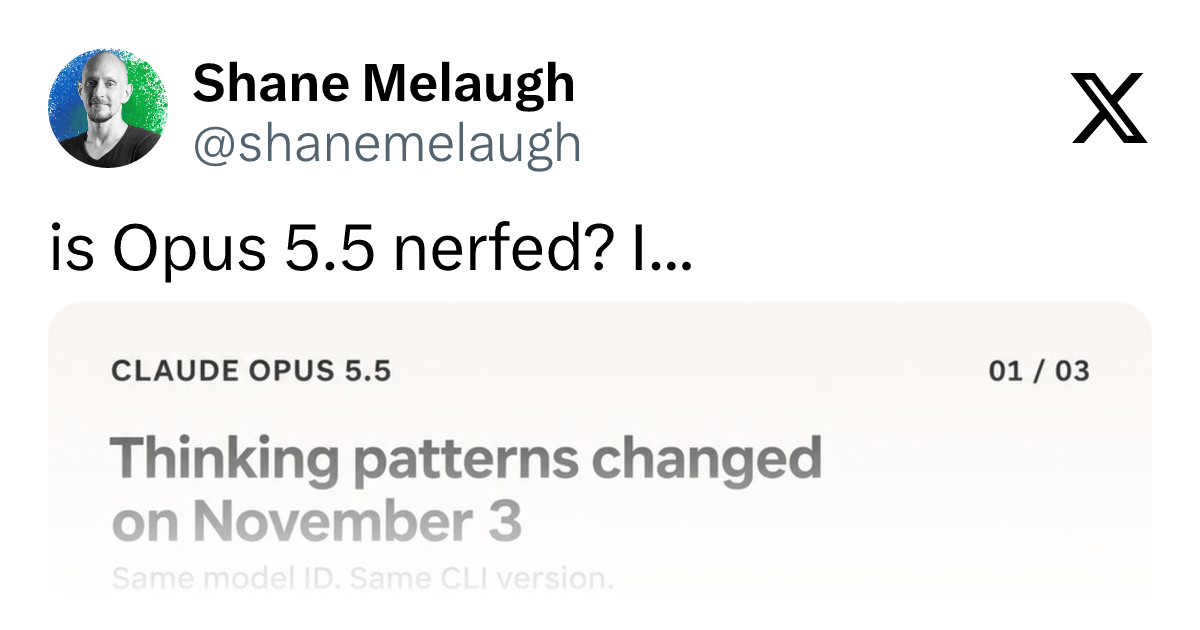
Users question whether Opus 5.5's thinking patterns changed after an update, sparking HN community discussion about silent model degradation.
The article revolves around a post questioning whether Anthropic's Opus 5.5 was "nerfed" after November 3. The post gained 209 points and 137 comments on Hacker News, showing this isn't an isolated feeling. The core dispute isn't surface output quality but the "thinking pattern" changes users perceive—shifts in reasoning style, assumption order, and strategies for handling ambiguous instructions. The article analyzes why such judgments are hard to settle: model output stochasticity, changing user prompts and parameters over time, and vendors' common practice of undisclosed post-training and safety alignment adjustments. Finally, it recommends developers build lightweight regression test sets and retain human review to cope with model behavior drift, rather than fixating on qualitative conclusions.
Introduction: Community Doubts Sparked by an Update
Recently, a discussion about Anthropic's Opus 5.5 model has been gaining traction in technical communities. A user posted on X (formerly Twitter), questioning whether the model had been "nerfed" after November 3, pointing out that its thinking patterns had visibly changed. The post quickly gained 209 points on Hacker News and accumulated 137 comments, indicating that this is not an isolated feeling from a single user but rather something that has struck a chord with a significant portion of developers and users.
Linking model updates to "silent degradation" is not uncommon in the large model space. But what makes this discussion special is that users aren't merely complaining about declining output quality—they're specifically pointing to a change in "thinking patterns." This suggests the issue may lie in reasoning paths or internal decision-making logic, rather than simple surface-level response differences.
The Core Dispute: What Exactly Changed in the Thinking Patterns
According to the original post, the user's core question is: after November 3, Opus 5.5's "thinking patterns" changed. Although the post itself doesn't elaborate on technical details, the scale of 137 comments on Hacker News suggests that many users have observed similar phenomena.
In the context of large models, "thinking patterns" typically refers to the model's reasoning style before generating a final answer—for example, which assumptions it tends to make first, how it weighs different information sources, and its default handling strategies when facing ambiguous instructions. The changes users perceive may manifest as answers becoming more conservative, more formulaic, or performing worse on certain tasks requiring multi-step reasoning.
Interestingly, this kind of perception is often subjective and easily influenced by use cases and prompts. However, when a large number of users develop similar feelings after the same time window, it's worth examining from a product iteration perspective.
Chain-of-Thought and Reasoning Style
What users call "thinking patterns" is often technically related to the model's chain-of-thought behavior. Chain-of-thought refers to the practice of generating a series of intermediate reasoning steps before giving a final answer—a capability that is particularly critical in complex multi-step tasks. Different models, or different versions of the same model, may differ in the length of reasoning steps, degree of explicitness, and order of assumptions. For example, certain alignment adjustments may cause the model to tend toward more briefly "skipping" intermediate steps, or to more conservatively refuse ambiguous requests—all of which change what users perceive as "thinking patterns." Notably, chain-of-thought is not the model's internal true state but an observable output sequence, so users' judgments about "thinking pattern changes" are essentially generalizations about output patterns.
How Post-Training and Safety Alignment Shape Reasoning Behavior
After pre-training, large models typically go through post-training stages including supervised fine-tuning, reinforcement learning from human feedback (RLHF), and safety alignment—all of which significantly influence the model's default response style. Safety alignment may make the model more cautious when facing sensitive or ambiguous instructions, manifesting as increased refusal rates or more formulaic answers; while reasoning capability optimization may change the model's path for handling multi-step problems. Vendors often emphasize capability improvements in release notes without disclosing these style-level adjustments one by one—this is one of the technical roots of users' perception of "silent nerfing."
Community Reaction: What 137 HN Comments Tell Us
A score of 209 points and 137 comments represents moderately high discussion activity on Hacker News. Judging by the scale of discussion, this has moved beyond simple "personal complaints" into the stage of community-wide exploration.
Although the original material doesn't provide the specific content of the comments, based on common patterns in such discussions, we can infer that community focus likely centers on several directions: first, confirming whether the phenomenon is widespread; second, attempting to quantify differences through comparative testing; and third, discussing whether model providers have incentives for "silent updates." The value of such discussions lies in forming a user-side oversight mechanism—when official release notes aren't transparent enough, the community spontaneously conducts cross-validation.
Why "Whether the Model Was Nerfed" Is Hard to Determine
Verifying whether a model has been "nerfed" is technically not simple. Large model outputs are stochastic—the same prompt may yield different results at different times; and users' usage habits, prompt phrasing, and even API parameters may change over time. This means reliable conclusions are hard to draw from subjective impressions alone.
More complicated is that model providers typically conduct ongoing post-training adjustments and safety alignment, and these changes may not be announced as "version number updates." Therefore, the changes users perceive may be real, but attributing them to the specific date of "November 3" requires more rigorous comparative data.
From a product strategy perspective, it's normal for vendors to balance inference costs, safety compliance, and output quality. The problem is that when adjustments affect capability performance that users have come to depend on, communication transparency becomes key.
Reproducibility Challenges from Stochasticity and Temperature Parameters
Large model outputs have inherent randomness—even with the same prompt and same model, multiple calls may yield different results. This randomness primarily comes from the sampling process, controlled by decoding parameters such as temperature and top-p. Higher temperatures produce more divergent outputs; lower temperatures produce more deterministic outputs, but even at zero, inference under different batches and infrastructure may still have subtle differences. Therefore, to determine whether a model has been "nerfed," statistical comparison must be conducted under fixed parameters, fixed prompts, and multiple repetitions—otherwise single-experience differences can easily be misread as version changes.
Industry Norms for Silent Updates and Model Version Management
"Silent updates" refer to vendors updating model backends without changing external version numbers or release notes. This is quite common in the industry, due to ongoing post-training iterations, cost optimization, safety patches, and infrastructure migrations. For users, this means that even if the API name hasn't changed, actual behavior may drift over time. This version management approach improves iteration efficiency but sacrifices predictability—an important variable developers need to incorporate into risk management.
Implications for Developers: How to Cope with Model Behavior Drift
For teams relying on Opus 5.5 for product development or workflows, this discussion offers a pragmatic reminder: don't assume model behavior is constant.
One viable approach is to establish a lightweight regression test set—using a fixed set of prompts covering core scenarios, regularly recording model outputs and comparing them. This way, even if the abstract changes in "thinking patterns" can't be fully reproduced, performance fluctuations can be captured at the specific task level. Additionally, retaining human review in critical business logic prevents model outputs from being the sole basis for decisions.
Conclusion
Whether Opus 5.5 has truly been "nerfed" remains undetermined. But this discussion sparked by a single post reflects users' high concern about model behavior stability. In the absence of detailed official explanations, the community's collective observations and cross-validation are themselves valuable sources of information. For users, rather than agonizing over the qualitative judgment of "whether it was nerfed," it's better to focus energy on establishing quantifiable monitoring mechanisms—this has more long-term value than any single conclusion.
Related articles
Claude Fable 5.2 Hands-On: Top Intelligence but Absurdly Expensive
Anthropic releases Claude Fable 5.2 and Mythos 5.2, topping the Artificial Analysis intelligence leaderboard with big gains in scientific reasoning, strong game and hardware design, but max mode costs ~$26.54 per task. Hands-on game, circuit board design, and pricing advice.

1,000 AI Agents Formalize Fermat's Last Theorem in 30 Hours, Anthropic Releases New Claude Models
Anthropic releases Claude Fable 5.2 and Mythos 5.2: 1,000 agents formalize Fermat's Last Theorem in 30 hours, coding costs halved, plus hardware design and physics.

Claude Fable 5.2 Released: A Thousand AI Agents Build a Bootable OS in 8 Days
Anthropic releases Claude Fable 5.2 and Mythos 5.2—same model, two safety tiers. Demo shows 1,000 AI agents build a bootable OS in 8 days, formalize Fermat proof in 30 hours, score 64.6 beating Gemini 4 Carbon, price cut 20%.