Waymo Confirms Split from Uber in January 2028 as Autonomous Driving Competition Escalates

Waymo confirms ending Uber partnership in January 2028, shifting from partners to direct competitors.
Waymo has confirmed it will terminate its partnership with Uber in January 2028, moving from a complementary technology-traffic relationship to direct competition in the robotaxi market. The article reviews their original division of labor—Waymo providing vehicles and tech, Uber providing traffic and operations—and notes the split is unsurprising: Waymo favors direct user service as it expands, while Uber pursues platformization and multiple partners to spread risk. After the split, Waymo must build its own customer acquisition and operations, while Uber must ensure other suppliers fill capacity. The article sees this as reflecting that autonomous driving commercialization is still in the exploration stage, with no consensus on vertical integration versus platform aggregation, though increased competition may drive coverage expansion and price optimization.
According to RSS feed reports, Waymo has confirmed that it will terminate its partnership with Uber in January 2028. This decision means the two companies will engage in direct competition in the robotaxi market, while Uber's platform also integrates numerous other autonomous driving partners.
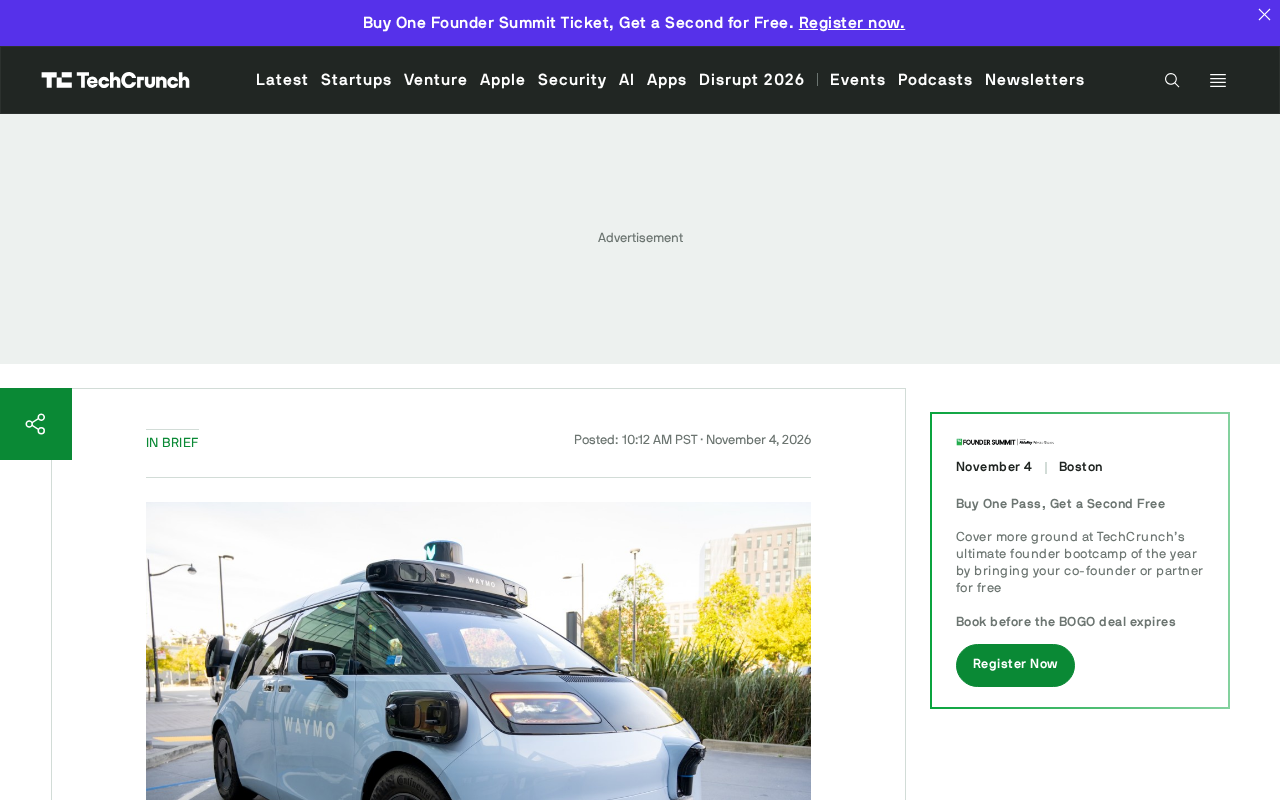
Partnership Termination: From Partners to Rivals
The Waymo-Uber partnership was once a typical model for commercializing autonomous driving: Waymo provided autonomous vehicles and technology, while Uber provided the traffic gateway and operating network. This division of labor allowed both parties to leverage their respective strengths and gave consumers faster access to Robotaxi services.
However, the end of the partnership is not surprising. As Waymo gradually expands the operating scope of its robotaxi services, its willingness to serve users directly has also grown. Uber, as a mobility platform, wants to remain neutral and integrate multiple autonomous driving suppliers to avoid dependence on a single partner.
According to the original report, this split will "create direct competition in those markets," because Uber's network already has many other autonomous vehicle partners. This means that after Waymo exits, Uber can more flexibly integrate autonomous fleets from different companies, while Waymo will compete with Uber for passengers as an independent service provider.
Robotaxi (autonomous taxi) refers to vehicles that complete all driving tasks through autonomous driving systems and provide paid passenger services called via an app. Its commercialization typically involves three layers of capability: the autonomous driving technology stack (perception, decision-making, control), fleet operations (charging, cleaning, maintenance, remote assistance), and user acquisition channels (traffic gateways). The division of labor between Waymo and Uber was split exactly along these lines: the former was responsible for the technology stack and part of fleet operations, while the latter provided traffic and dispatch networks. The core difference between Robotaxi and ordinary ride-hailing is the removal of the human driver as a cost item, but at the same time, the responsibility for safety validation, regulatory compliance, and handling of exceptional scenarios is transferred to the operator, which is also the main threshold for scaling this model.
Uber's Multi-Partner Strategy: Not Putting All Eggs in One Basket
Uber's strategy in the autonomous driving field has always leaned toward "platformization." It is not satisfied with deep binding to just one autonomous driving company, but instead tries to build an aggregated network so that Robotaxis from different suppliers can all connect to Uber's hailing system.
The advantage of this strategy is that Uber can reduce technology路線 risk while maintaining control over the user gateway. Even if Waymo leaves, Uber can still rely on other partners to continue providing autonomous mobility services. Conversely, Waymo's choice to end the partnership also shows that it has enough confidence in its ability to operate independently and is unwilling to funnel traffic to a platform over the long term.
The platform aggregation model in autonomous mobility refers to a mobility platform not binding itself to a single technology supplier, but instead connecting multiple Robotaxi fleets through a unified interface, with the platform responsible for order distribution and the user gateway. The advantage of this model is dispersing technology route risk and improving vehicle utilization; the challenge is that different suppliers' vehicles vary greatly in capability, operating areas, and safety records, and the platform needs to establish unified access and dispatch standards. For technology companies, connecting to a platform can quickly generate demand, but it also makes passengers remember only the platform brand, weakening the accumulation of their own user assets—this is an important motivation for companies such as Waymo to shift toward independent operations.
Impact on the Autonomous Mobility Market
After the split, the most direct change is the market competition landscape. Waymo will have to establish its own user acquisition channels and operating systems in markets where Uber has already deep roots, while Uber will need to ensure that other autonomous driving suppliers can fill the capacity gap after losing Waymo as an important partner.
From an industry perspective, this kind of coupling and uncoupling between "technology providers" and "platform providers" reflects that the commercialization of autonomous driving is still in the model exploration stage. Whether technology companies should vertically integrate mobility services or platform companies should horizontally aggregate multiple technology suppliers remains undecided. This split between Waymo and Uber will become an important case for observing the pros and cons of the two paths.
For consumers, the short-term impact may be limited, but in the long run, intensified competition is expected to drive expansion of service coverage and price optimization. However, all of this depends on whether autonomous driving companies can operate safely and stably at scale.
Vertical integration and horizontal aggregation are two typical paths for commercializing autonomous mobility. Vertical integration means technology companies build their own hailing apps, fleets, and operating systems to directly face passengers, represented by Waymo's own Waymo One service; horizontal aggregation means platform companies connect multiple technology suppliers without holding autonomous driving technology themselves, represented by Uber's aggregation network. The former can control user experience and the data loop, but must bear asset-heavy operations and customer acquisition costs; the latter is asset-light and expands quickly, but is highly dependent on suppliers and offers limited differentiation. The two paths are not mutually exclusive, and hybrid forms have also emerged in the industry, where technology companies and platforms cooperate in the short term and then gradually diverge.
Conclusion
The split between Waymo and Uber is not the end, but the starting point of a new stage in autonomous mobility competition. The January 2028 deadline gives both parties sufficient transition time and gives market observers a clear milestone. By then, whether Waymo can stand on its own feet and whether Uber's multi-partner network is reliable will be tested by reality.
One-line Summary
Waymo confirms it will terminate its partnership with Uber in January 2028, shifting from partners to direct competitors.
Paragraph Summary
Waymo has confirmed that it will terminate its partnership with Uber in January 2028, with the two companies moving from a complementary relationship of technology and traffic to direct competitors in the robotaxi market. The article reviews the original division of labor—Waymo providing vehicles and technology, Uber providing the traffic gateway and operating network—and notes that the split is not surprising: after expanding operations, Waymo tends to serve users directly, while Uber insists on a platform-based, multi-partner strategy to diversify risk. After the split, Waymo needs to build its own customer acquisition and operating systems, while Uber needs to ensure other suppliers fill the capacity gap. The article argues that this reflects that autonomous driving commercialization is still in the model exploration stage, and whether vertical integration or platform aggregation is superior remains undecided, but intensified competition may in the long run drive expanded coverage and price optimization.
Related articles

Bypassing DeepSeek Detection: Sneaky Reverse-Proxy Tricks to Avoid Bans and Their Risks
A Bilibili creator shares a DeepSeek reverse-proxy scheme to avoid bans: evading XML tags, using a single English word as trigger, and registering with overseas emails. This article breaks down the technical approach, Harness integration results, and the real risks of this "unlimited tokens" game in terms of rule confrontation, account stability, and compliance.

4 Must-Have Plugins for Saving Tokens in DSH — Stop Installing Blindly
A detailed guide to 4 must-have DSH token-saving plugins: DSH Shops shortens tool output, Billion Context compresses early context, Vision Router converts images to text, and Thinking Levels auto-adjusts thinking depth — plus backup and verification tips before installing.
Retested 51 Times: DeepSeek Harness Token-Saving Plugins — Use Them Right and Save Half, Use Them Wrong and Pay More
51 test runs of three DeepSeek Harness token-saving plugins: Ops saves half only in PTC mode, Flash Presets saves ~20% via rules, Billion Context saves context space but not money. Includes selection guide and pitfalls.