Waymo Expands to Singapore: Another Milestone in Its Global Robotaxi Strategy

Waymo names Singapore as its next overseas Robotaxi city, rolling out in phased stages from mapping to commercial service.
Alphabet's Waymo has announced Singapore as one of its first international Robotaxi destinations, following commercial operations across several U.S. cities. Under a phased plan, vehicles will arrive within months to complete HD mapping, supervised road testing with safety drivers, and eventually a public driverless taxi service. Singapore's orderly traffic, strong infrastructure, and open regulatory stance make it an ideal proving ground for Waymo's technology outside the U.S., while also signaling Alphabet's broader ambition to scale Waymo into a global commercial player.
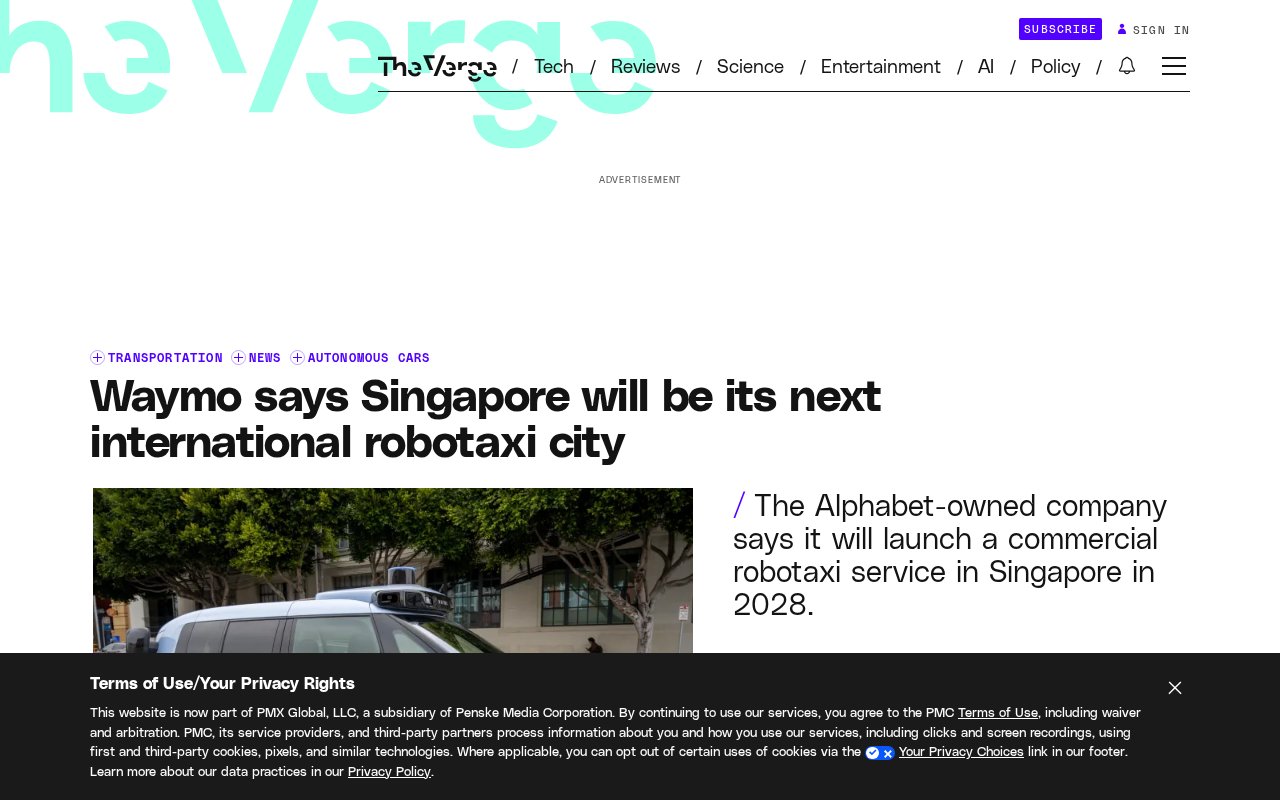
Alphabet's autonomous driving subsidiary Waymo has announced that Singapore will be its next international destination, with plans to launch a Robotaxi service there. The move marks a significant acceleration in the global expansion of the world's leading autonomous driving company, as it looks to export the technology and operational know-how it has built up in the United States to Asian markets.
A Phased Rollout: From Testing to Commercial Operations
According to Waymo's announced plans, its autonomous vehicles will begin arriving in Singapore over the coming months. Initially, these vehicles won't be carrying passengers — instead, they'll focus on high-definition (HD) map data collection and preparatory groundwork for autonomous driving tests.
Actual road testing will follow, with human safety drivers remaining behind the wheel to handle unexpected situations and continue gathering data. This "human-in-the-loop" transitional approach is consistent with Waymo's standard playbook when entering new markets — using large volumes of real-world road data to train and validate its systems while gradually reducing the need for human intervention.
The timeline progresses from vehicle arrival to HD mapping, then to supervised testing with safety drivers, and finally to a public-facing Robotaxi service. Waymo's careful, phased approach reflects both respect for Singapore's complex urban driving environment and the localization challenges inherent in deploying autonomous driving technology across international borders.
HD maps are one of the core infrastructure components of any autonomous driving system, fundamentally different from standard navigation maps. They contain centimeter-level data on lane markings, road signs, traffic signal positions, gradients, and curvature — enabling vehicles to accurately localize themselves even when sensor perception is limited. Before entering any new city, Waymo must collect HD map data from scratch, a process that typically takes weeks to months and is one of the most time-intensive preparation steps in cross-city or cross-border expansion.
Why Singapore? The Strategic Logic Behind the Choice
Singapore is a strategically compelling choice for Waymo. As a benchmark for urban governance and smart transportation in Asia, Singapore offers highly regulated traffic patterns, well-developed road infrastructure, and a relatively open regulatory environment toward autonomous driving technology. These factors collectively reduce the operational risks of deploying an autonomous system in an unfamiliar environment.
Compared to other Asian metropolises — where traffic is often congested and unpredictable — Singapore's orderly urban structure makes it a far more suitable testing ground for Waymo to validate how well its technology adapts to markets outside the United States. Lessons learned here could eventually be replicated in other international cities.
Notably, Singapore itself is actively pushing for autonomous vehicle adoption, viewing it as a key solution to driver shortages driven by an aging population and a means to improve public transportation efficiency. Waymo's entry aligns neatly with the city-state's existing policy direction.
The Strategic Rationale Behind Waymo's Global Push
For Alphabet, taking its Robotaxi business overseas is a critical step in transforming Waymo from a "technology leader" into a "scaled commercial player." In U.S. cities like Phoenix, San Francisco, and Los Angeles, Waymo has already amassed significant commercial mileage and passenger data. Going international means re-validating the robustness of its technology under different regulatory frameworks, driving cultures, and road environments.
Overseas expansion is also an inevitable response to intensifying competition in the autonomous driving space. As more players enter the Robotaxi race, the battle for market share has expanded from individual cities to a global stage. Whoever can establish sustainable operating networks across multiple international markets first will be best positioned to dominate in the long run.
That said, cross-border deployment is no easy feat. Challenges include re-collecting map data from scratch, adapting to local regulations, hardware-level adjustments such as right-hand drive configurations, and building public trust in autonomous vehicles — all of which Waymo must tackle one by one. Choosing to pilot in a mature, stable market first is precisely the strategy for accumulating this valuable cross-border operational experience within a controlled environment.
There is one significant hardware difference between Singapore and the United States when it comes to road rules: Singapore follows the British left-hand traffic system, with steering wheels on the right side of the vehicle (right-hand drive), while Waymo's existing fleet is designed for left-hand drive in accordance with U.S. traffic rules. This means Waymo's autonomous hardware suite — including the mounting positions and viewing angles of its LiDAR units and camera arrays — as well as its underlying perception algorithms, will all need to be re-adapted and re-validated for right-hand drive, left-hand traffic scenarios. This represents one of the more costly engineering challenges in technical localization. It remains unclear whether Waymo plans to retrofit existing vehicles or introduce a new vehicle model for the Singapore deployment.
Conclusion: A New Signal in the Global Autonomous Driving Race
Waymo's decision to add Singapore to its international footprint sends a clear signal that autonomous driving commercialization is moving from regional to global. Its phased, safety-first approach reflects how an industry leader balances technological maturity with commercial ambition.
For the broader autonomous driving industry, this move is not just a milestone in Waymo's own expansion — it also serves as a reference model for other players charting their own international paths. As more vehicles take to Singapore's streets, the global race to define the future of mobility is entering a more intense and consequential new phase.
Related articles

WorkBuddy Full Tutorial: Build an AI Office Automation Agent from Scratch
A complete WorkBuddy tutorial: installation, three working modes, multimodal picture book video practice, expert team agent building, and workflow configuration for low-cost AI office automation.

WorkBuddy Agent Complete Guide: From Beginner to Automation in 7 Days
Based on Bilibili's 256-episode WorkBuddy masterclass, this systematically breaks down Tencent's AI office workbench core capabilities: Agent principles, Skill encapsulation, cross-platform connectors, scheduled automation, knowledge bases, and zero-code development, with learning path recommendations.

8 AI Accounts, 7 Failed: An Honest Review of Using AI to Get Work Done
Only 1 of 8 AI-run Bilibili accounts succeeded. We break down the real difference between "performing AI" and "using AI to get work done."