Waymo Robotaxi Calls Police on Its Own Passengers: Two Armed Minors Arrested
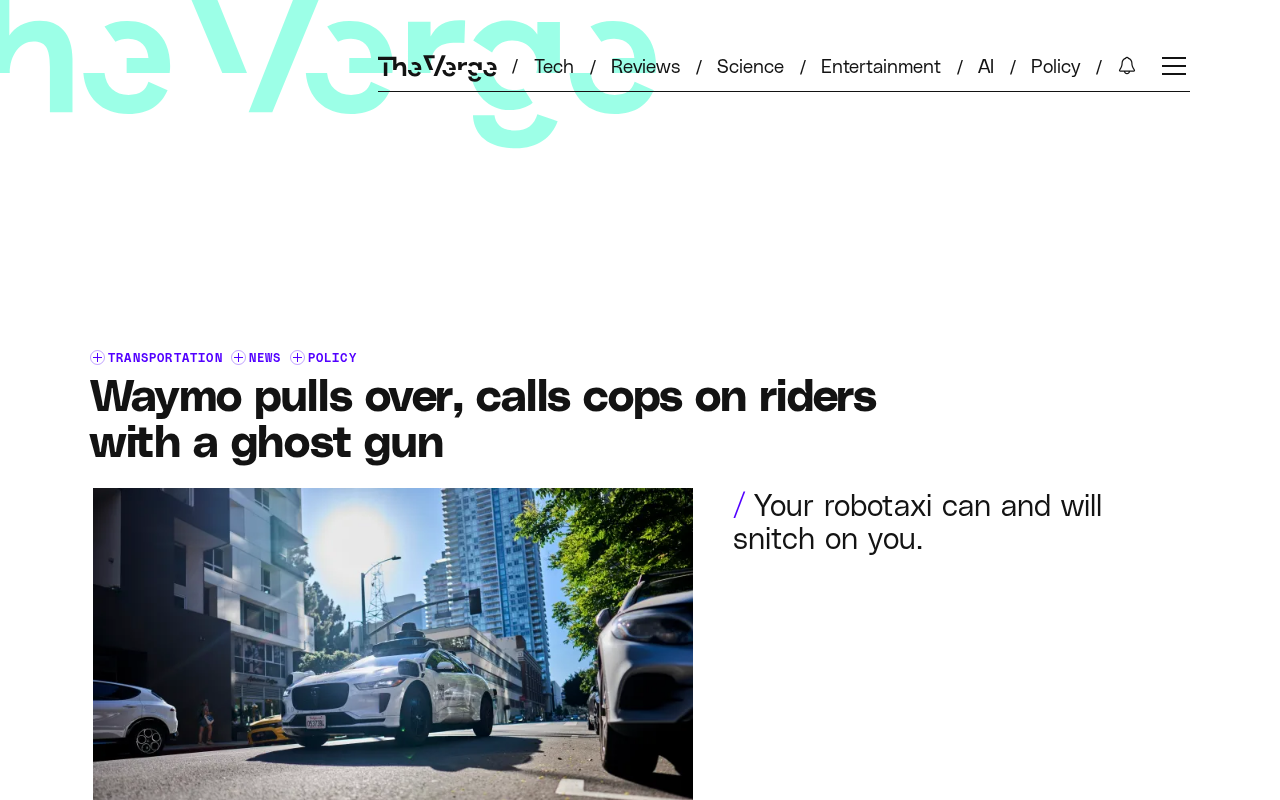
A Waymo robotaxi in San Francisco pulled over and alerted police, helping arrest two armed minors onboard.
In San Francisco, a Waymo robotaxi pulled over mid-trip and contacted law enforcement, resulting in the arrest of two minors carrying a loaded AR-style ghost gun. The key question remains unresolved: was the alert triggered autonomously by the AI system, or by Waymo's remote safety team? The police report is ambiguous, though Waymo's human-in-the-loop remote assistance model suggests a hybrid intervention is most likely. The incident has thrust robotaxi interior surveillance into public debate, sparking discussions about passenger privacy, data usage policies, and the legal boundaries of law enforcement collaboration — signaling that autonomous vehicles are becoming nodes in urban safety governance, not just transportation tools.
Incident Overview: An Unusual Autonomous Ride
A striking incident unfolded in San Francisco when two passengers aboard a Waymo robotaxi found themselves at the center of a police confrontation — after the vehicle pulled over and contacted law enforcement on its own. Officers who responded arrested both passengers, who were minors carrying a loaded AR-style ghost gun. The two juveniles were subsequently taken to a youth detention facility.
A "ghost gun" refers to a homemade or assembled firearm with no serial number and no traceable origin — a regulatory gray area in the United States and a priority concern for law enforcement. What made this incident particularly noteworthy wasn't just the weapons violation itself, but the fact that the entity initiating the police call was an autonomous vehicle.
Who Actually "Called the Police"? The Line Between AI and Human
Based on available information, the police report does not clearly specify who — or what — actually executed the alert. This leaves a critical question unanswered: did the vehicle's automated systems independently trigger the call based on some anomaly-detection mechanism, or did Waymo's remote safety monitoring team intervene manually after observing conditions inside the vehicle?
This distinction matters enormously. If an AI system autonomously determined that law enforcement should be contacted, it would imply that self-driving vehicles now possess a meaningful degree of "environmental awareness" and "decision-triggered alerting" — raising deeper questions about algorithmic accuracy, false-positive risks, and privacy boundaries. The more likely scenario, however, is that Waymo vehicles — which are widely equipped with interior cameras and remote operations centers — had a background safety operator make a human judgment call after detecting suspicious or dangerous behavior.
Either way, the incident exposes a reality: modern robotaxis are not simply "mobility tools." They are complex network nodes connecting real-time surveillance, remote operations, and law enforcement systems.
What This Means for Passenger Privacy
For everyday riders, this incident raises a question that has rarely been discussed: just how private is the interior of an autonomous taxi?
Operators like Waymo typically deploy interior cameras and audio-capture systems to monitor vehicle conditions, deter vandalism, and handle emergencies — all in the name of safety. In this case, that monitoring did serve a public safety purpose: a loaded, illegal firearm was intercepted before it could lead to more serious consequences.
At the same time, this means a passenger's every move may be observed and recorded. Striking the right balance between convenience, safety, and privacy will be an unavoidable topic as autonomous ride-hailing becomes mainstream.
Broader Industry Implications
What appears to be an isolated law enforcement incident actually reflects the cascading effects of autonomous driving technology entering everyday life.
As companies like Waymo deploy robotaxis at scale in cities such as San Francisco, these vehicles are gradually becoming part of the urban transportation and public safety ecosystem. Beyond their transport function, they are quietly evolving into extensions of security surveillance networks — with latent capabilities to detect anomalies, report dangers, and assist law enforcement.
For regulators, this raises a new set of questions: Under what circumstances do autonomous vehicle operators have the right — or the obligation — to contact law enforcement? How will passenger data collected by these vehicles be stored and used? Who is liable if a misidentification results in harm to a passenger's rights?
For the public, it requires a fundamental reassessment of what a "driverless car" actually is — not just a convenient transportation service, but a node embedded within the broader urban governance system.
Conclusion
Two minors carrying illegal firearms were reported to police and arrested by a robotaxi — a dramatic demonstration of how AI-driven transportation intersects with real-world social governance. The event both highlights the unexpected value autonomous vehicles can provide in public safety, and brings sensitive issues of surveillance, privacy, and accountability into sharp focus.
As autonomous driving technology matures and becomes deeply integrated into daily commutes, boundary questions like these will only multiply. Establishing clear rules that balance security with respect for passenger rights is a challenge the entire industry — and its regulators — will need to confront together.
Related articles

Claude Completes First Formal Proof of Fermat's Last Theorem: A Record-Breaking 13 Million Lines of Lean Code
Anthropic's Claude completes the first formal proof of Fermat's Last Theorem in over 13 million lines of Lean code — the largest ever — plus 29,000+ subsidiary theorems, opening new paths for AI-assisted math verification.

Microsoft Copilot Enters the NFL: How AI Is Supporting On-Field Decision-Making
Microsoft Copilot and Excel are entering NFL sidelines and booths, helping Seahawks analysts and coaches with real-time game decisions. Here's what it means for AI in pro sports.
Microsoft Copilot Goes Autopilot: From Assistant to Autonomous Long-Running Task Execution
Microsoft is evolving Copilot into autonomous Autopilots powered by Opal and Windows 365 cloud PCs, enabling end-to-end completion of long-running tasks without human intervention.