We Need Smart People Who Genuinely Care: A Talent Philosophy for the AI Era

In the AI era, the execution barrier is dropping, and smart people who genuinely care about outcomes become a scarce competitive edge.
Starting from the HN hot post "We need smart people who give a shit," the article argues that the tech industry never lacks smart people—what's truly scarce is smart people who genuinely care about the results of their work. This "caring" shows up as sensitivity to edge cases and a refusal to paper over known defects, not as hours worked. As AI coding tools take on boilerplate code and test generation, the execution barrier drops and "writing fast" is diluted as a competitive edge; judgment—whether generated code is trustworthy, whether architectural decisions plant debt—becomes key, and judgment depends on caring. Organizations that measure only delivery speed will lose these people first; the article suggests making quality behavior visible, adding code review in hiring, and protecting dissent channels. For individuals, deep care and commitment to quality are a moat hard to automate, but they need an environment that gives them an outlet to avoid burnout.
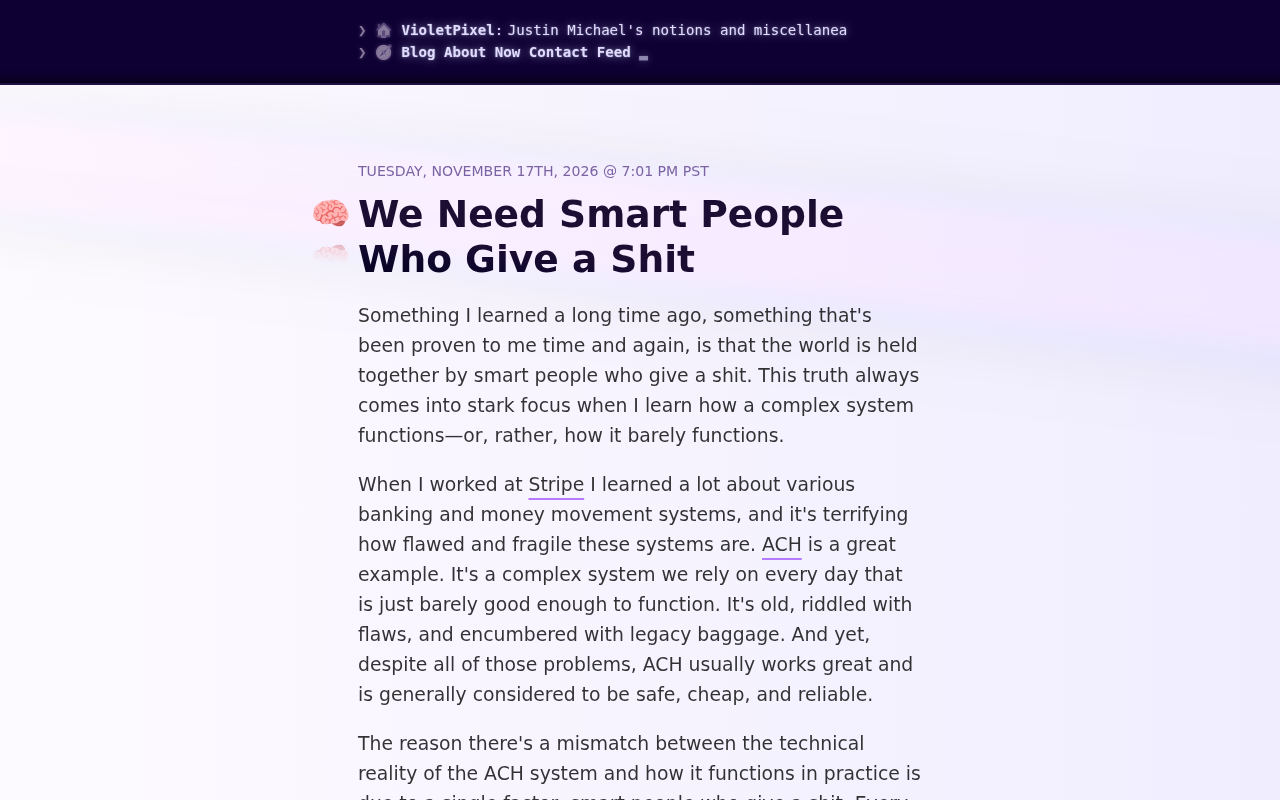
A post titled "We need smart people who give a shit" has sparked heated discussion on HN. With 319 points and 168 comments, it clearly struck a shared nerve in the tech community. The title itself isn't complicated, but the question it points to deserves unpacking: in an era of rapidly expanding AI capabilities, what kind of engineers and creators are still scarce?
Being Smart Isn't Scarce—Caring Is
The tech industry has never lacked smart people. Those who can pass algorithm interviews, quickly pick up new frameworks, and translate requirements into code are in relatively ample supply. What's genuinely hard to find is a different combination: smart, and genuinely invested in what they're doing.
This kind of "caring" isn't about hours worked, nor is it slogan-style enthusiasm. It shows up as sensitivity to boundaries—knowing who a feature will affect once it ships, being willing to spend an extra half hour on an unglamorous edge case, refusing to paper over known defects with "let's just ship it first." Much of the HN comment thread revolves around this point: many people said they've worked with colleagues who were technically strong but whose delivery quality was hit-or-miss, and also with people of modest credentials who held systems steady. The long-term value of the latter is often underestimated.
From a hiring perspective, "smart" can be quickly screened through written tests and interviews, but "caring" is hard to verify in a few rounds of conversation. That's exactly where the title's impact lies: it puts a dimension that hiring often avoids onto the table.
AI Lowers the Execution Barrier and Raises the Judgment Barrier
Today's AI coding tools can already handle a substantial share of boilerplate code, test generation, and documentation work. The execution barrier is dropping, which means the competitive edge of simply "writing fast" is being diluted.
As the cost of generating code approaches zero, what truly separates people is judgment: judging which generated output can be trusted, judging whether an architectural decision will turn into debt six months later, judging what users actually need. These judgments depend precisely on "caring"—people who don't care won't ask what the generated code does on exception paths, nor will they proactively check those inconspicuous warnings in production logs.
In other words, AI hasn't made "caring" less important—it has made it the key variable distinguishing output quality. The more powerful the tools, the more the intent and sense of responsibility of the person using them is magnified.
The capability boundary of code generation tools: Current mainstream AI coding assistants (such as Copilot, Claude Code, Cursor, etc.) are essentially probabilistic models trained on large-scale code corpora. They excel at completing patterned code, generating boilerplate logic, and writing unit tests, but they lack awareness of runtime context, business constraints, and long-term maintenance costs. The code they generate is often syntactically correct yet may leave hidden risks in non-obvious paths such as exception handling, concurrency safety, and resource release. Therefore, "judging which generated output can be trusted" is no mystery—it requires engineers to have real skills in code review, static analysis, and test design. This is precisely the technical handle through which "caring" becomes actionable.
How Organizations Can Identify and Retain These People
One recurring point in the HN discussion: many organizations say they value quality but actually reward speed. When delivery pace becomes the only measured metric, people who care are the first to feel frustrated, because the extra cost they pay for quality is invisible in performance reviews.
Several directions discussed are worth considering. First, make quality-related behavior visible—for example, explicitly record "who found that boundary issue" in retrospectives rather than only "who delivered on time." Second, add steps in hiring that expose real working habits—for instance, have candidates review a piece of flawed code and observe whether they proactively point out problems. Third, protect channels for raising objections so that "I think something's wrong here" isn't treated as noise slowing down progress.
None of these practices are new; what's hard is sustaining them. The problem with organizational culture is often not that people don't know the answer, but that the incentive structure is quietly casting its vote.
Goodhart's Law in performance measurement: When an organization makes "delivery speed" a core KPI, team behavior quickly tilts toward that metric, while hard-to-quantify dimensions like quality and maintainability are systematically neglected. This phenomenon is known in management as Goodhart's Law—"when a measure becomes a target, it ceases to be a good measure." What the HN discussion calls "making quality behavior visible" is essentially about building alternative signals in the incentive structure for contributions that are hard to measure—for example, recording defect finders in retrospectives and incorporating code review quality into promotion reviews—so that people who care don't leave due to misaligned incentives.
What It Means for Individuals
For individuals, the takeaway is to re-examine your positioning. If your advantage is only execution, that's worth being wary of—that part is being rapidly covered by tools. If your advantage includes deep care for the domain and steady commitment to quality, that's a relatively safe moat, because it's hard to automate and hard to replicate through short-term training.
Another practical reminder: caring needs an outlet. Spending a long time in an environment that doesn't reward caring will turn enthusiasm into burnout. Finding a team that values quality—or at least finding a way of working that lets you maintain your standards—is itself part of career decision-making.
Conclusion
The value of this HN hot post isn't in offering new answers, but in raising again a question obscured by efficiency and metrics. There are plenty of smart people; people willing to take responsibility for outcomes have always been scarce. At a stage when AI amplifies individual output, this judgment deserves to be taken more seriously than ever.
One-line Summary
In the AI era, the execution barrier is dropping, and smart people who genuinely care about outcomes become a scarce competitive edge.
Paragraph Summary
Starting from the HN hot post "We need smart people who give a shit," the article points out that the tech industry never lacks smart people—what's truly scarce is smart people who genuinely care about the results of their work. This "caring" shows up as sensitivity to edge cases and a refusal to paper over known defects, not as hours worked. As AI coding tools take on large amounts of boilerplate code and test generation, the execution barrier drops and the competitiveness of "writing fast" is diluted; judgment—judging whether generated code is trustworthy and whether architectural decisions plant debt—becomes the key to distinguishing output quality, and judgment depends precisely on "caring." At the organizational level, measuring only delivery speed will drive these people away first; the article suggests making quality behavior visible, adding code review steps in hiring, and protecting channels for dissent. For individuals, deep care and commitment to quality are a moat hard to replace through automation, but they also require an environment that gives them an outlet, so that enthusiasm doesn't burn out into fatigue.
Related articles

GPT-6.2 Sol/Astra Released! A Step-by-Step ChatGPT Plus Subscription Guide and Tier Comparison
GPT-6.2 Sol/Astra is out—here's a ChatGPT Plus subscription guide: register an account, compare Go/Plus/Pro tiers, and subscribe in a minute.

Comparing Three Channels for Subscribing to GPT Plus in China: Is Website Top-Up the Easiest?
How to subscribe to GPT Plus in China? This article compares website top-up, credit card, and mobile top-up channels—process, cost, and risk—with steps and tips to help you choose wisely.
GPT-6.2 Dual-Model Hands-On Test: Astra Burns $419, Sol Just $5
OpenAI GPT-6.2 Astra vs Sol tested on Blender clock, neon shooter, and Formula racing. Astra costs $419, Sol $197, cheapest clock under $5. Cost comparison and selection advice.