Weave Router 2.0: A Subscription-Aware AI Coding Agent Router with Cross-Service Intelligent Dispatch
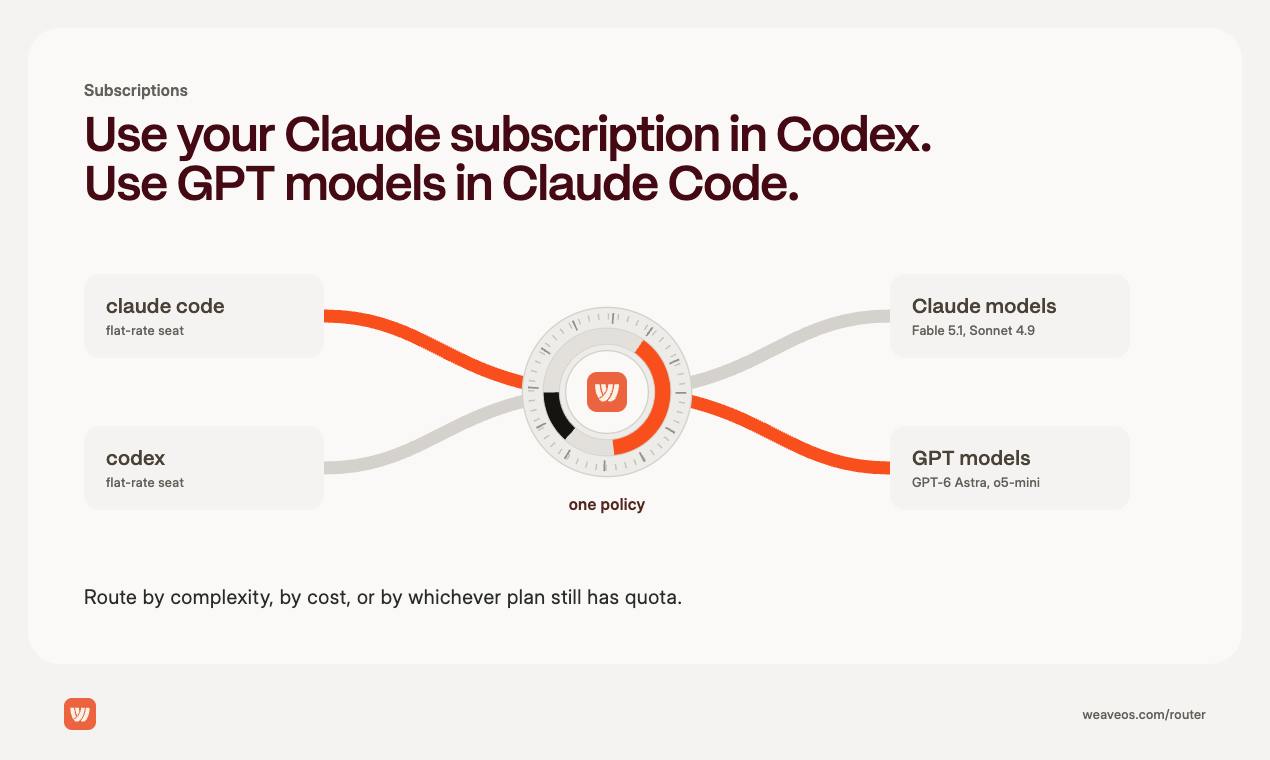
Weave Router 2.0 intelligently dispatches coding requests across Claude/Codex/GPT subscriptions, claiming half the cost and twice the speed.
Weave Router 2.0 is a subscription-aware AI coding agent router that topped Product Hunt. It breaks down multi-vendor subscription silos by using a task complexity classifier to match each request to the cheapest model that can handle it correctly, while an ache-aware switching mechanism ensures model switches only happen when savings outweigh context reconstruction costs. The team claims it matches GPT-6 Astra on Terminal-Bench 4.0 and SWE-Atlas at half the cost and twice the speed, though no independent third-party verification exists. Released as open source, it's best suited for heavy developers subscribing to multiple AI services who are sensitive to cost — though data flow and privacy compliance should be assessed before adoption.
In an era where AI coding assistants are increasingly ubiquitous, developers often juggle multiple subscriptions — Claude, Codex, and GPT each have their strengths, but managing quotas and costs has become a new pain point. Weave Router 2.0, which just topped Product Hunt (127 upvotes, ranked #1), aims to solve exactly this problem. It's a "subscription-aware" coding agent router that automatically dispatches each coding request to the most cost-effective model that can actually get the job done.
Core Idea: Turning Model Selection into a Routing Problem
Weave Router 2.0 is positioned as a "Subscription Aware Coding Agent Router." Its key capability is breaking down the subscription silos between different AI vendors — you can call Claude models from within Codex, or call GPT models from within Claude Code, all based on your existing paid plans, with requests routed to whichever service still has remaining quota.
In other words, it transforms "which model to use" from a manual decision made by the developer into a routing problem handled automatically in the background. For heavy users who subscribe to multiple services and frequently hit quota limits, this kind of cross-subscription elastic dispatching can meaningfully reduce interruptions and waste.
Performance Claims: Matching GPT-6 Astra at Half the Cost and Twice the Speed
According to the official description, Weave Router 2.0's performance on two benchmarks — Terminal-Bench 4.0 and SWE-Atlas — is comparable to GPT-6 Astra, but at half the cost and twice the speed.
This combination of "equivalent intelligence at lower cost" is the product's core selling point. The logic is straightforward: if a simple task can be handled by a cheaper model, there's no need to invoke the most expensive flagship; only genuinely complex tasks get routed to the highest-capability model. Overall, the router keeps average costs down by matching each request to "the cheapest model that can get it right."
It's worth noting that these performance figures currently come solely from vendor-side marketing claims, with no independent third-party evaluation to back them up. Real-world effectiveness still awaits community validation.
Terminal-Bench and SWE-Atlas are "real engineering task" benchmarks that have emerged in recent years, distinct from traditional code completion accuracy tests. Terminal-Bench focuses on the ability to complete multi-step command-line tasks in terminal environments, while SWE-Atlas (and its predecessor SWE-bench) centers on end-to-end capability to locate and fix issues in real GitHub repositories — widely regarded as an important indicator of a coding agent's practical usability. It's worth noting that self-reported benchmark results carry risks of "evaluation set overfitting" or favorable experimental conditions — the model combinations, temperature parameters, context lengths, and other variables chosen during evaluation can all influence results. GPT-6 Astra is also not a publicly available model that has been widely tested, making the reproducibility of these comparison figures questionable. Readers should approach them with appropriate skepticism.
Two Key Technologies: Complexity Classifier and Ache-Aware Switching
Weave Router 2.0's routing decisions are driven by two mechanisms:
Task Complexity Classifier
A new classifier scores the complexity of each coding task. The score determines which tier of model the request "deserves" — simple changes go to lighter models, while architecture-level or highly difficult problems get escalated to more capable ones. This is the foundation for achieving "on-demand compute allocation."
Task Complexity Classification is not an entirely new concept in the LLM routing space. Prior work in academia and industry — including RouteLLM and FrugalGPT — has explored this, with the core idea being to train a lightweight "gating model" that estimates input difficulty before invoking a full-scale LLM. Common feature dimensions include: token count, programming languages or frameworks involved, whether cross-file dependencies are present, and the number of reasoning steps required. The classifier itself is typically a small classification network or a fine-tuned small-parameter model with negligible inference cost. Weave Router 2.0's classifier training data and architecture have not been publicly disclosed, which is one reason it's difficult for outsiders to verify routing decision quality — the classifier's accuracy directly determines the probability of misclassifying simple tasks as complex (or vice versa), which in turn affects final cost and quality outcomes.
Ache-Aware Switching
More interesting is what the team calls "ache-aware switching" (best understood as "cost-aware switching"). The router doesn't blindly switch models just to save money — it only executes a switch when the savings from switching exceed the cost of rebuilding context.
This directly addresses a real challenge in multi-model collaboration: switching models means losing accumulated context and needing to re-establish conversational state, which itself carries a cost. By factoring in this "reconstruction cost," Weave Router avoids the shortsighted behavior of repeatedly disrupting workflows to save a few cents — a notably restrained and pragmatic design choice.
"Context reconstruction cost" is an underestimated hidden overhead in multi-model collaboration. In conversational coding assistant scenarios, a model's effective operation depends on accumulated context — including codebase structure, current task objectives, completed steps, and intermediate file changes. When switching to another model, this state must be re-injected via prompt, consuming additional tokens and potentially introducing errors due to the new model's different interpretation of the context. The "ache-aware" naming draws from the concept of "cache-aware" in operating system scheduling: just as process switching causes CPU cache invalidation (cache miss), model switching causes "context cache" invalidation. Quantifying this switching cost and incorporating it into routing decisions is a key design element that makes the router genuinely usable in real engineering scenarios — rather than merely optimizing costs on isolated single requests.
Who Should Use It — and Who Should Be Cautious
Weave Router 2.0 falls under Product Hunt's Open Source, Developer Tools, and Artificial Intelligence categories, built by Adam Cohen, Andrew Churchill, Brennan Lupyrypa, Drew Bailey, Steven, and others. As an open-source tool, it's especially well-suited for developers who are willing to tinker with configuration and hold multiple AI subscriptions.
It's most likely to resonate with people who:
- Subscribe to multiple services like Claude, Codex, and GPT simultaneously and frequently hit quota limits;
- Are cost-sensitive about AI coding expenditure and want automated cost control;
- Are comfortable with "let the router decide the model" rather than manually specifying one.
For users who are insensitive to cost, or who insist on always using a single top-tier model, the value of this kind of router diminishes considerably. Additionally, forwarding requests between different vendors' models raises questions around data flow and privacy compliance — teams should conduct a proper evaluation before adoption.
Conclusion
Weave Router 2.0 represents a new direction for AI coding tools: as models proliferate and subscriptions become increasingly fragmented, "intelligent dispatch" itself becomes a form of value. It combines complexity classification and cost-aware switching to reconcile two often-conflicting goals: saving money and getting things right. Whether the officially claimed "half the cost, twice the speed" holds up under real-world projects remains to be seen — and will ultimately depend on more developers putting it through its paces.
Related articles
AI Agent Learning Roadmap: A Four-Stage Guide for Complete Beginners
A four-stage AI Agent learning roadmap for beginners: from core concepts and model deployment to RAG, LangChain, LoRA, and interview-ready projects.
Free Access to Mystery Model & DeepSeek V4 via Cline: Complete Setup Tutorial
Learn how to use DeepSeek V4 and the mystery "Niumai" model for free on Cline — covering IDE extension and CLI installation, account setup, and model selection.
Cline + VS Code in Practice: Generate a To-Do App from a Single Prompt
Cline is an autonomous coding agent inside VS Code. This hands-on guide shows how to generate a to-do app from one prompt and compares Claude, Ollama, and Groq integrations.