Weekend Hack: Filtering 43 Million HN Comments with Claude to Build a Clean YouTube Recommendation Site
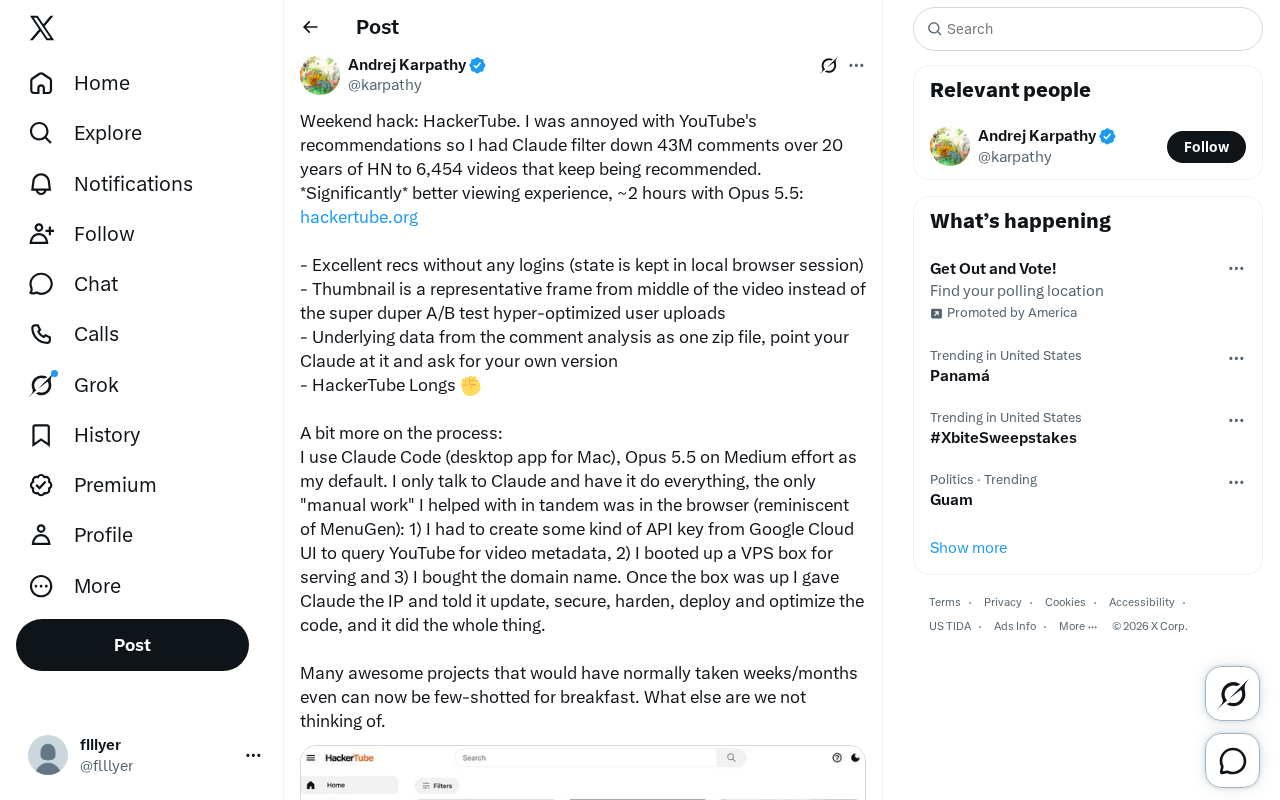
Developer uses Claude Code to analyze two decades of HN comments, building a no-login video recommendation site in two hours.
A developer used Claude Code (Opus 5.5, Medium effort) to analyze 43 million Hacker News comments from the past twenty years, filtering out community-recommended high-quality video links to curate a list of 6,454 videos, and built the recommendation site HackerTube over a weekend in roughly two hours. Humans only handled the Google Cloud API key, VPS setup, and domain purchase; Claude independently completed hardening, deployment, and optimization. Notable design choices: no-login recommendations based on community consensus stored locally, and thumbnails taken from mid-video frames instead of A/B-tested clickbait covers. The author released the data publicly, encouraging others to generate custom versions.
Tired of YouTube's increasingly absurd recommendation algorithm? One developer used Claude Code and two decades of Hacker News comment data to build a video recommendation site called HackerTube over a weekend — featuring only high-quality videos repeatedly recommended by the HN community, all in just two hours.
From 43M Comments to 6,454 Videos: A Data-Driven Recommendation Logic
The core idea behind HackerTube isn't complicated, but its execution demonstrates the power of "data remixing" in the age of large models: the developer treated the 43 million comments accumulated on Hacker News over the past 20 years as a raw ore deposit, having Claude sift out the video links that were "consistently recommended," ultimately producing a curated list of 6,454 videos.
According to the author's tweet, the entire process used the Claude Code desktop app with the Opus 5.5 model set to Medium effort. He handed the filtering task entirely to Claude, keeping only three browser operations that had to be done manually: creating an API key in the Google Cloud UI to query YouTube video metadata, spinning up a VPS to deploy the service, and purchasing a domain. Once the server was ready, he gave Claude the IP address and issued the instruction to "update, harden, deploy, and optimize the code" — and Claude independently completed everything that followed.
This division of labor — "humans build the stage, AI performs" — is a microcosm of how AI coding tools are evolving: developers shift from writing code line by line to describing intent and providing necessary resources, while the model takes over execution details.
Claude Code is an AI coding agent tool for the command line/desktop released by Anthropic. Unlike traditional code completion, it works as an "agent": it can autonomously read files, execute shell commands, modify codebases, run tests, and iterate based on errors until the user's described task is complete. The "Medium effort" setting mentioned in the article refers to the adjustable compute budget the model invests in reasoning — higher effort means longer reasoning chains, higher latency, and higher cost. Opus 5.5, as one of the stronger models at the time, combined with Claude Code's agent loop, is what makes the fully automated workflow — "harden, deploy, and optimize with just an IP and an instruction" — possible, and it's the technical precondition for the "humans build the stage, AI performs" division of labor to hold.
"No-Login Recommendations" and Reverse-Engineered Thumbnail Design
HackerTube makes two notable design choices in terms of user experience.
First, the recommendation system requires no login whatsoever. All state is stored in the local browser session, so users can start using it immediately — no account system, no tracking, no cross-site profiling. This directly sidesteps the "filter bubble" problem that plagues mainstream platform recommendation systems built on long-term user behavior modeling — HackerTube's recommendations are based not on "what you watched" but on "what the HN community has repeatedly endorsed."
Second, thumbnails are taken from a representative frame in the middle of the video, rather than a clickbait cover artfully A/B tested by the creator. The author states plainly in the tweet that the "hyper-optimized" user-uploaded thumbnails on YouTube are often decoupled from content quality, whereas HackerTube's approach returns the preview to the content itself.
Together, these two details point to one conclusion: when the recommendation logic shifts from "maximizing watch time" to "community consensus filtering," the viewing experience is noticeably different. The author's own assessment is that it's "clearly a better experience."
Filter bubbles refer to the phenomenon in which recommendation systems continuously reinforce users' existing preferences based on their historical behavior, keeping individuals exposed to homogeneous content and narrowing their horizons. Mainstream platforms find this hard to avoid because their optimization targets are watch time and engagement rate, which require long-term, cross-site user profiles for personalized modeling. HackerTube's "no-login" design cuts this chain off at the mechanism level: no account means no cross-session behavior accumulation, and the recommendation signal comes from the historical consensus of the HN community rather than individual clicks. This is a "community collaborative filtering" approach — using repeated group recommendations as a proxy for quality, at the cost of lower personalization and the possibility that niche but high-quality content gets diluted by consensus.
Thumbnail A/B testing is a common practice in the YouTube creator ecosystem: multiple cover versions are prepared for the same video, the platform splits traffic among different audiences to test click-through rates, and the best-performing one is retained. This mechanism selects for covers with high click-through but not necessarily high information value, creating clickbait-style inducement. HackerTube instead uses a frame from the middle of the video as the thumbnail, effectively switching the preview's information source from "creator marketing intent" to "the actual imagery of the content itself." Click-through rates may drop, but the correspondence with the content is more reliable — consistent with its overall positioning of "not pursuing maximum watch time."
Open Data and "HackerTube Longs": Letting Everyone Customize Their Own Version
HackerTube is not a closed product. The author has packaged the underlying comment-analysis data into a zip file and released it publicly, encouraging others to "throw the data at Claude and have it generate your own version." This means anyone can build a vertical video recommendation site for different topics or preferences based on the same HN comment corpus.
The mention of "HackerTube Longs ✊" at the end of the tweet hints at a recommendation direction for longer videos or in-depth content, though the original post doesn't elaborate on the details.
When a "Weekend Project" Becomes a "Breakfast Project"
The most striking part of this share isn't HackerTube itself, but the author's reflection on the development paradigm: "Many great projects that used to take weeks or even months can now be few-shot out as breakfast in a few hours. What else are we not thinking of?"
This points to a shift that's already underway: AI coding tools are lowering not just the barrier to coding, but the cost of the entire pipeline from idea to deployable product. API applications, server operations, security hardening, deployment optimization — tasks traditionally spread across different roles — can now be chained together by a single model under unified instructions. The bottleneck shifts from "can we build it" to "can we think of something worth building."
For content creators and indie developers, the HackerTube case offers a reusable template: find a community with high-quality historical data, have a model extract consensus signals from it, and package the result into a lightweight application. Beyond HN, Reddit, specific forums, and mailing lists could all be the raw material for the next batch of "HackerTubes."
Few-shot originally refers to providing a small number of examples in a large model prompt to guide the output; the author uses it here metaphorically: work that used to take weeks can now be "generated" as a finished product with just a few instruction interactions. Behind this phrasing is the fact that AI coding agents bring tasks previously scattered across multiple roles — cloud resource provisioning, server hardening, deployment, and performance tuning — into a single context for unified orchestration, drastically compressing the cost of the pipeline from idea to deployable product. Notably, this model still relies on humans to provide key external resources and authorizations (API keys, VPS, domain), and on humans to make final judgments about the output — so the bottleneck shifts from "implementation capability" to "problem selection and acceptance."
One-line Summary
Developer uses Claude Code to analyze two decades of HN comments, builds a no-login video recommendation site in two hours.
Paragraph Summary
A developer used Claude Code (Opus 5.5, Medium effort setting) to have the model analyze 43 million comments accumulated on Hacker News over the past twenty years, filtering out high-quality video links consistently recommended by the community to produce a curated list of 6,454 videos, and built the video recommendation site HackerTube over a weekend in about two hours. Humans only handled requesting the Google Cloud API key, spinning up the VPS, and purchasing the domain; once the server was ready, hardening, deployment, and optimization were all completed independently by Claude. The product has two notable design features: recommendations require no login, with state stored in the local browser session and based on community consensus rather than personal behavior; and thumbnails come from the middle of videos rather than A/B-tested clickbait covers. The author also released the analysis data publicly, encouraging others to use Claude to generate customized versions, and remarked that many projects that used to take weeks can now be completed in a few hours.
Related articles

Qwen 3.8 Beats Opus at Coding—But Can Your Mac Run It?
Open-source Qwen 3.8 beats Opus 4.6 at coding at just 18GB, but how much Mac memory do you need? 24GB crashes; 32GB is the sweet spot. Full config guide inside.

Claude Code + Agent: Building a Fully Automated AI Testing Loop
Bilibili course breakdown: how test developers can use Claude Code terminal-based Agents to build a fully automated AI testing loop. Compares permission boundaries of terminal vs. device Agents, explains why enterprise projects choose Claude Code over Open Claude-type tools, and outlines the Node.js environment setup and DeepSeek model integration path.

Working with AI Agents Requires Nerves of Steel
The more autonomous AI agents become, the heavier the user's psychological burden. Drawing from a Hacker News discussion, this article analyzes black-box anxiety, behavior drift, and monitoring fatigue in agent collaboration, and offers practical approaches like sandbox isolation, permission control, and task granularity management to reduce cognitive load.