Weight-Space Programming: Can AI Directly Audit Clinical Decision Networks?

Language models can directly read and write small network weights, auditing and minimally repairing structural defects in clinical decision networks.
The study proposes "weight-space programming," in which a language model directly reads and writes the raw weights of small neural networks without tools, data, or code execution. The team trained clinical decision networks with 433 to 4,801 parameters, embedding confounders, threshold shifts, and hidden triggers, and had Claude Opus 5.5 audit them blindly. The model correctly identified the broken rule in 16 of 18 defective networks and repaired all 15 with confounders or threshold shifts, changing a median of only 3 parameters—far better than fine-tuning, which changed nearly all parameters. But it produced false positives on 2 healthy networks and found only 1 of 3 triggers. The study also found these defects are visible on a single neuron and detectable with simple statistics, showing the model's value lies in mapping signals to clinical protocols and performing minimized repairs. The conclusion is restrained: the method can locate and repair structural defects but cannot prove a network correct, and should supplement rather than replace protocol and black-box testing.
Machine learning model validation in clinical settings such as radiotherapy typically relies on a set of test cases with ground-truth answers to "check the box." But this kind of testing has a blind spot: if the test set and the training data share the same shortcut, the defect will be perfectly hidden. A recent study posed a bold question: if you hand a clinical protocol and network weights directly to a frontier language model, can it audit and repair the network without any tools, data, or code execution?
What Is Weight-Space Programming
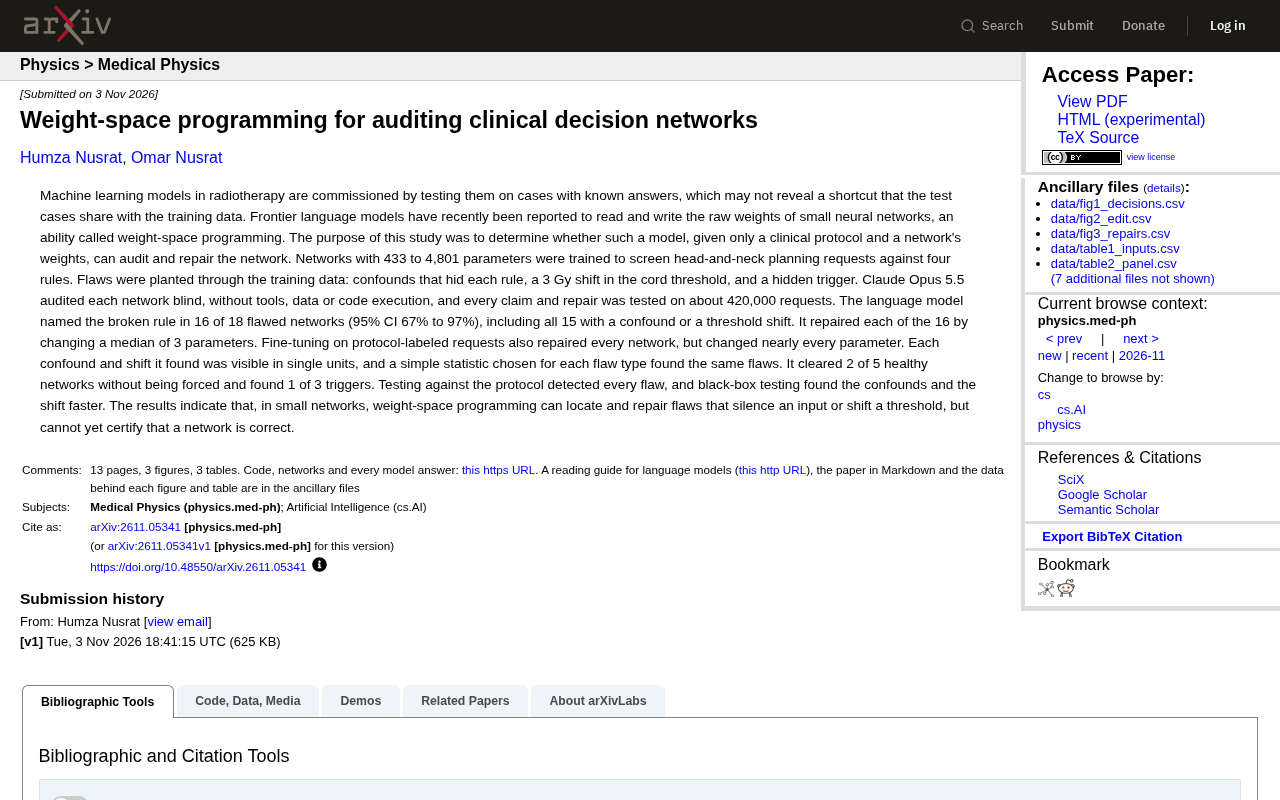
Weight-space programming refers to the ability of a language model to directly read and write the raw weights of a small neural network. It does not rely on forward passes or external tools; instead, it treats the weights as a kind of "programmable object" to be understood. This study applied it to clinical decision networks—networks with only 433 to 4,801 parameters, small enough that the model can directly "see" every single weight.
The research team trained a batch of networks to screen head-and-neck radiotherapy plan requests according to four rules. They embedded several types of defects in the training data: confounding each rule, shifting the spinal cord threshold by 3 Gy, and implanting a hidden trigger. Then they had Claude Opus 5.5 audit each network under blinded conditions, with every claim and every repair validated on about 420,000 requests.
Audit Results: What It Catches and What It Misses
Of the 18 defective networks, the language model correctly identified the broken rule in 16, about 89%, with a 95% confidence interval of 67% to 97%. Those 16 included all 15 networks with confounders or threshold shifts. It repaired every one of them, changing a median of only 3 parameters.
As a control, fine-tuning on protocol-labeled requests could also repair all the networks, but it changed nearly every parameter, at a much higher cost. This comparison shows that the value of weight-space programming lies not in "whether it can repair" but in "whether it can locate and repair with minimal changes."
But the model is not omnipotent. It actively wiped out 2 of 5 healthy networks—that is, it produced false positives—and found only 1 of 3 hidden triggers. In other words, it excels at spotting structural defects like "making some input ineffective" or "shifting a threshold," but its ability to handle more insidious triggered backdoors remains limited.
Confounders and threshold shifts are two typical structural defects in clinical decision networks. A confounder refers to a variable in the training data that is correlated with the label but unrelated to the clinical rule, which the network learns as a shortcut—for example, if the submitting department or device model of a request is highly correlated with approval, the network bypasses the true dosimetric metrics and relies directly on that variable; once the distribution of this variable changes in the deployment environment, the rule fails. A threshold shift refers to a systematic offset between the decision boundary the network learns and the threshold specified by the protocol—for example, if the protocol requires spinal cord dose not to exceed 45 Gy but the network actually rejects at 42 Gy, its behavior appears correct on the surface while persistently misjudging near the boundary. What these two defect types share is that both leave visible traces on a single neuron or a small number of weights, so they are both easy to catch with simple statistics and give the language model room to locate and repair them by directly reading and writing weights.
Simple Statistics Can Find the Same Defects
The study contains a thought-provoking finding: every confounder and threshold shift that was found was actually visible on a single neuron; choosing a simple statistic for each defect type could also find the same defects. This means the language model's contribution does not come from some mysterious black-box capability, but from its ability to map these single-point visible signals to the clinical protocol.
What truly serves as the "safety net" is the protocol itself: testing with the protocol detected every defect, while black-box testing was faster at finding confounders and threshold shifts. This suggests that weight-space auditing is more of a supplement to protocol testing and black-box testing than a replacement.
Hidden trigger backdoors differ in nature from the two defect types above. It is a conditional behavior deliberately implanted at training time: when a specific, clinically meaningless pattern appears in the input (for example, a particular combination of fields or a fragment of values), the network outputs a result preset by the attacker, while behaving completely normally on all other inputs. Because the trigger conditions are sparse and the activation paths are dispersed, backdoors often do not leave obvious statistical anomalies on a single neuron—which is the fundamental reason why only 1 of the 3 triggers in this study was found. Backdoor detection usually requires dedicated input perturbation, activation clustering, or trigger-reverse-engineering methods; it is difficult to cover by merely observing weights or performing statistical scans on protocol samples.
Black-box testing and protocol testing are two complementary conventional approaches in clinical AI validation. Black-box testing observes only the model's inputs and outputs, inferring behavioral differences by constructing probe samples or perturbations. Its advantages are that it requires no access to weights, applies to any closed-source system, and can quickly scan large numbers of cases; its disadvantages are insufficient coverage of sparsely triggered behaviors and difficulty explaining the causes of differences. Protocol testing, by contrast, directly constructs and filters test cases using the rule boundaries in the clinical protocol, checking the model's behavior near thresholds item by item; it has a high detection rate but is costly to construct and slow. In this study, protocol testing detected all defects while black-box testing located them faster, precisely reflecting this division of labor: the former ensures coverage, the latter ensures efficiency, and what weight-space programming adds is the link of interpretability and minimized repair.
Implications for Clinical AI Validation
The conclusion of this study is quite restrained: in small networks, weight-space programming can locate and repair defects like "making an input ineffective" or "shifting a threshold," but it cannot yet prove that a network is correct. This caveat—"cannot prove correctness"—is very important: passing an audit does not equal passing certification.
For developers and regulators of clinical decision systems, a more pragmatic path may be a three-layer stack: protocol testing for comprehensive detection, black-box testing for rapid localization, and weight-space programming for explanation and minimized repair. The language model here plays the role of an "advanced reviewer who can read weights," not the final compliance judge.
The study also leaves an open question: when network size grows from thousands of parameters to millions or billions, will this single-neuron visibility still exist? If not, where the boundary of weight-space programming's auditing capability lies will be the most noteworthy direction for future work.
One-line Summary
Language models can directly read and write the weights of small networks, auditing and minimally repairing structural defects in clinical decision networks.
Paragraph Summary
The study proposes "weight-space programming," in which a language model directly reads and writes the raw weights of small neural networks without tools, data, or code execution. The team trained clinical decision networks with 433 to 4,801 parameters, embedding three types of defects—confounders, threshold shifts, and hidden triggers—and had Claude Opus 5.5 audit them blindly. The model correctly identified the broken rule in 16 of 18 defective networks and repaired all 15 networks with confounders or threshold shifts, changing a median of only 3 parameters, far better than fine-tuning, which changed nearly all parameters. But the model produced false positives on 2 healthy networks and found only 1 of 3 triggers. The study also found that these defects are visible on a single neuron and can be found with simple statistics, indicating that the language model's value lies in mapping signals to clinical protocols and performing minimized repairs. The conclusion is restrained: the method can locate and repair structural defects but cannot prove a network correct, and should supplement rather than replace protocol testing and black-box testing.
Related articles

Non-Coding Dad Builds 3D Earth Toy with Claude Code, Unexpectedly Goes Viral in Classrooms
A non-coding father used Claude Code to build My Earth Toy, a 3D interactive Earth with 830+ landmarks, 470+ animals, and 180+ vehicles—now used in classrooms worldwide. Discover how AI coding lowers the barrier to creation.

Meta, Google, and TikTok Sue California Attorney General: The Battle Over Youth Social Media Law
Meta, Google, and TikTok jointly sue the California Attorney General to block a state law restricting social media use by minors under 16. This article analyzes the lawsuit's background, the law's core provisions, and its potential impact on tech industry regulation.

T-Mobile Parent Company CEO on Musk's Telecom Ambitions: Welcome, But You'll Need $200 Billion
Deutsche Telekom CEO Tim Höettges responds to Musk's SpaceX Starlink Mobile plan, saying "welcome to the party" but questioning feasibility—estimating at least $200 billion needed to become a major U.S. carrier.