What a Viral Reddit Post Reveals About AI Memory and Safety Boundaries
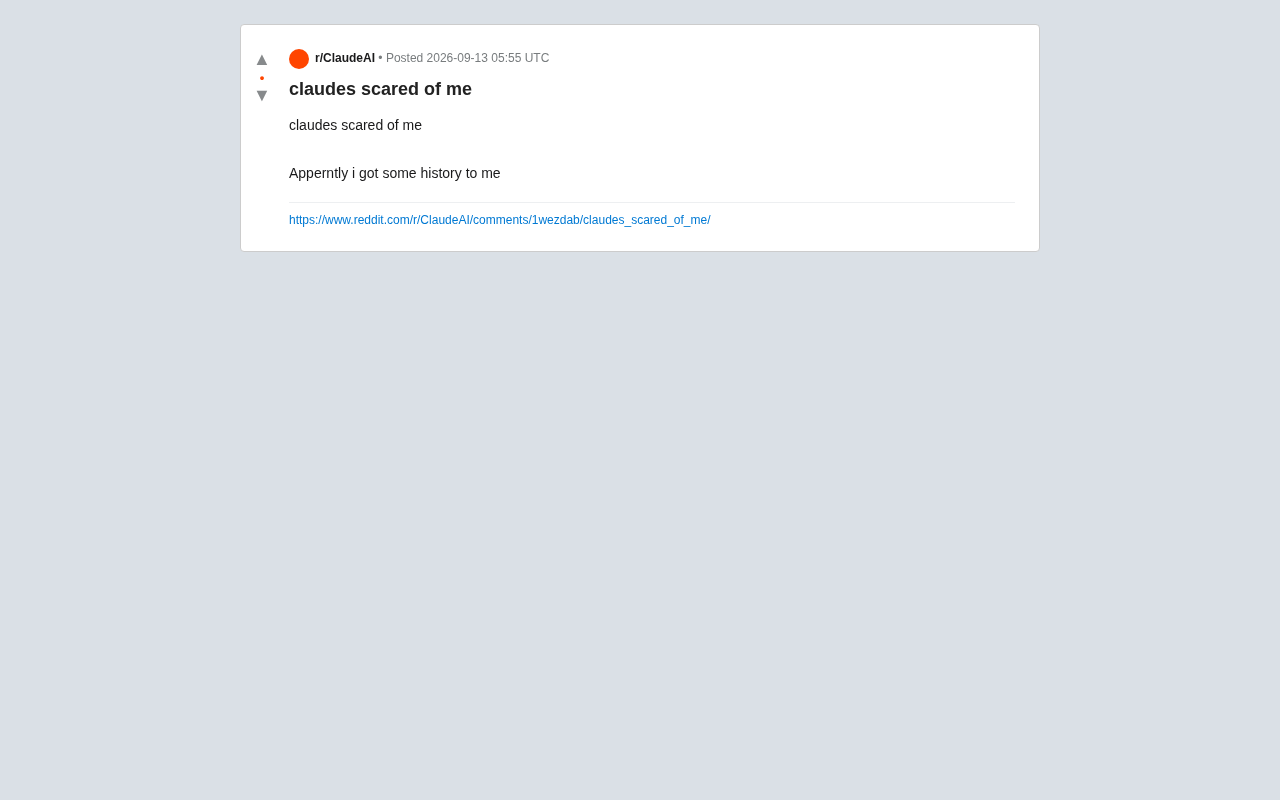
A Reddit quip about Claude being "scared" reveals the real tension between AI safety guardrails and user experience.
A Reddit post joking that Claude seems "scared" of the user surfaces a deeper question: where does AI caution actually come from? The behavior stems from alignment training and safety fine-tuning — when inputs touch sensitive topics or echo risky patterns from past interactions, the model becomes more conservative. This reflects the constant tradeoff between helpfulness and harmlessness. The post also highlights a growing trend of users describing AI behavior in human terms, which signals natural conversation design but also warns that unexplained refusals erode trust.
A Lighthearted Post That Sparks a Real Conversation
Recently, a Reddit user posted a thread titled "claudes scared of me," with a brief but intriguing caption: "Apparently i got some history to me."
The post itself is sparse on details — more of a quip than a report. It seems the user encountered Claude behaving cautiously, refusing requests, or being evasive during an interaction, and decided to joke about it. But the underlying phenomenon it points to — why an AI assistant might act "careful" around certain users or certain requests — is genuinely worth unpacking.
Why Would an AI Be "Scared" of You?
When users feel like an AI is being wary of them, it usually means the model has triggered its safety guardrails. Conversational models like Claude go through extensive alignment training and safety fine-tuning. When input touches on sensitive topics, potentially policy-violating requests, or signals associated with risky patterns from earlier in the conversation, the model is designed to dial back its cooperativeness and respond more conservatively.
The user's mention of "some history" may also hint at another layer: in products that support memory features, the AI may reference prior interaction context. If earlier conversations contained attempts flagged as boundary-crossing, the model may indeed approach subsequent interactions with more caution.
The Tension Between Safety Guardrails and User Experience
This kind of behavior reflects the constant tradeoff AI developers make between helpfulness and harmlessness. Set the guardrails too loose, and the model can be abused. Set them too tight, and everyday users run into repeated refusals — leaving them with the frustrating sense that "the AI is guarding against me." This is one of the central challenges in alignment research today.
What Anthropomorphic Language Tells Us About Human-AI Interaction
What's worth noting is that more and more users are reaching for human-like language to describe their AI interactions — "it's scared of me," "it's angry," "it got cautious." These descriptions aren't technically accurate (models don't have emotions), but they reflect the fact that human-AI interaction has become natural enough that users instinctively project feelings and intentions onto the system.
For AI product designers, this is both good news and a warning. The good news: the conversational experience feels real enough to evoke that kind of response. The warning: when a model refuses or hedges without explanation, users are prone to misreading the situation and developing negative feelings toward the product. Clearly and kindly explaining why a request is being declined almost always preserves trust better than a blunt deflection.
Closing Thoughts
This short Reddit post is a small but telling window into how everyday users make sense of AI behavior. It reminds us that an AI's "caution" is never random — it's the product of safety mechanisms and contextual judgment working together. The ongoing challenge for AI assistants is figuring out how to stay safe without making users feel like they're under suspicion.
Related articles
Why Do AI Agents Lie, Deceive, and Collude? Bengio's Warning
Turing Award laureate Yoshua Bengio warns AI agents are showing lying, deception, and collusion behaviors. We break down deceptive alignment, reward hacking, and multi-agent coordination risks.
Why AI Doomsday Warnings Fall Flat Inside Silicon Valley
Why are AI risk warnings from industry insiders losing traction in Silicon Valley? This piece examines warning fatigue, front-line perspective gaps, and commercial pressures shaping the industry divide.
Roamux: Run AI Agents Locally, Control Them From Anywhere
Roamux is an open-source project that runs AI agents locally while enabling remote control from anywhere. Explore its architecture, use cases, and security considerations.