What Are Agent Skills? Understanding the Core Components of AI Agent Skills

Agent Skills extend AI Agents via a lightweight SKILL.md format, with name and description as the essential metadata fields.
Agent Skills are a lightweight, open format for extending AI Agent capabilities with modular knowledge and workflows. Their core carrier is the SKILL.md file, which requires at minimum two metadata fields: name and description. The description field is especially critical because underlying LLMs — such as DeepSeek, GPT, and Doubao — rely on it to determine what a skill does and when to invoke it. This mirrors the Tool definition pattern in Function Calling, where clear, accurate descriptions are a prerequisite for correct model-driven capability orchestration.
What Are Agent Skills
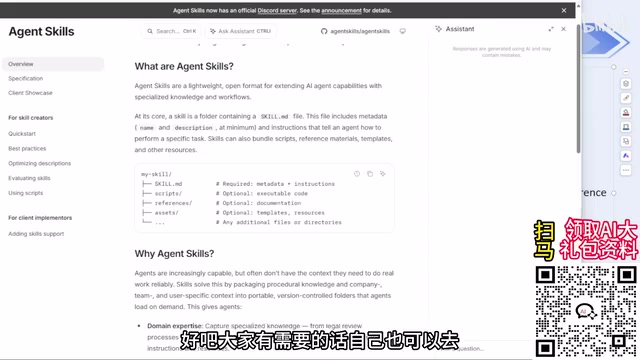
Many developers new to agent development have misconceptions about what Agent Skills actually are. The most direct way to understand them is to look at the official definition on the Agent Skills website.
According to the official documentation, Agent Skills are a lightweight, open-ended format for extending AI Agent capabilities with specialized knowledge and workflows. In other words, Skills are essentially "add-on modules" for your Agent — enabling it to iteratively develop the capabilities needed for a specific project, ultimately handling an entire business development workflow.
The official site is in English, but the descriptions are fairly straightforward. If you have trouble reading it, tools like translation extensions can help — just select the text and translate it on the spot.
The Core Components of a Skill
So what exactly does a Skill consist of? The official documentation clearly outlines its core structure.
At the center is a skill.md file (i.e., SKILL.md), which carries the Skill's metadata. Within that metadata, at minimum two fields are required:
- name: the name of the skill
- description: a description of the skill
In other words, whether you're creating a custom Skill or exploring an existing one online, you should always be able to find these two components: name and description. The name is self-explanatory, and the description explains what the skill does.
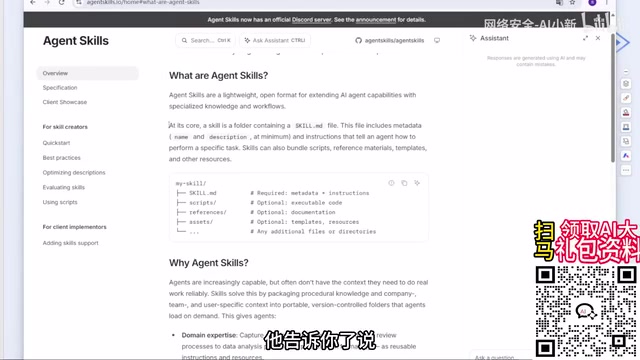
This structure looks simple, but it's precisely this "lightweight + open" design that gives Skills strong reusability and extensibility. Think of them as modular building blocks for Agent capabilities.
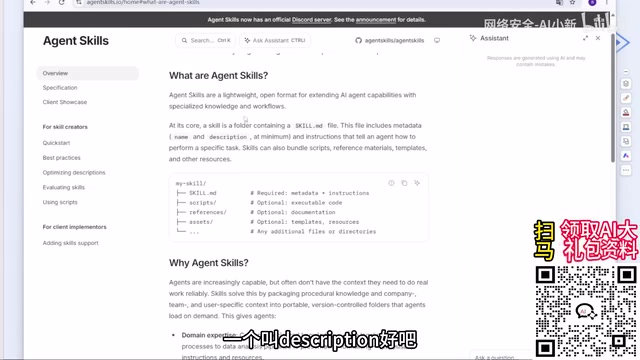
Metadata refers to data that describes the properties of other data. In software engineering, it's widely used to declare a module's identity, version, dependencies, and more. The metadata in SKILL.md functions like an "ID card" for a skill: when an Agent needs to load a particular skill at runtime, the system first reads the metadata to identify what the skill is and what it can do, then decides whether and how to invoke it. This "declare first, invoke later" design pattern is a standard practice in plugin systems and package managers (such as npm and PyPI), enabling skills to be independently distributed and reused across different projects and environments.
Why description Matters So Much
You might wonder: it's just a description field — why does the official documentation place such emphasis on it? The answer ties back to a concept common in LLM development: Tools.
If you've done any LLM development, especially around Function Calling, you've likely defined something called a Tool. A Tool is essentially a function or method. When we define a tool, we typically attach a descriptor to it — and that descriptor also requires a name and a description.
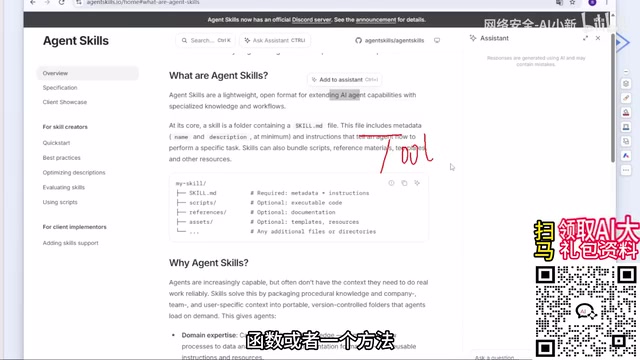
In the LLM world, description is critically important. Here's why: all LLM development today — including every tool used by various Agents — fundamentally relies on the underlying model's ability to understand natural language, whether that model is DeepSeekAd, Kimi, Doubao, GPT, or any other.
The LLM reads the description to determine what a given skill or tool "is for" and "when it should be called." The clarity and accuracy of that description directly determines whether the model can invoke the right capability at the right moment. This is why description is a mandatory field in both Skills and Tool definitions — it's simply non-negotiable.
Function Calling is the core mechanism through which LLMs collaborate with external tools. Developers define a set of tool functions in advance and attach structured descriptions to them. During inference, the model automatically determines — based on user intent — whether a tool needs to be called, which tool to call, and how to pass in the parameters. This mechanism transforms LLMs from "text generators" into "action executors," and is one of the foundational capabilities behind Agent systems. Because the model's invocation decisions rely entirely on the natural language in the description, the quality of that description directly impacts call accuracy. Vague or ambiguous descriptions can cause the model to trigger the wrong tool — or fail to trigger one at all when it should.
Summary
The design philosophy behind Agent Skills is to use a lightweight, open format to extend the capability boundaries of an Agent. The core carrier is the SKILL.md file, and the two most fundamental metadata fields are name and description. The reason description is so critical is that LLMs depend on it to understand and orchestrate skills. Once you grasp this underlying logic, you'll be well-equipped to confidently create custom Skills or reuse existing ones.
Related articles

Is the Agent Harness Dead? Cursor's Early Engineer Breaks Down the Real Architecture of AI Coding Agents
Cursor early engineer Jediah breaks down the real architecture of the agent harness: why "the harness is dead" is only half right, how the data flywheel lets the harness obsolete itself, and how Grokbot, software factories, and primitive design open new frontiers for agents.

Python Visitor Pattern and Better Alternatives Explained
A deep dive into Python's visitor pattern and four alternatives: method pattern, pattern matching, dictionary mapping, and functools.singledispatch. Choose the best decoupling design by change frequency.

357 Days of Deep Experience: Why Omarchy Made Me Stop Distro-Hopping
A 357-day deep dive into Omarchy: 59-second install, out-of-the-box audio and GPU support, the Quattro QuickShell rewrite migration pains, and why Arch users should try it.