What Are Claude Code Mods? A Deep Dive into Anthropic's New Extension Mechanism

Anthropic's Claude Code Mods lets developers modify the agent from the inside, not just build around it.
Anthropic has introduced Mods for Claude Code, an architectural upgrade to its extension system. Unlike skills, hooks, and MCP servers — which all operate outside Claude Code as external plug-ins — Mods live inside Claude Code and persist for the entire session lifecycle, giving them direct control over the agent harness. Compared to stateless, one-shot hook scripts, Mods can maintain state across turns, display live dashboards, and proactively pause before high-risk operations. This marks a shift from Claude Code as an "extensible tool" to a "deeply customizable platform."
Anthropic has introduced a new Mods mechanism for Claude Code — the first time the company has truly "opened up" the Claude Code core to developers. Unlike previous extension approaches such as skills, hooks, and MCP servers, Mods run directly inside Claude Code, enabling deep intervention in the agent's behavioral logic. For the first time, developers have the ability to change the tool itself, rather than simply building around it.
How Mods Differ from Previous Extension Approaches
Before Mods, Claude Code's extensibility relied primarily on three types of components: skills, hooks, and MCP servers (Model Context Protocol servers). These components share one defining characteristic — they all exist outside of Claude Code, and are invoked by Claude Code on demand.
In other words, the previous extension model was "plug-in" style: you could add peripheral capabilities to Claude Code, but you couldn't touch its core execution logic. Mods fundamentally changes this. It lives inside Claude Code, with direct control over the behavior of the agent harness.
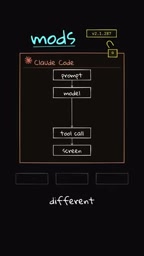
The most immediate consequence of this architectural difference: Mods can intercept Claude Code just before it executes an action, modify that action, or even prevent it entirely. This is something plug-in-style components could never do.
MCP (Model Context Protocol) is an open standard from Anthropic designed to let AI assistants communicate in a standardized way with external data sources, tools, and services. MCP servers run as independent processes, and Claude Code makes requests to them via a protocol interface to gain additional capabilities — such as reading from a database, calling an external API, or performing domain-specific computation. Skills are similar to predefined capability packages that tell Claude Code "what it can do," while hooks are event-triggered scripts that execute when specific operations occur. Together, these three formed Claude Code's extension ecosystem before Mods arrived. Architecturally, they all follow the same logic: Claude Code is the caller, and the extension components are the callees — control flow always remained in Claude Code's hands.
Why Mods Are More Powerful Than Hooks
A natural first reaction from many developers might be: we already have hooks — can't those also intercept behavior? Why does Mods deserve its own spotlight?
The key difference lies in lifecycle and state persistence. A hook is essentially a shell script: it triggers once in response to an event, runs, returns a result, and then exits — stateless and one-shot.
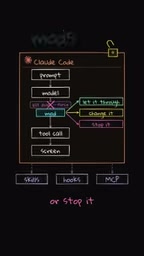
Mods work completely differently. A Mod is loaded once at the start of a session and then remains running for the entire duration of that session. This seemingly simple distinction unlocks an entirely new class of possibilities.
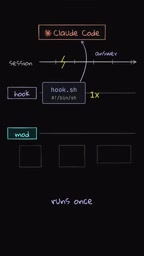
Because Mods run persistently, they can:
- Maintain state: retain context and data across multiple interaction turns, rather than starting fresh each time
- Provide a live dashboard: display an information panel that updates in real time with every exchange
- Pause and ask: stop before executing a command and prompt you for confirmation
At its core, this transforms Claude Code from a tool that "passively responds to events" into a platform that can be continuously and deeply customized by a resident Mod.
The agent harness refers to the orchestration layer that drives an AI agent through multi-step tasks — managing the loop between model invocations, tool execution, result parsing, and next-step decision-making. In Claude Code's architecture, the harness determines "when to call which tool," "how to handle tool results," and "when to report progress to the user." Previous extension components could only attach to the harness as peripheral "tools" to be called. Mods, by contrast, can directly intervene in the harness's execution loop itself — inserting custom logic at the critical decision points where the agent chooses its next action, rather than merely reacting after the fact.
What "Changing the Tool Itself" Really Means
The significance of Mods can be summed up in one line: the same core engine, combined with different Mods.
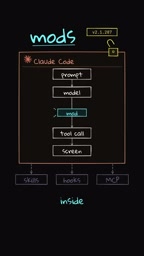
What you could do before was "add things around it"; now, you can "change the thing itself." This is a qualitative leap from extension to customization.
For teams looking to deeply customize their AI coding workflows, this means they can reshape the behavioral boundaries of the agent according to their own needs — for example, enforcing human approval gates for high-risk operations, injecting persistent contextual memory for specific projects, or building dedicated real-time monitoring views. These were previously either impossible or could only be cobbled together with brittle scripts.
How to Make Sense of This Update
The launch of Mods marks a significant shift in Anthropic's openness strategy for Claude Code. Moving from "letting you build an ecosystem around the tool" to "letting you intervene inside the tool" represents a fundamental increase in control granularity.
Of course, greater control also means greater responsibility — components capable of intercepting and modifying agent behavior naturally carry a larger blast radius. For developers, Mods represent both an opportunity and a design challenge that demands more careful thinking. As this mechanism is gradually adopted by the community, the customization ecosystem around Claude Code may well be poised for a new wave of growth.
Related articles

Anthropic IPO Countdown: The Compute Cost Ledger Behind a $2 Trillion Valuation
Anthropic's IPO targets up to $2 trillion — double its Series H valuation. We break down the timeline, compute cost logic, and the key question investor day must answer.

Anthropic IPO Prospectus Revealed: Behind 12x Revenue Growth, the Twin Tests of Compute Costs and Customer Concentration
Anthropic filed its IPO prospectus: 2025 revenue up 12x to $4.6B, net loss $42B including $34B non-cash. Breaking down compute costs, $2T valuation logic, customer concentration risks, and founder control.

Xteink X4 Pro Review: A Mini E-Reader That Fits in Your Pocket, Now More Affordable
Xteink X4 Pro is a 4.26-inch mini e-reader, smaller and thinner than a 6-inch Kindle, magnetically attachable to phones, and cheaper than ever. We analyze its screen, design, use cases, and value.