What 'Celery Man' Tells Us About AI: How a 2011 Comedy Predicted Today's Human-Machine Interaction
How a 2011 Paul Rudd comedy sketch accidentally predicted the age of LLM-powered natural language interfaces.
A 2011 comedy sketch called Celery Man has resurfaced on Reddit, with users marveling at how accurately it predicted today's natural language AI interaction. One user tested it by asking Claude to "load up Celery Man" — and Claude reproduced the sketch nearly word for word. This sparked the classic "stochastic parrot" debate: is that responsiveness genuine understanding or statistical pattern-matching? The discussion reflects a fundamental shift in human-computer interaction, from precise commands to expressed intent, and closes with a reminder that fluent outputs can mislead us into overestimating AI comprehension.
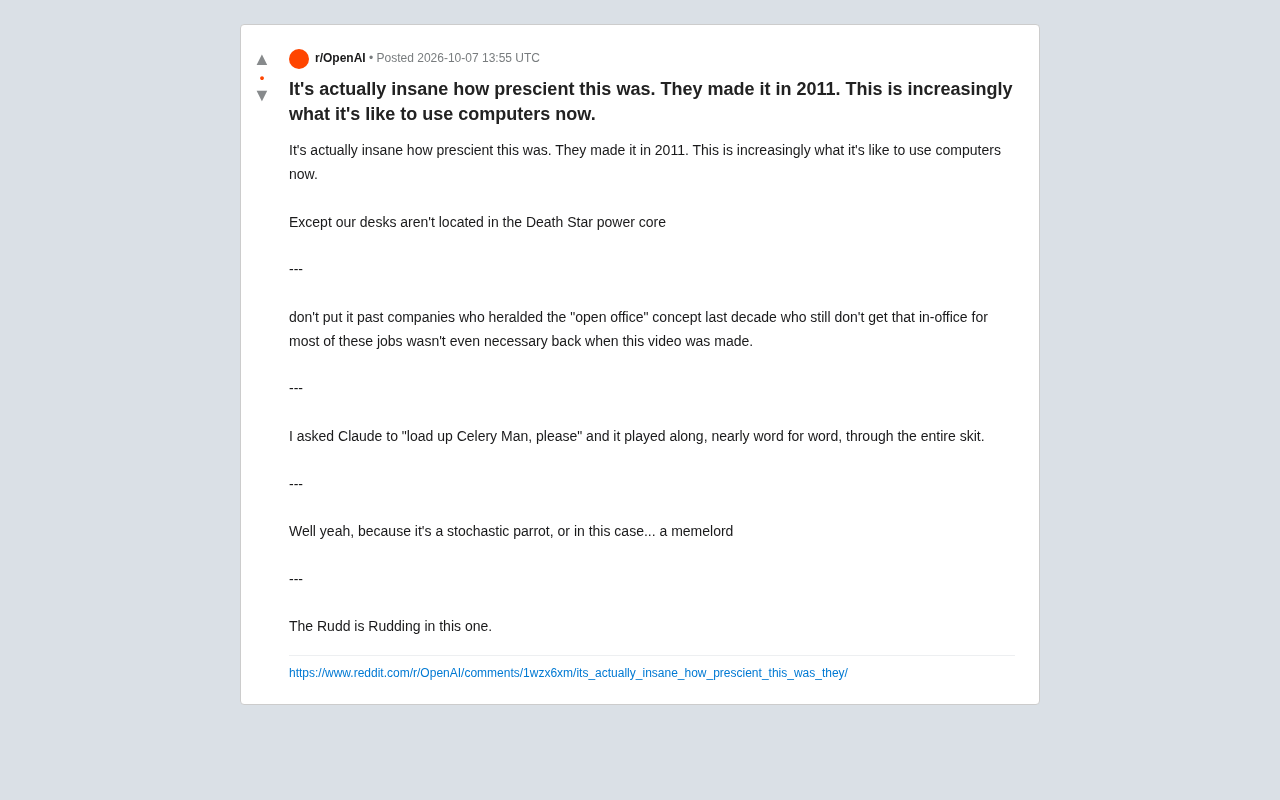
A 2011 comedy sketch called Celery Man has recently sparked a lively discussion on Reddit about how we interact with AI. Users were struck by the realization that what was originally played for laughs had turned out to be a remarkably accurate preview of how we use computers today — issuing natural language commands, having the machine retrieve content, generate visuals, and respond in real time.
Why a Comedy Sketch Is Being Called "Prophetic"
Celery Man features comedian Paul Rudd in a web series. In the sketch, a character sits at a desk and controls his computer using casual, conversational commands, prompting the system to play a series of absurd virtual characters and animations. At the time, it read as a zany exaggeration of future technology.
But as the original poster put it: "It's honestly hard to believe how ahead of its time this was, made in 2011. This is becoming more and more like how we actually use computers now." The only difference, as one commenter quipped, is that "our desks aren't inside the energy core of the Death Star."

The resonance isn't coincidental. The core interaction pattern in the sketch — issuing vague, casual, even joke-inflected commands in natural language, with the system interpreting intent and acting on it — is precisely the experience that large language models (LLMs) deliver today. What was a punchline fifteen years ago has become part of everyday life.
When Claude Actually "Plays Along"
The most dramatic comment in the discussion came from someone who put it to the test: "I asked Claude to 'load up Celery Man' and it acted out basically the whole sketch almost word for word."
This detail perfectly illustrates the sketch's "prophecy": when a user issues a command that started as a comedy bit, a modern AI can not only grasp the context but draw on relevant content from its training data to perform a kind of reenactment. The intuitive human-machine rapport that the sketch imagined has now been replicated by a real model.
Is This Intelligence, or a "Stochastic Parrot"?
Predictably, this sparked a classic community debate. One commenter was quick to push back: "Yeah, because it's a stochastic parrot — or in this context… a memelord."
The "stochastic parrot" is a critical metaphor for LLMs, suggesting that models don't truly understand content but instead recombine text from their training data based on statistical patterns. Claude's ability to reproduce the sketch word for word stems from the fact that the script almost certainly exists in its training corpus — it's closer to high-fidelity content retrieval and recombination than to creative comprehension.
This small exchange encapsulates one of the central debates about AI capability: does the "intuition" and "responsiveness" a model displays reflect some emerging form of understanding, or is it merely a probabilistic mapping of an enormous dataset?
The term "stochastic parrot" originates from the 2021 paper On the Dangers of Stochastic Parrots: Can Language Models Be Too Big? by Emily Bender and colleagues. The paper compared LLMs to a parrot capable of stitching together language fragments with remarkable fluency — producing statistically plausible outputs while remaining entirely unaware of the meaning, causality, or real-world referents behind the words. Its core critique: models learn which words tend to appear together, not why those words are meaningful. The paper caused significant controversy in AI research circles. Google subsequently asked the authors to retract it, citing violations of publication policy, which ultimately led to the departure of co-author Timnit Gebru — turning an academic debate into a highly publicized corporate governance incident. Understanding this background helps clarify whether "stochastic parrot," when invoked in community discussions, is a precise technical critique or has become a generalized expression of skepticism.
The Real Shift Behind the Prophecy
Setting aside the philosophy of AI, this discussion points to a concrete and practical transformation: the paradigm of human-computer interaction is shifting from precise commands to expressing intent.
In traditional computing, users had to issue instructions in exact syntax that machines could parse — clicking specific buttons, entering accurate commands, following fixed workflows. In LLM-driven interaction, users can express their needs vaguely, conversationally, even through cultural references, leaving the model to infer intent and act on it.
The effortless "say it and the machine just gets it" dynamic in Celery Man is an exaggerated version of exactly this new paradigm. The sketch's "prophecy" holds not because its creators foresaw a specific technological trajectory, but because they captured something fundamental about what humans ultimately want from computers — to use a machine the way you'd talk to another person.
The shift from precise commands to expressed intent maps onto the technical evolution from command-line interfaces (CLI) to graphical user interfaces (GUI) to natural language interfaces (NLI). CLIs require users to memorize exact syntax; GUIs lowered the learning curve through visual metaphors, but operations still depended on predefined buttons and menu structures. The core breakthrough of NLI is transferring the cognitive burden of how to express a need from the user to the model. That transfer isn't without cost: the predictability of precise commands gives way to the ambiguity of natural language, and deterministic outputs become probabilistic generation — requiring users to build an entirely new mental model for when to trust and when to verify. Part of what made Celery Man feel absurd in 2011 was precisely that the idea of "letting the machine handle ambiguity" still belonged to the realm of science fiction.
A Note of Sobriety
For all the excitement of the analogy, a clear-eyed perspective is warranted. The sketch is a comedy — it amplifies the smoothness and magic of interaction while omitting all the friction that comes with reality: models make mistakes, hallucinate, and can fail entirely when they lack relevant training data. Claude can reproduce Celery Man precisely because it's well-known enough to be well-represented in the training corpus. Try a more obscure prompt, and the results could be very different.
This echoes the "stochastic parrot" camp's caution: we are easily seduced by fluent output into believing the machine understands. The more important question isn't whether AI can flawlessly reproduce a comedy sketch — it's how humans can develop an accurate mental model of a tool's capabilities and its limits, even as its interface grows ever more natural.
A joke from fifteen years ago has become a footnote to reality. And reality, as always, is more complicated than the punchline.
Related articles

Anthropic IPO Countdown: The Compute Cost Ledger Behind a $2 Trillion Valuation
Anthropic's IPO targets up to $2 trillion — double its Series H valuation. We break down the timeline, compute cost logic, and the key question investor day must answer.

Anthropic IPO Prospectus Revealed: Behind 12x Revenue Growth, the Twin Tests of Compute Costs and Customer Concentration
Anthropic filed its IPO prospectus: 2025 revenue up 12x to $4.6B, net loss $42B including $34B non-cash. Breaking down compute costs, $2T valuation logic, customer concentration risks, and founder control.

Xteink X4 Pro Review: A Mini E-Reader That Fits in Your Pocket, Now More Affordable
Xteink X4 Pro is a 4.26-inch mini e-reader, smaller and thinner than a 6-inch Kindle, magnetically attachable to phones, and cheaper than ever. We analyze its screen, design, use cases, and value.