What Does MoE Routing Control? Causal Interventions on Expert Trajectories Reveal Divergent Fates for Format and Concept

Causal interventions reveal that MoE routing can control format but struggles to control concept.
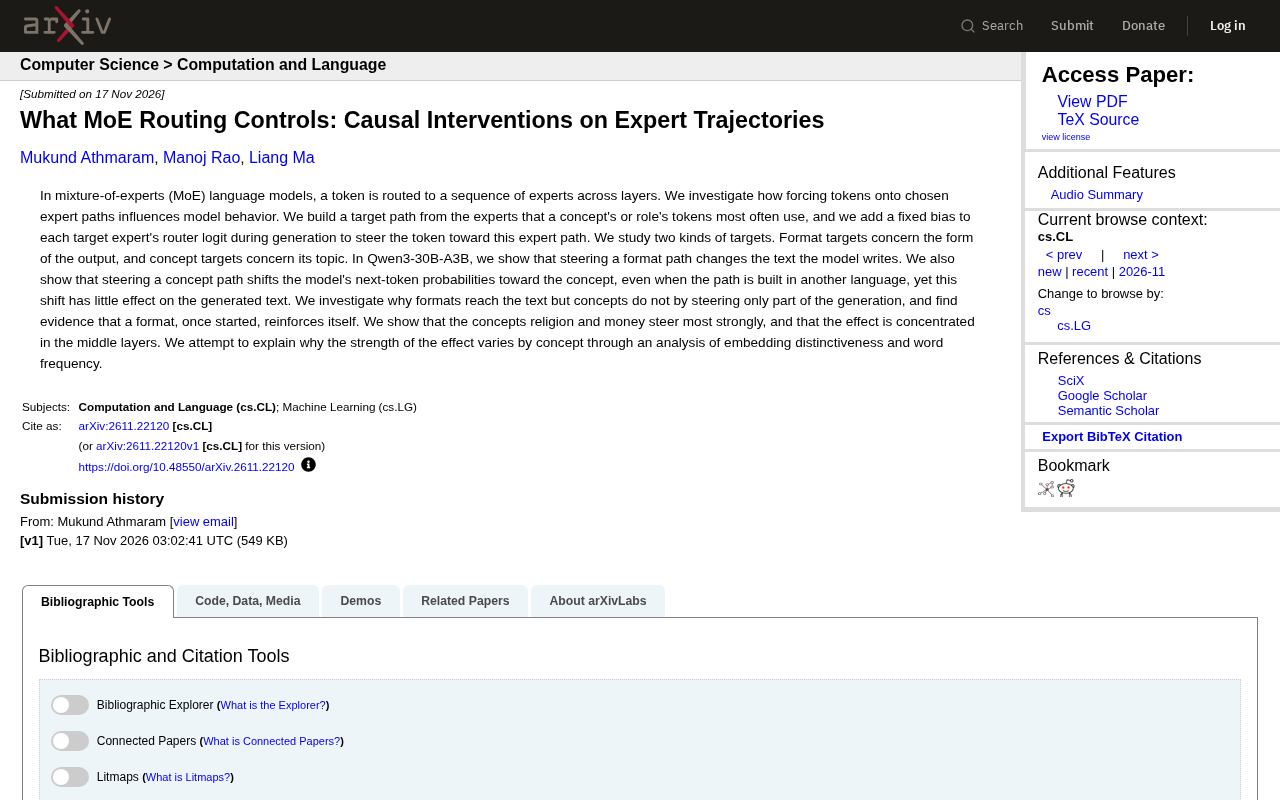
The study adds a bias to the routing logit of target experts in an MoE model to achieve causal intervention on token expert pathways, and tests its effects on Qwen3-30B-A3B. The results show a clear asymmetry: steering tokens toward format-related expert pathways changes the language and style of the generated text, while steering toward concept pathways such as "religion" and "money" shifts the next-token probability toward the concept but leaves the final text almost unchanged. Mechanistically, format effects are maintained by a self-reinforcing loop, while concept effects concentrate in the middle layers, and the intervenability of different concepts differs significantly. The study concludes that routing intervention can be an effective means of format control but has limited concept control, and must be combined with other methods.
How Mixture-of-Experts (MoE) models route each token to different experts has always been a key question for understanding the internal mechanisms of large models. A recent study, through causal intervention experiments, reveals the control boundaries of MoE routing over model behavior: when tokens are forced toward specific expert pathways, format targets can change the generated text, while concept targets are almost ineffective. What mechanism lies behind this?
Research Background: The Interpretability Challenge of MoE Routing
The MoE architecture expands model capacity while maintaining computational efficiency through sparse activation of expert networks. But the black-box nature of routing decisions makes it difficult for researchers to predict model behavior. Prior work mostly observed routing patterns, whereas this study adopts causal intervention: during generation, a fixed bias is added to the routing logit of target experts, actively steering tokens toward a preset expert pathway.
The study focuses on two types of target pathways: format targets concern the output form (e.g., language, style), and concept targets concern the output topic (e.g., religion, money). Experiments on the Qwen3-30B-A3B model provide a new perspective for understanding the relationship between routing and semantics.
The core of the Mixture-of-Experts (MoE) architecture lies in replacing a single FFN with multiple parallel feed-forward networks (i.e., "experts"), and using a lightweight router (router/gate) to compute a score for each expert for each token, typically activating only the Top-K experts with the highest scores (e.g., Top-2). This sparse activation allows the total number of model parameters to be far larger than the number of parameters actually used in a single forward pass, thereby expanding model capacity while keeping inference cost approximately unchanged. Routing scores are generally obtained by multiplying the token's hidden state with a learnable gating matrix and applying softmax. Because each token's expert combination is discrete and dynamic, the correspondence between routing decisions and semantics is not explicit—this is precisely the difficulty of MoE interpretability research.
Causal intervention differs from purely observational analysis: the latter only statistically determines "which experts are often activated by a certain type of input" and cannot rule out confounding factors; the former actively modifies an internal variable of the system (here, adding a bias to the routing logit of target experts) and then observes how the output changes, thereby establishing a causal chain of "changing routing → changing behavior." In this study, the bias is added to the routing logit rather than directly hard-specifying an expert, so the intervention strength can be continuously adjusted while the rest of the model remains unchanged. This design is in line with activation manipulation in neuroscience and the do-operator idea in causal inference, and is a key means of judging whether an internal pathway has causal efficacy on the final output.
Core Findings: Format Can Change Text, Concept Cannot
Interventions on format pathways can significantly change the generated text. For example, when researchers steer tokens toward an expert pathway associated with a certain language format, the model output switches to the corresponding language style. This is intuitive: format features have a direct mapping at the routing level.
Interventions on concept pathways show a dissociation phenomenon. When researchers steer tokens toward an expert pathway associated with a specific concept (e.g., "religion"), the model's next-token probability distribution does shift toward that concept, and this holds even when the pathway is constructed in another language. However, this probability shift has almost no effect on the final generated text. In other words, the model internally "thinks" of the concept, but the content it "says" remains unchanged.
This dissociation suggests that although concept information can be detected and manipulated in routing, downstream mechanisms suppress its expression.
Mechanism Exploration: Format Self-Reinforcement and the Mid-Layer Concentration of Concepts
To explain the different fates of format and concept, the researchers conducted partial-generation intervention experiments. The evidence indicates that once a format is initiated, it consolidates itself through a self-reinforcing loop. For example, when the model begins generating in a certain format, the routing of subsequent tokens tends to maintain that format, forming positive feedback. This explains why format interventions can penetrate through to the output text.
The effects of concept interventions show a different pattern. The study finds that concept effects are most concentrated in the middle layers, and the intervenability of different concepts differs markedly: routing interventions for the concepts of "religion" and "money" are the strongest. The researchers attempt to explain this difference from the perspectives of embedding uniqueness and word frequency, but the specific mechanism remains to be further explored.
The dissociation between the next-token probability distribution and the final generated text can be understood from the dynamics of autoregressive generation. A single-step probability shift affects only one step of sampling; if the routing in subsequent steps quickly returns to normal, the shift is diluted. By contrast, format features (e.g., language, punctuation, sentence structure) have local coherence—once they appear, they continuously influence the context of subsequent tokens and are thus amplified. Concepts often need to span multiple steps and be carried jointly by multiple tokens before they can manifest in the text; a single-point perturbation is difficult to accumulate into a visible semantic change. This suggests that "an internal representation can be detected" and "that representation can causally drive output" are propositions at two different levels.
Implications and Outlook: The Boundaries of Routing Intervention
This study provides an important reference for MoE interpretability. Routing intervention is not a master key: format-oriented interventions can serve as an effective means of text control, while concept-oriented interventions must be treated with caution. For applications that require precise control of output topics, routing bias alone may not be sufficient, and other intervention methods must be combined.
Moreover, the finding that concept effects concentrate in the middle layers offers a potential entry point for model editing and knowledge injection. Future research can explore more refined intervention strategies, such as layer-wise and time-segmented routing adjustments, to unlock deeper controllability of MoE models.
Key Points
- On Qwen3-30B-A3B, forcing tokens toward target expert pathways via routing logit bias enables causal intervention on model behavior.
- Format pathway interventions can change the form of generated text, whereas concept pathway interventions only change the next-token probability and have little effect on the final text.
- Format effects involve a self-reinforcing mechanism; concept effects concentrate in the middle layers, and interventions on concepts such as "religion" and "money" are the strongest.
- The study suggests that routing intervention is effective for format control but limited for concept control, and must be combined with other methods.
Additional Background
Qwen3-30B-A3B is the MoE version in the Tongyi Qianwen Qwen3 series. In the name, "30B" refers to a total parameter count of about 30 billion, and "A3B" means about 3 billion parameters are activated per token (Active 3B), i.e., a relatively small Top-K expert activation ratio is used. Choosing such a medium-scale MoE model for intervention experiments balances two aspects: a sufficiently large number of experts (a large routing space, convenient for constructing target pathways) and controllable experimental cost. It should be noted that whether the causal conclusions on a single model can generalize to other MoE architectures (different numbers of experts, different routing algorithms, whether shared experts are used) still requires cross-validation.
One-line Summary
Causal interventions reveal that MoE routing can control format but is hard-pressed to control concept.
Paragraph Summary
The study adds a bias to the routing logit of target experts in an MoE model to achieve causal intervention on token expert pathways, and tests its effects on Qwen3-30B-A3B. The results show a clear asymmetry: when tokens are steered toward format-related expert pathways, the language and style of the generated text change accordingly; when steered toward concept pathways such as "religion" and "money," the next-token probability shifts toward the concept, but the final text remains almost unchanged. Mechanistically, format effects are maintained by a self-reinforcing loop, while concept effects concentrate in the middle layers, and the intervenability of different concepts differs significantly. The study concludes that routing intervention can be an effective means of format control but has limited concept control, and must be combined with other methods.
Related articles
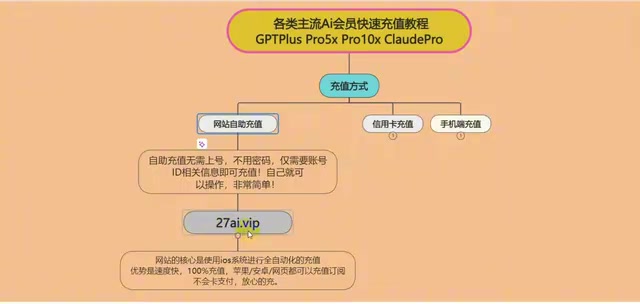
ChatGPT Plus Top-Up in China: Third-Party Website Recharge That Supports WeChat Pay and Alipay, No Overseas Card Needed
A Bilibili creator tests ChatGPT Plus top-up methods in China: comparing third-party website recharge, direct credit card, and mobile in-app purchase, with a full walkthrough of password-free WeChat/Alipay recharge and an analysis of Session credential and payment risk-control risks.

6GB Delivers Opus-Level Performance: Bonsai 2.5 27B Hands-On Test
Prism ML releases Ternary Bonsai 2.5 27B: ternary quantization brings it to just 5.9GB, runnable on a single consumer GPU while retaining 262k context and vision. Hands-on agentic benchmarks approach full-precision Qwen 3.8 27B, exceeding 150 tokens/s on a 4090, with impressive frontend and dashboard results, though game development and long tasks remain weak spots.

System Exchange Spawns an Offbeat Journey to the West: Why This Comedy Series Works
A Bilibili comedy short series reimagines Journey to the West with a system-exchange premise, as the protagonist challenges Sun Wukong, Erlang Shen, and other classics.