What Exactly Is an AI Agent? A Plain-English Breakdown from Principles to Practice

AI Agents decompose complex commands into LLM-powered subtasks — and their quality hinges on rule and prompt design.
This article explains AI Agents in plain English. An Agent has no fixed definition — it breaks a complex command into subtasks, mimicking how humans handle multi-step work. Agents aren't separate from LLMs; they make fuller use of them, calling the model at every step. Crucially, the article highlights a key real-world limitation: because LLMs hallucinate and produce unstable outputs, what truly determines Agent quality isn't "autonomous intelligence" but the rules and prompts a human carefully designs.
What Is an AI Agent: A Concept Without a Standard Definition
In the AI world, the Agent (also called an "intelligent agent" or simply "agent") is one of the hottest concepts in recent years — yet it has no single, universally agreed-upon definition. One educator put it plainly in their course: rather than handing students a pile of definitions to memorize, they wanted to share their genuine, hands-on experience of actually using Agents.
That perspective is worth embracing. An Agent is more of a "living" concept. What it is depends entirely on what problem you want it to solve. Just as everyone pictures a different kind of robot in their head, the workflow of your Agent and someone else's can look completely different. Agents are inherently DIY in nature — how you design and conceive of one largely determines what it becomes. There's no need to lock yourself into a single algorithmic blueprint.
Understanding How Agents Work Through a "Go to Class for Me" Analogy
A wonderfully grounded analogy helps illustrate what an Agent really is. Imagine one morning you can't drag yourself out of bed, so you ask your roommate: "Hey, cover my class for me today." You've issued a single command — but that command can't be completed in one step. It has to be broken down into multiple stages:
- When the teacher takes attendance, answer "here" on your behalf;
- When homework is due, hand yours in;
- When the teacher covers important material, take notes so you can review them later;
- And if your roommate is really thoughtful, they might infer that you're still asleep at noon and don't want to go to the cafeteria — so they grab lunch for you on the way back.
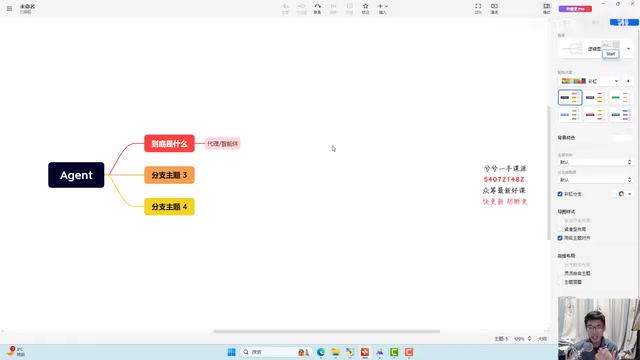
This is the essence of an Agent: you have a need or a command, but that command can't be fulfilled instantly or in a single step — it must be broken down into many stages, each of which is then executed individually. What an Agent does is mimic the way humans think and act when completing a complex task.
The Relationship Between Agents and LLMs: Both Decomposition and Execution Rely on the Model
Many people conflate Agents with large language models (LLMs), or assume that Agents are some entirely new species separate from LLMs. Neither is quite right.
An LLM's interaction pattern is relatively straightforward: you ask, it answers; you ask again, it answers again. An Agent, by contrast, operates as a continuous process — it must first understand your command, then break the task down into step one, step two, step three, and so on.
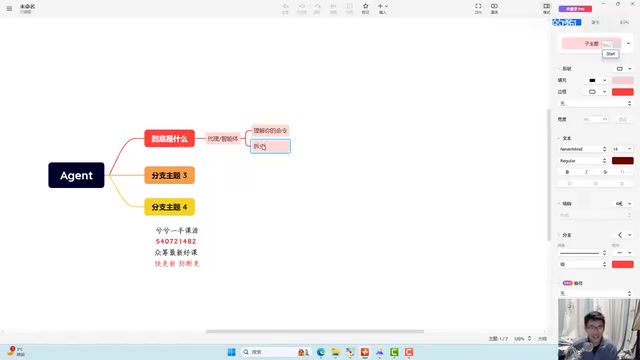
So what gives an Agent the ability to decompose tasks? Does it have genuine intelligence — a "mind" of its own? The answer is refreshingly clear: inside an Agent, everything is handled by the LLM. When you issue the command "go to class for me," the Agent packages your context and situation together with that command as a prompt and feeds it to the LLM, which then automatically produces a breakdown of subtasks.
In other words, an Agent isn't a replacement for an LLM — it's a way of making fuller use of one. Every single step involves calling the LLM. Once the subtasks are generated, executing each one requires asking the LLM again: "What's my current environment? What's the command I received? How should I complete this?"
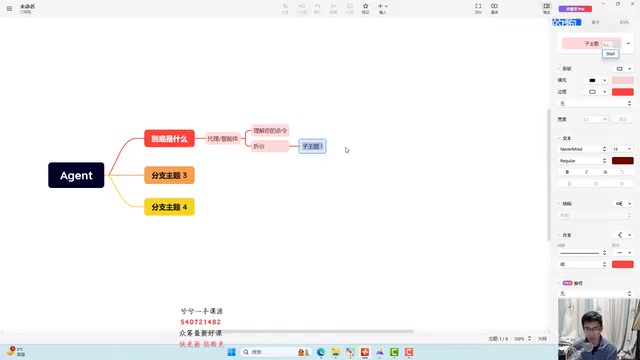
All of these decisions and actions are fundamentally the result of extensive back-and-forth between the Agent and the LLM. A useful way to think about it: first understand the command, then keep breaking it down — and rely on the LLM to execute each step and produce a result.
From a technical architecture perspective, the LLM plays the role of the "brain" within an Agent system, while the Agent itself functions more like a scheduling framework — the "body and nervous system." One widely adopted pattern in mainstream Agent implementations is ReAct (Reasoning + Acting): the model first reasons through what to do next, outputs an action plan, executes that action, feeds the result back to the model as new context, and repeats — until the task is complete. This loop is the technical logic behind the idea that "every step involves calling the LLM." Other variants like Plan-and-Execute exist as well, each with different approaches to separating planning from execution, but all of them fundamentally depend on repeated LLM calls. This is also why the quality of an Agent's reasoning is closely tied to the capability of the underlying model — the stronger the model, the better the task decomposition and decision-making tend to be.
The Real-World Limits of Agents: Rule Design Matters More Than "Autonomous Thinking"
This point deserves particular emphasis. Many talks, frameworks, and stories about Agents have mythologized them — painting a picture of systems that can fully and autonomously analyze and understand anything. But as of today, Agents are far from truly understanding every human behavior and intent.
The reason lies in the inherent weaknesses of LLMs: they can hallucinate, producing outputs that are diffuse and inconsistent. As a result, Agents that actually work in production are largely driven by rules.
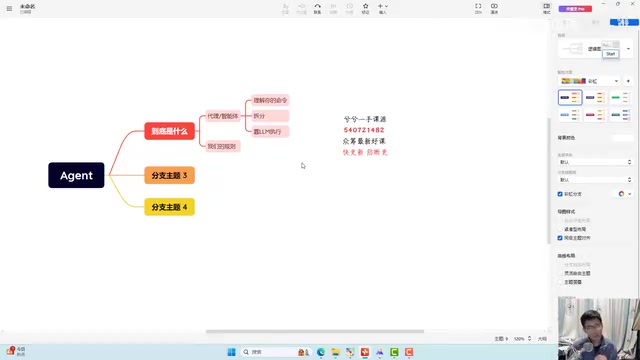
What are rules? Using our "cover my class" example: you can hardcode the workflow — you must check in for me, you must take notes, you must submit my homework. The way these rules are established is, at the end of the day, writing prompts — packaging information like "you're covering class for someone," "this person's mindset and needs (e.g., they don't enjoy class but love reviewing notes before exams)," and "the current objective" into a prompt for the LLM, so it can decide what to do at each step.
A useful parallel is software development: successful projects are typically ones where a product manager (PM) maps out every step of the process first, and then hands each piece off to the appropriate developer. That's where Agents are right now — they're still far from having genuine autonomous thinking. It's not that the LLM can't reason at each step; it's that if you don't design the rules carefully, the output will be poor. This is the core limitation of Agents today.
The "hallucination" problem in LLMs refers to the model producing content with high confidence that is factually incorrect or internally contradictory. This stems from the fundamental nature of LLMs — they are probabilistic text-prediction systems trained on massive corpora, and they have no true understanding of the real world. They simply generate text in the direction that is "statistically most plausible." In a single-turn Q&A setting, hallucinations are relatively contained. But in an Agent scenario that requires chaining multiple steps together, a hallucinated output at one stage can be passed into the next, causing errors to compound and ultimately derail the entire task. This is precisely why carefully designed prompts and clearly defined rule constraints are so critical in Agent engineering — they act as guardrails at every decision point, limiting the model's room for free-form generation and bringing hallucination risk down to an acceptable level.
Summary: Understanding Agents in One Sentence
Putting it all together, the operating logic of an Agent can be distilled into a single chain:
Receive a command → Understand the command → Break it into subtasks → Call the LLM for each subtask using rules (prompts) → Arrive at the desired output.
For anyone looking to get started with Agent development, this plain-English mental model is far more valuable than memorizing definitions. It's a reminder: don't be dazzled by the idea of Agent "autonomous intelligence." What truly determines how well an Agent performs is your ability to decompose tasks and your skill at designing rules (prompts). Understand that, and you've genuinely crossed the threshold toward building your own intelligent agent.
Related articles

Felix Rieseberg Personal Homepage
Felix Rieseberg's personal homepage sparks attention on Hacker News. This article covers the Slack engineer's technical background, the rise and fall of nativefier, and the value of a developer homepage as a tech calling card.

@ai-sdk/vue 3.0.306 Patch Release Syncs with [email protected] Update
@ai-sdk/vue 3.0.306 released, synced with [email protected]. A routine patch release for the Vercel AI SDK ecosystem with no public API changes; the Vue adapter layer stays version-aligned with the core package.

Gemini 4 Argon API Launches: The Era of Million-Token Output Begins
Google launches Gemini 4 Argon with sparse MoE architecture, up to 1M output tokens, and a 68.90% Vals Index score, available across API, AI Studio, and the Gemini app.