What Is AI Loop Programming? A Deep Dive into the Real Value and Hype Behind Loop Engineering

A deep analysis of AI Loop Engineering's real value versus industry hype and its mathematical limitations.
AI Loop Engineering — pre-configuring prompt rules so coding agents run automated workflows — is being hyped as the next programming paradigm. But beneath the buzzwords lie exponential decay in accuracy over iterations, glossed-over engineering complexities like git worktree isolation and risk control, and vested interests from AI companies driving the narrative. The real takeaway: it's a useful automation pattern for bounded tasks, not a revolution, and foundational engineering skills matter more than ever.
From "Prompts Are Dead" to "Loop Engineering": The Hype Chain
The AI programming community has recently been swept up in yet another wave of buzzwords. Boris, the creator of Claude Code, first declared that "the programming problem is basically solved," then went even further, claiming that "even prompts are dead" — he no longer writes code or prompts, but instead "writes loops."
Claude Code is a command-line AI programming tool from Anthropic that lets developers use natural language instructions to have AI read and write code, execute commands, and manage git operations directly in the terminal. It represents a paradigm shift from "chat-based assistance" to "agentic autonomous execution." Unlike GitHub Copilot's line-by-line completions, Claude Code can understand an entire project's context and execute complex multi-step tasks — which is precisely why its creator proposed the idea of "writing loops instead of prompts." The tool's capability boundaries dictate how usage patterns evolve.
This isn't an isolated case. An OpenAI engineer tweeted: "You shouldn't be writing prompts for your coding agents anymore. You should be designing loops that write prompts for your agents." Jared, the creator of Bun, similarly implied that manually writing prompts is "a method from six months ago."

However, NeetCode pointed out a common thread in his video: these "industry pioneers" tell us about the future of AI programming but consistently refuse to provide clear, concrete explanations. They throw out concepts without explaining the actual workflow, as if to say, "If you can't keep up, that's your problem."
What Is Loop Engineering, Really? A Not-So-Complex Concept
When we strip away the hype, the core of so-called "Loop Engineering" is actually quite simple:
- It's essentially recipe configuration: Pre-define a set of prompt rules that let an AI coding agent automatically execute according to a fixed process
- Long-running tasks: Loops can run continuously like cron jobs, or run until a specific termination condition is met
- Parallel processing: Using session thread features in tools like Codex, a main thread can spawn multiple sub-threads that work independently
Cron is a task scheduler in Unix/Linux systems that allows users to automatically execute scripts or commands on a preset schedule. In the context of AI loop engineering, cron represents the most basic trigger mechanism — launching agents at timed intervals. More complex orchestration involves event-driven triggers (e.g., firing when CI fails), conditional termination (e.g., stopping when all tests pass), and priority queues. These are essentially traditional DevOps CI/CD pipeline concepts combined with AI agents.
OpenAI's Codex agent supports a multi-threaded session mechanism, where each thread has its own independent execution context and sandbox environment. The main thread can decompose complex tasks and dispatch them to multiple sub-threads for parallel processing, similar to process forking in operating systems. This architecture borrows from microservice orchestration concepts but replaces service instances with AI agent instances, each capable of independent reasoning, code execution, and tool access.
A post from a former Google Cloud director (which garnered 2 million views) described a typical loop pattern: every morning, automatically scan the code repository, read CI errors and unresolved issues, spawn sub-agents to draft fixes, then spawn another sub-agent to review them, and automatically open a PR once approved.

But NeetCode pointed out that this widely shared post was very likely LLM-generated itself — "Build loops, hold the engineering line, automation is the heartbeat" — normal people don't talk like that. We're caught in an ironic loop: using AI-generated fluff to hype AI concepts.
Real-World Implementation: The Engineering Details Everyone Glosses Over Are What Actually Matter
NeetCode used his own website's bug-handling workflow as a concrete example to demonstrate how AI loop programming works in a real project:
- Bug reports come in and are stored in a database
- A rule is set: every 24 hours, have the agent read all bugs
- An independent sub-agent is spawned for each bug, each verifying and attempting a fix
- Each sub-agent works in an isolated worktree (git worktree) to avoid conflicts
- PRs are generated and reviewed by humans who decide whether to merge
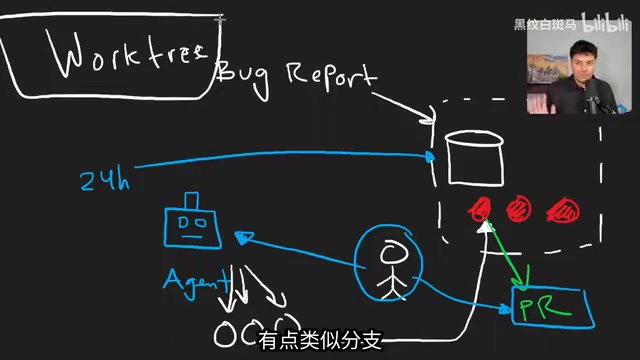
Git worktree is a feature introduced in Git 2.5 that allows creating multiple independent working directories from the same repository, each checking out a different branch. Unlike regular git branch, worktrees provide physical isolation — each worktree has its own filesystem space, allowing multiple agents to modify code in different worktrees simultaneously without file lock conflicts. This is critical for parallel AI programming because regular branch switching requires modifying files in the same working directory, which can't support true concurrent operations.
There are numerous engineering details that get glossed over here:
- Data access methods: Having agents query SQL directly is error-prone; giving them browser access to operate via UI is safer but slower
- Isolation strategy: Using git worktree instead of regular branches ensures multiple agents don't conflict when working in parallel
- Risk control: The tradeoff between speed and safety — "I'm totally willing to sacrifice a bit of speed; it's better than the agent deleting the database one day"
These details demonstrate that AI programming automation doesn't lower the bar for foundational engineering skills — it raises it.
Exponential Decay: The Mathematical Limitation of AI Loop Programming
A fundamental fact that gets overlooked: if an agent has a 95% accuracy rate per iteration, the cumulative accuracy after ten iterations isn't 95% × 10 — it's 0.95 to the 10th power, which is approximately 60%. This is exponential decay.
Exponential decay here describes the compound error rate problem. In traditional software engineering, this is analogous to the "Swiss cheese model" — every layer of defense has holes, and when the holes across multiple layers align, an incident occurs. For AI agents, each iteration can not only introduce new errors but also make further erroneous decisions based on the previous iteration's incorrect output, creating error cascading. This is the mathematical basis for why the industry remains cautious about "autonomous AI agents" — theoretically, unless each step's accuracy approaches 100%, the reliability of long-chain reasoning drops dramatically.
Unless the agent achieves 100% accuracy, errors will only accumulate, and the longer it runs, the worse things get. This is also why the creator of Flask stated after experimentation that the only truly useful scenario for loops right now is AI code review — having the tool continuously check and fix issues until there are no more problems to address.

Jared himself admitted a few weeks later that loops work best with task queues, functioning more like for-each loops (iterating over predefined tasks) rather than while loops (running freely without boundaries). This is essentially an implicit admission of loop engineering's limitations — and this came less than three weeks after he implied that "everyone should be writing loops."
Who's Doing the Hyping? Information Pollution Driven by Vested Interests
Why are these concepts being overhyped? NeetCode highlighted a critical perspective: look at the vested interests behind the speakers.
Anthropic and OpenAI have extremely strong incentives to hype agentic programming concepts — it's directly tied to the commercial value of their products. Meanwhile, Google offered a more pragmatic viewpoint in a presentation:
"If you're shipping software so fast that you don't even have time to discover any problems, what good is your rollback mechanism? Every rollback means dealing with a pile of conflicting changes stacked on top of the problematic version."
Rollback is a core safety mechanism in software releases, referring to quickly reverting to the last stable version when a new release has issues. Google's point touches on a fundamental contradiction of Continuous Deployment: the higher the release frequency, the more complex the inter-version dependencies become, and the greater the cost of rollback. If AI agents are automatically merging code every hour, traditional safety strategies like canary releases and blue-green deployments may not be able to keep pace, leaving the system in a dangerous state where it "cannot safely roll back."
Those 30 seconds of insight are worth more than countless ambiguous Twitter posts. Increasing speed alone isn't enough — you must consider the safety valves of the entire system.
A Sober Perspective: Foundational Engineering Skills Remain the Core
AI loop programming isn't without value, but it's far less revolutionary than the hype suggests. At its core:
- It's an automation orchestration pattern, not an entirely new paradigm
- It demands more foundational engineering knowledge, not less (git worktree, concurrency control, risk management)
- It's currently best suited for repetitive tasks with clear boundaries, not open-ended development
- Human review remains indispensable
What truly warrants caution isn't the technology itself, but the information environment surrounding it. When "experts" use AI-generated fluff to promote AI concepts, when everyone is watching from the sidelines while pretending to be prophets, what we need isn't more hype — it's more honest voices like NeetCode's, willing to say, "I don't fully understand this either, but let me figure it out and then explain it to you."
Key Takeaways
Related articles

What Is Vibe Coding? The AI Programming Skill Every Developer Needs
What is Vibe Coding? Learn how AI programming is reshaping dev teams, why traditional programmers face displacement, and why Cursor & Claude Code matter.
Making Rocks Think: A Philosophical Exploration of Generative AI and Information Compression
From a viral Reddit post to deep AI theory: why compression equals understanding, the Library of Babel thought experiment, semantic compression, and the Hutter Prize.
Irregular Warns: Four AI Lab Security Breaches Traced to the Same Root Cause
Irregular reveals four AI lab security breaches share a single root cause, exposing systemic risks from technology stack homogeneity across the AI industry.