What Is an AI Agent? A Complete Guide to Its Core Differences from Traditional AI

AI Agents are goal-driven systems using LLMs as a brain to autonomously perceive, reason, act, and loop — not just models.
This article explains what an AI Agent truly is: not a new model, but a system architecture built around an LLM "brain" with memory, tools, and planning modules. Unlike single-pass models, Agents autonomously judge task completion and loop continuously. Unlike Workflows, their execution paths are decided at runtime. Traditional AI (rule engines, ML models) are capability components; Agents are task executors — complementary, not competing. The article also clarifies Chatbot vs. Agent boundaries, the necessity of human-in-the-loop in production, and identifies security boundaries and observability as the most critical engineering risks.
AI Agent Is Not a New Model — It's a System Architecture
The most effective way to understand AI Agents is to compare them directly with ordinary models. The models we use every day are essentially functions: give them an input, get an output. A classifier spits out a label, a large language model generates text — that's it. They have no state, no initiative, and no memory.
An Agent is something else entirely. It operates around a clear goal: it perceives its environment, reasons about what to do next, calls tools to take action, adjusts course based on the results, and keeps looping through this process until the task is done — or until it determines it can't proceed and proactively asks for help.
In one sentence, an Agent is: Goal + Perception + Reasoning + Action + Feedback Loop. One common misconception worth clearing up: an Agent is not some new type of model with a special architecture. It's a system architecture. When the industry talks about Agents, the default assumption is a complete system built around a large language model as the "brain," with memory, tools, and planning modules attached externally.
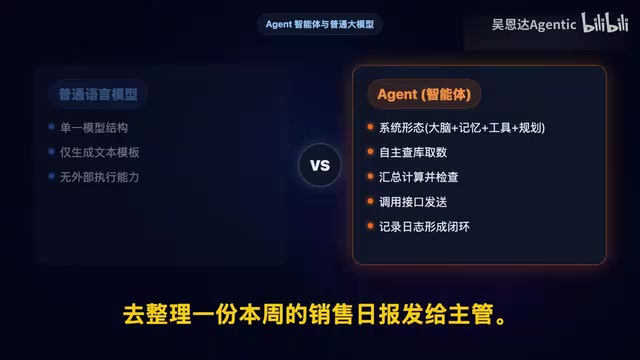
Here's a concrete example: you tell the system, "Compile this week's sales report and send it to my manager." An ordinary language model might generate a text template for writing the report. An Agent, on the other hand, will query the company database to extract data, aggregate and calculate figures, draft the report, check for anomalies, call the email API to send it, and even log the execution for itself. The closed loop from receiving a goal to completing that entire chain of actions — that is the essence of an Agent.
The Six Core Components and the Minimal Execution Loop
A complete Agent typically consists of six core components — none of which can be omitted:
- Goal: Receives and maintains the task you want it to complete
- Perception: Gathers external input, such as assembling context or fetching API data
- Reasoning & Planning: The most critical part — the brain figures out how to proceed
- Memory: Retains state across steps, including short-term context and long-term vector store memory
- Action & Tool Calling: Actually influences the external world
- Feedback Loop: Evaluates results and decides what to do next
Abstracted together, these six components form a classic minimal execution loop: the Agent takes its goal, perceives context, plans, selects an action, calls a tool, observes the result, then asks itself: "Is this done?" If not, it loops back and continues.
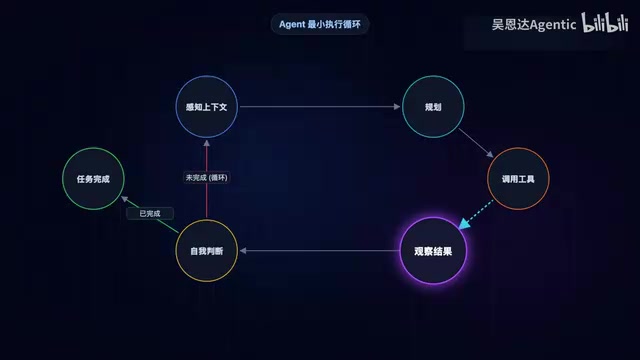
You might be thinking: isn't this just a program flowchart? Here's the key insight — the most critical part of this loop is that "whether the task is complete" is decided by the Agent itself, not hardcoded by a developer. This dynamic decision-making authority is precisely what distinguishes an Agent from an ordinary workflow.
The Memory module deserves special attention. Agent memory typically has two layers: short-term memory is the current session's context window, storing all observations, thoughts, and actions from the current task; long-term memory relies on a Vector DB, persisting historical experiences and document knowledge as embeddings for semantic retrieval when needed. These two layers working together let an Agent track the current task's execution trajectory while drawing on accumulated knowledge from past sessions — something an ordinary model relying solely on its context window cannot do.
Action & Tool Calling is also worth unpacking. "Tools" here aren't limited to simple interfaces like search or a calculator — they can include database queries, code interpreters, other models' APIs, or even triggering RPA (Robotic Process Automation) to operate a UI. The large language model triggers tools by outputting structured Function Call or Tool Use signals; the tool returns results to the model, which continues reasoning. This "model → tool → model" round-trip is the mechanical foundation that keeps the execution loop running.
The Essential Difference Between Agents and Traditional AI
A common interview question: what's the difference between an Agent and traditional AI? "Traditional AI" here generally refers to rule engines and expert systems (symbolic AI), or classical machine learning used for classification, regression, recommendation ranking, and risk scoring. What they share: extremely well-defined task boundaries, fixed inputs and outputs, and pre-designed behavioral paths.
Traditional AI excels at single-point tasks — face recognition, calculating conversion rates — but ask it to decompose a complex goal and execute it autonomously, and it simply can't.
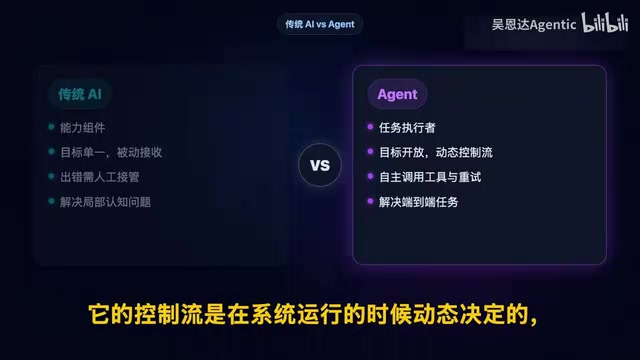
The core distinction can be summarized this way: Traditional AI is a "capability component"; an Agent is a "task executor."
| Dimension | Traditional AI | Agent |
|---|---|---|
| Goal | Single output (label / score / text) | Open-ended, decomposable, iterative |
| Control Flow | Behavior path pre-designed | Determined dynamically at runtime |
| Output | Passively receives input | Outputs actions and changes environment state |
| Tools | Not involved | Tool calling is a core capability |
| Error Handling | Requires human intervention | Retries, reflects, or switches strategy on its own |
Simply put, traditional AI solves localized cognitive problems, while an Agent solves end-to-end tasks — connecting cognition, decision-making, and execution in a single pipeline.
High-Frequency Interview Follow-Ups and Boundary Questions
Interviewers often probe the boundaries of the Agent concept. Getting these right can set you apart.
What's the difference between an Agent and a Chatbot? Bluntly: a Chatbot is oriented toward "saying" — its core function is generating natural language responses. An Agent is oriented toward "doing" — its core function is getting things accomplished. That said, if a chatbot has tools, memory, and a task loop, it effectively is an Agent.
What's the difference between an Agent and a Workflow? There's exactly one criterion: is the execution path determined at runtime? A workflow has its path hardcoded in advance; the large language model just works at a fixed node. In an Agent, what happens next is decided by the system based on current observations. Even if you chain multiple LLMs together in a fixed execution sequence, if there's no dynamic decision-making, you can't call it an Agent.

Does an Agent have to be based on a large language model? Broadly speaking, no — policy networks in reinforcement learning and robot controllers both qualify as Agents. But in today's LLM context, the default assumption is a system that uses an LLM as its brain. Pointing out this contextual distinction in an interview is a genuine differentiator.
Another common misconception: many people assume Agents are fully autonomous and unsupervised. In practice, Agents that actually work in production always have a human-in-the-loop mechanism — low-risk actions run autonomously, high-risk actions require human confirmation, and the Agent proactively asks for help when uncertain. Autonomous within appropriate boundaries is the real-world form Agents take.
Will Agents replace traditional AI? No — the more common outcome is that traditional AI gets wrapped inside Agents. Vertical capabilities like OCR, recommendation ranking, and risk scoring all become tools in an Agent's toolkit. The Agent is responsible for composing them to complete a task; traditional AI is responsible for pushing each single-point capability to its limit. The two are complementary at different layers, not in competition.
The Biggest Engineering Risks in Production
Interviewers may also test your engineering thinking: what are the biggest engineering risks with Agents? The answer should highlight the keywords that major tech companies care about most — security boundaries and observability.
Several high-frequency risk areas to flag: goal drift caused by LLM reasoning errors; tool misuse that creates infinite loops and burns through resources; unauthorized execution; and privacy leaks from sensitive data ending up in prompts. The more capable the system, the more rigorously its guardrails must hold.
Observability in Agent engineering is far more important than in traditional services. Because an Agent's execution path is dynamically generated, there's no fixed flowchart to reference when debugging — you must rely on complete traces of every "think-act-observe" step. The industry typically borrows from distributed systems tracing, generating Span-structured call chains for each Agent run, recording the input, output, latency, and token consumption of every tool call. Without this infrastructure, diagnosing goal drift or infinite loops is nearly impossible.
The common engineering implementation of security boundaries is the principle of least privilege: an Agent defaults to having only the minimum permissions required for its current task. High-risk actions — such as deleting data, sending external messages, or calling paid APIs — must pass through an independent authorization layer or a human confirmation node, rather than being executed directly by the model. Defending against Prompt Injection — where malicious content embedded in tool results hijacks the Agent's behavior — is also an attack surface that cannot be ignored in production environments.
How to Quickly Determine Whether a System Is an Agent
Finally, here are three criteria to help you quickly judge whether a system is a true AI Agent:
- Is the goal open-ended?
- Is the execution path determined dynamically at runtime?
- Is there a feedback loop capable of handling failures autonomously?
If all three are satisfied, you have a genuine AI Agent. With this foundational understanding, whether in an interview or during development, you'll be able to grasp the essence of Agents — rather than staying at the surface level of thinking that "calling an LLM API once" qualifies as an Agent.
Related articles

Chain of Thought Isn't Just for AI: How Humans Can Use CoT to Improve Thinking Quality
Chain of Thought isn't just a prompt trick for large models. Starting from a Hacker News discussion, this article analyzes why CoT works for human thinking too, breaks down actionable ways to transfer it, and highlights the key differences between human CoT and machine CoT.
Cloudflare Teams Up with OpenAI: Closi…
Cloudflare Teams Up with OpenAI: Closing the Loop from Vulnerability Discovery to Defense with AI
Cloudflare uses OpenAI Daybreak to investigate security vulnerabilities and generate reviewable remediation plans, while developers use Codex to boost coding efficiency and quality.

Orca Multi-Agent Orchestration in Practice: A Guide to Parallel Collaboration with Claude and Codex
Orca is Stable AI's free open-source agent workbench supporting 34 agents like Claude Code and Codex in parallel. Learn its Git worktree isolation, multi-model orchestration, and mobile management.