What Is an AI Agent? A Three-Layer Progression to Fully Explain the Concept

A three-layer progression from LLM to Workflow to Agent that clearly explains what AI Agents are.
This article explains AI Agents through a clear three-layer progression: starting with LLMs (text understanding and generation), moving to AI Workflows (multi-step automated processes with human-designed logic), and finally arriving at AI Agents (autonomous systems that reason, act, and iterate on their own). Using real-world examples, it demystifies concepts like RAG, ReAct framework, and self-reflection mechanisms.
From Chat Assistants to Intelligent Agents: What Exactly Is an AI Agent?
The term "AI Agent" has been buzzing non-stop lately, but most explanations are either too technical and intimidating, or too shallow to be useful. This article attempts to use a clear progression path to thoroughly explain what AI Agent really means.
The core idea is simple: start from the Large Language Model (LLM) you're already familiar with, move into AI Workflow, and finally arrive at AI Agent. Three layers, each illustrated with tangible real-world examples, making concepts like RAG and ReAct land naturally without the intimidation factor.
Layer 1: Large Language Models (LLM) — AI's Foundational Capability
DeepSeekAd, ChatGPT, Kimi — the core engine behind these chat assistants is the Large Language Model (LLM). They are all essentially applications built on top of LLMs, and what LLMs excel at is understanding and generating text.
The way it works is very straightforward: you input some text, the LLM generates a response based on its training data, and outputs it back to you. For example, you say "Write me a product description," that sentence is the input, and the generated copy is the output.
From a technical perspective, today's mainstream LLMs are all based on the Transformer architecture proposed by Google in 2017. The training process consists of two stages: during the pre-training stage, the model learns statistical patterns of language and world knowledge from massive amounts of internet-scraped text (typically trillions of tokens); the fine-tuning stage uses techniques like Reinforcement Learning from Human Feedback (RLHF) to make the model's outputs better aligned with human expectations, safer, and more useful. This explains why LLMs can generate fluent and insightful text — they have indeed "read" a large portion of human knowledge. But precisely because knowledge is "frozen" at training time, they know nothing about information after their training cutoff date or private data they've never encountered.
But if you ask "What time am I free tomorrow afternoon?" it can't answer — because it has no access to your calendar. Here are two key characteristics of LLMs to remember:
- Limited knowledge of private information: Although they've been exposed to massive amounts of data during training, they know almost nothing about your personal information or internal company data.
- Fundamentally passive: They typically need you to provide a question or task first before they respond.
These two characteristics form the foundation for understanding AI Workflow and AI Agent in the layers that follow.
Layer 2: AI Workflow — Automated Execution Along Preset Paths
Continuing from the example above. Suppose I tell the LLM in advance: "From now on, whenever I ask about my schedule, first search for the relevant information in Feishu Calendar, then come back and answer me." Once this process is set up, the next time I ask "What time am I free tomorrow afternoon?" it can check the calendar first and then give the correct answer.
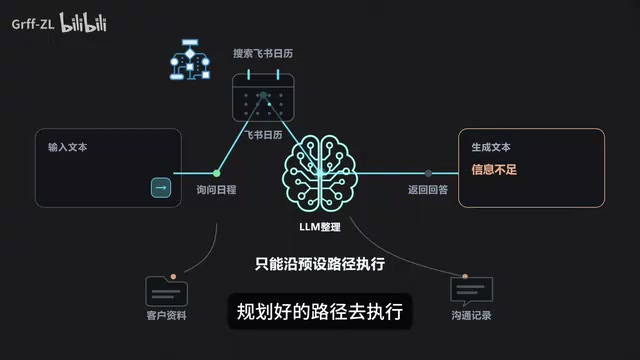
But if I follow up with "Where did we leave off in the last client meeting?" it gets stuck again — because the workflow was only set up to check Feishu Calendar, not to read client files or communication records. This is the core characteristic of AI Workflow: it can only execute along pre-planned paths. This preset execution path is technically called Control Logic.
Control Logic is a classic concept in software engineering, referring to the conditional judgments and branching structures that determine execution order in a program — if-else conditional branches, loops, parallel execution, etc. In the AI Workflow context, it manifests as fixed rules like "first do A, if the result meets condition X then do B, otherwise do C." Current mainstream workflow orchestration tools include Dify, Coze, LangChain, n8n, and others. They provide visual drag-and-drop interfaces that let non-programmers design complex multi-step AI processes, essentially democratizing the "process orchestration" capability from traditional software development.
Even With Hundreds of Steps, It's Still a Workflow
We can certainly add more steps to the Workflow: connect to a CRM via API to read client files, then hook up a Feishu bot to automatically push the organized information. The process can get longer and longer, capable of doing more and more. But the key point is — even if there are hundreds of steps, as long as the decision-maker is still a human, it remains just a Workflow and won't automatically become an Agent.
What Is RAG (Retrieval-Augmented Generation)?
You've probably heard the term RAG (Retrieval-Augmented Generation) frequently. It's actually not that complicated: it lets AI find relevant information from external sources before answering, then generates a response based on that information. For example, pulling client history from a company knowledge base and handing it to the LLM to organize. So RAG itself can be a part of an AI Workflow, used to compensate for the model's lack of external information.
Looking deeper, RAG's complete technical pipeline involves three key steps: First is Chunking, which splits long documents into segments of a few hundred characters each for precise retrieval later; second is Embedding, which uses embedding models to convert these text segments into high-dimensional mathematical vectors (think of them as "digital fingerprints of meaning") and stores them in specialized vector databases (such as Pinecone, Milvus, Weaviate); finally comes Retrieval and Generation — when a user asks a question, the system also converts the question into a vector, finds the most relevant document segments through similarity calculation, concatenates them as context into the Prompt, and hands it to the LLM to generate an answer. This approach preserves the LLM's powerful generation and summarization capabilities while solving the problems of knowledge timeliness and private data access. It's one of the most mainstream architecture patterns in enterprise AI applications today.
A Real Workflow Example
Building a simple Workflow with Dify: step one searches for the day's latest AI news, step two hands it to the LLM to filter out duplicates and low-value content, step three generates brief summaries, and finally it automatically pushes to Feishu, with the option to run on a daily schedule.
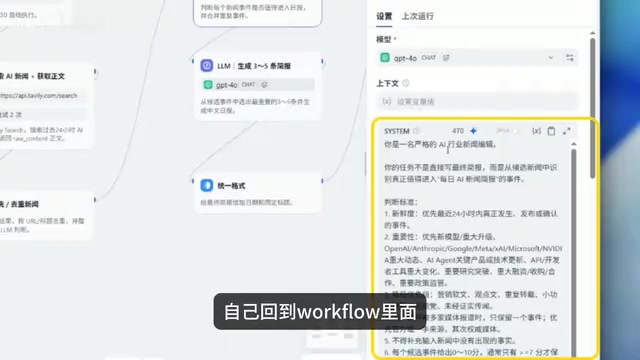
But here's the problem: if after running it I find the selected news isn't what I actually care about, or the summaries are too verbose, I still have to go back into the Workflow myself to modify the filter conditions and Prompt. In other words, while the process can run automatically, "identifying problems, deciding how to fix them, and re-testing" still requires a human. This is precisely where AI Agent brings fundamental change.
Layer 3: AI Agent — The Autonomous Decision-Making Intelligent Agent
Back to the previous example. My goal is simple: find noteworthy AI news every day and compile it into a briefing. The entire process can be broken down into two things:
- Reason: Judgment and thinking — where to find news, which content to keep, how to summarize, where to send the results.
- Act: Execution through tools — actually searching, calling the LLM to filter, generating summaries, pushing the briefing.
In a Workflow, the Reason part is done by me. And when I also hand over "making decisions" to the LLM, the system begins to transform from a fixed Workflow into a true AI Agent.
The Agent Judges and Acts on Its Own
Now the Agent thinks for itself: Where should I look for today's noteworthy news? Should I search fixed websites directly or use a search tool first? After finding results, which are worth keeping and which are duplicate reports? If there's not enough information, should I continue searching other sources? These steps that previously required human pre-planning are now judged autonomously by the Agent.
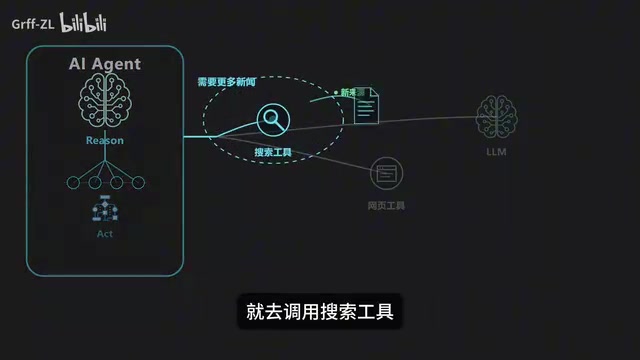
After judging, it still needs to execute: if it needs more news, it calls the search tool; if it needs full content, it opens the webpage; if it needs to organize, it calls the LLM to generate summaries. This "think — act — think again — act again" loop is precisely the very common architecture known as the ReAct framework (Reason + Act).
The ReAct framework was formally proposed by Google Research and Princeton University in their 2022 paper "ReAct: Synergizing Reasoning and Acting in Language Models." Its core innovation is having the LLM alternate between "Chain-of-Thought reasoning" (articulating its thinking process before giving conclusions) and "external action calls" (such as searching, calculating, querying databases) during generation, then feeding action results back as new Observations to continue reasoning. Compared to pure reasoning approaches, ReAct significantly reduces model "hallucination" by introducing real-world feedback; compared to pure action approaches, it gives every decision a traceable chain of thought, making it more interpretable and controllable. ReAct has now become one of the de facto standard paradigms for Agent development, with virtually all mainstream Agent frameworks (LangChain, AutoGPT, CrewAI, etc.) having built-in ReAct mode support.
Iteration: The Agent's Self-Checking and Iterative Capability
Besides Reason and Act, AI Agent has another key capability: Iteration. In an ordinary Workflow, if the briefing quality is poor, I need to manually adjust it; but in an Agent, this checking and adjusting process can also be handled by the Agent itself.
The specific approach is to introduce another LLM, dedicated to filtering and checking its own output. If the results aren't good enough, it continues adjusting, regenerating, re-checking, and revising until preset requirements are met.
This capability corresponds academically to "Self-Reflection" mechanisms, with representative works including the Reflexion framework and the CRITIC method. Technical implementation typically uses a "Generator-Evaluator" dual-model architecture: one LLM is responsible for executing tasks and generating output (Generator), while another LLM (or the same model called in a different role) evaluates output quality and provides specific improvement suggestions (Evaluator/Critic). Evaluation dimensions can include accuracy, completeness, relevance, format compliance, and more. This mechanism simulates the human cognitive process of "reviewing and revising after writing a first draft," enabling the Agent to progressively approach target quality through multiple iterations without human intervention. In practice, a maximum iteration count is usually set to prevent infinite loops.
A More Complete Agent Example
Hand a video to Codex with only the final goal: "Identify and continuously track the main people in the footage, add bounding boxes, highlights, and labels, then export the processed video."
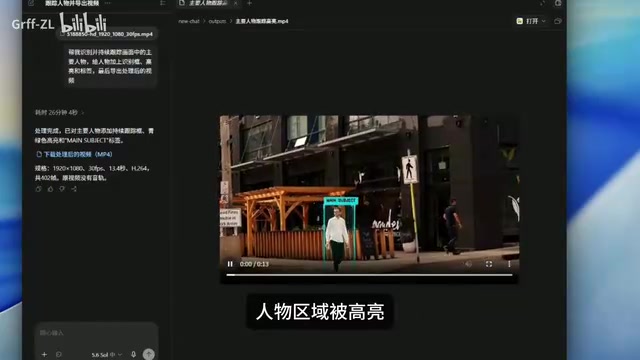
After receiving the task, Codex first performs Reason (determining how to read the video, identify people, and maintain tracking), then enters Act (writing the processing program, calling tools, actually running it). Throughout the entire process, no one told it specifically how to do it — only the final goal was given. What tools to call, how to adjust when encountering problems — all of this was judged and executed by Codex itself.
Codex represents a special and powerful Agent paradigm — the code-execution intelligent agent. Unlike pure text conversations, this type of Agent can write code and actually run it in an isolated sandbox environment, verifying and correcting its approach by observing the results (successful output or error messages). This means the Agent reasons not only in "language space" but also gets real, deterministic feedback in "execution space" — code either runs successfully or throws errors, with no ambiguity. Similar products include Devin (dubbed the AI software engineer), Microsoft AutoGen, OpenAI's Code Interpreter, and others. Together they represent an important trend of Agents evolving from "conversational assistants" to "productivity tools that can independently deliver results," and this is also one of the most mature scenarios for Agent deployment today.
Three-Layer Comparison: One Chart to Understand the Differences Between LLM, Workflow, and Agent
Putting the three layers side by side, the picture becomes very clear:
| Layer | Core Characteristic | Decision Maker |
|---|---|---|
| LLM | You give it a question, it replies based on training knowledge | Human asks, model answers |
| AI Workflow | Can call tools and include multiple steps, but the execution path is pre-designed by humans | Human designs the process |
| AI Agent | You only need to give it a goal — it Reasons, Acts, and Iterates on its own | AI decides autonomously |
Here's an analogy: a Workflow is you planning exactly what to do at every intersection, while an Agent only needs you to tell it "where the destination is" — as for how to navigate there, it figures that out on its own.
This is the most fundamental difference between AI Agent and Workflow, and it's the key to understanding the current direction of AI development. When decision-making authority shifts from humans to AI, the way we collaborate with tools will undergo profound change.
Related articles

Chain of Thought Isn't Just for AI: How Humans Can Use CoT to Improve Thinking Quality
Chain of Thought isn't just a prompt trick for large models. Starting from a Hacker News discussion, this article analyzes why CoT works for human thinking too, breaks down actionable ways to transfer it, and highlights the key differences between human CoT and machine CoT.
Cloudflare Teams Up with OpenAI: Closi…
Cloudflare Teams Up with OpenAI: Closing the Loop from Vulnerability Discovery to Defense with AI
Cloudflare uses OpenAI Daybreak to investigate security vulnerabilities and generate reviewable remediation plans, while developers use Codex to boost coding efficiency and quality.

Orca Multi-Agent Orchestration in Practice: A Guide to Parallel Collaboration with Claude and Codex
Orca is Stable AI's free open-source agent workbench supporting 34 agents like Claude Code and Codex in parallel. Learn its Git worktree isolation, multi-model orchestration, and mobile management.