What Is an MCP Server? The Standard Interface for Safe AI Tool Calling

MCP is a universal protocol that gives AI models safe, standardized access to external tools and data.
MCP (Model Context Protocol), open-sourced by Anthropic in late 2024, addresses three persistent pain points in AI integration: the N×M explosion of custom integrations across models and systems, token waste and security risks from over-fetching API data, and the exposure of credentials to AI models. Acting as an intelligent adapter layer over existing APIs, MCP lets AI models declaratively invoke capabilities from a "tool menu" rather than receiving raw data dumps — with server-side credential management keeping keys completely out of reach of the model. Like USB unified hardware peripherals, MCP gives Claude, GPT, Gemini, and others a plug-and-play standard interface, positioning it as the likely de facto standard for AI tool calling.
It Starts With a Mess of Code
Imagine a developer named Alex who wants to add an AI chatbot to his e-commerce app. Sounds simple enough — until he connects the AI model to his database, search engine, payment system, and Slack. Suddenly he's dealing with four different authentication flows, four error formats, and four data interfaces he has to maintain indefinitely. Every bit of it is custom code that only he owns and must keep patching.
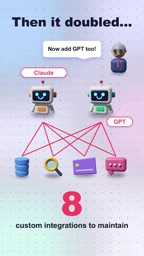
Then his boss drops the classic line: "Can we try ChatGPT too?" And just like that, the integration count doubles to 8 APIs to maintain. Every new model means another round of duplicated effort. Any developer who's done AI integration will recognize this pain immediately.
The "Data Firehose" Problem with APIs
Beyond maintenance overhead, there's another hazard that rarely gets mentioned: APIs tend to return everything at once. The AI might only need one piece of information — say, "order status" — but the system sends back the entire customer record.
This triggers a chain reaction: wasted tokens, slower responses, a polluted context window, and the AI being exposed to sensitive data it never needed to see. In an era where both cost and security are under increasing scrutiny, this kind of indiscriminate data transfer simply isn't sustainable.
Enter MCP: An Intelligent Adapter Layer on Top of Your APIs
This is exactly the problem MCP (Model Context Protocol) is designed to solve. Think of it as a smart adapter layer sitting on top of your existing APIs — one that transforms raw data into precisely what the AI actually needs.

The interaction model is intuitive: the AI asks "what can you do?", and the MCP server responds with a "tool menu" listing available capabilities. The AI then calls what it needs on demand, rather than passively receiving a flood of data. This "supply on demand" design fundamentally changes how AI interacts with backend systems.
Tools Are Auto-Discovered — No Redeployment Required
One of MCP's standout features is extensibility. When you add a new tool to the server, the AI can discover it on its own — no application redeployment, no prompt rewriting needed.
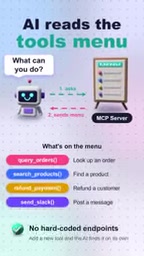
This dramatically reduces the cost of evolving your system. In the past, adding a feature meant touching the entire integration chain. With MCP, you simply register the tool server-side and the AI automatically recognizes the new capability. For products that need to iterate frequently, this kind of flexibility is enormously valuable.
Credentials Are Never Exposed to the AI
MCP also makes a critical improvement on the security front. In traditional setups, API keys are often stuffed into prompts, meaning the model itself can "see" those credentials. Under MCP's architecture, the AI never touches the keys.
The server inspects every request and appends the credentials itself. Authentication logic is fully centralized on the server side — the model is only responsible for expressing intent. This not only reduces the risk of key leakage, but makes permission management centralized and transparent.
MCP was proposed and open-sourced by Anthropic in late 2024, and its design follows a client-server architecture. The MCP client (typically embedded in an AI application or model runtime) communicates with the MCP server (a process encapsulating specific tools and data sources) via a standardized JSON-RPC messaging protocol. The server exposes three types of capabilities to the client: Tools (functions the AI can invoke, such as querying an order or sending a message), Resources (readable data objects like files or database records), and Prompts (pre-built prompt templates). This layered design means AI models don't need to understand the implementation details of underlying systems — they simply interact with a unified MCP interface, enabling "declarative capability invocation" rather than "imperative data fetching."
Embedding API keys in prompts was a common practice in early AI integrations, but it introduces serious security risks: keys can leak through model logs, conversation history, or the training data of third-party models. Additionally, some cloud model services use user inputs to improve their models, meaning credentials written in plain text into a prompt risk being recorded. MCP's server-side credential management aligns with traditional backend security practices — keys are stored in server environment variables or secrets management services (such as AWS Secrets Manager), and the AI can only perceive "I have permission to call this tool," with no access to the actual authentication credentials. This implementation of the Principle of Least Privilege achieves true decoupling between the AI layer and the credential layer.
A USB-Style Universal Interface
The author uses a fitting analogy: MCP is like a USB port. Whether you're using Claude, GPT, or Gemini, any of them can plug into the same MCP server and work immediately — any model, zero code changes.
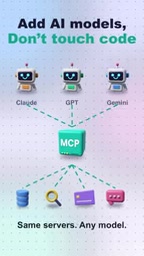
Circling back to Alex's ever-expanding pile of custom code at the start — MCP is essentially what replaces all of that. It collapses the fragmented reality of "one integration per model" into a single standardized access layer. Build once, reuse across models. That's the core appeal of a standard protocol.
The USB analogy points to MCP's deeper value: interoperability. Before MCP, the AI ecosystem exhibited a classic "N×M problem" — N AI models connecting to M external systems required N×M custom integrations. MCP compresses this to "N+M": each model only needs to implement an MCP client once, and each system only needs to implement an MCP server once, after which any combination can connect freely. This mirrors the logic of how USB unified peripheral interfaces, and how LSP (Language Server Protocol) unified editors with language toolchains. Companies including Cloudflare, Block, and Zed have already announced MCP support, and the open-source community has produced a growing number of ready-made MCP server implementations for platforms like GitHub, Google Drive, and PostgreSQL.
Why Developers Shouldn't Ignore It
MCP's significance goes beyond saving code. It represents a paradigm shift in how AI applications integrate with the world: moving away from siloed, point-to-point integrations toward a unified, secure, and discoverable standard interface.
For businesses, this means lower maintenance costs, more controllable data boundaries, and faster model-switching capability — in an era of rapid model iteration, avoiding vendor lock-in is itself a strategic advantage. As more tools and platforms adopt this protocol, MCP is likely to become the de facto standard for AI tool calling. For teams building AI applications today, investing the time to understand and adopt it early is well worth it.
Related articles

How Big Can Stars Really Get? The Physical Limits of the Largest Stars
Red supergiants are the largest stars by volume, with radii up to 2,000 times the Sun, engulfing the inner solar system. But there is no precise upper limit on stellar size—models predict up to 15,000 solar radii. The most massive blue stars are far smaller than red supergiants—biggest and heaviest are two different things.

Apple HomeView Smart Display Full Feature Breakdown: Wall-Mount or Desktop, $299
Apple launches HomeView, a $299 smart display with wall-mount and desktop options, 12MP camera for facial recognition, smart home control, music playback, and recipe step-by-step cooking. Full breakdown of watch faces, apps, privacy, and cooking integration.

Where Did the Promised New Studio Go? Craft Computing Answers After Five Years
Craft Computing's host responds to viewer questions: the new studio promised five years ago was shelved as construction costs soared from $30,000 to $75,000, and was replaced by a 168-square-foot garage conversion.