What Is Claude Code? A New AI Programming Tool for Beginners

Claude Code makes AI programming accessible to beginners — but watch out for bootcamp marketing hype.
Claude Code is an AI programming tool built around ease of use, allowing beginners to get started without mastering underlying principles. The article traces the shift from technically complex AI tools toward practical, out-of-the-box solutions, and outlines a typical learning path from beginner basics to enterprise-grade Agent development. It also offers a grounded perspective on course marketing, advising learners to prioritize runnable code and structured curricula over prize draws and giveaways. Real programming ability comes from sustained hands-on practice, not resource hoarding.
Claude Code: An AI Programming Tool That's More Accessible Than You Think
When people first hear about Claude Code, their instinct is often that it sounds mysterious and advanced — something far out of reach for the average developer. In reality, the opposite is true. Tools like this are most valuable precisely because they lower the barrier to entry, enabling developers — especially complete beginners — to dive in right away.
According to course content featured on Bilibili, Claude Code doesn't require users to understand the underlying technical principles. You can "just start using it." This aligns with the broader trend in AI programming assistants: the shift away from technical showmanship and toward practical, out-of-the-box usability. For those new to coding or looking to boost their productivity with AI, these tools are increasingly becoming the most relevant and accessible option.
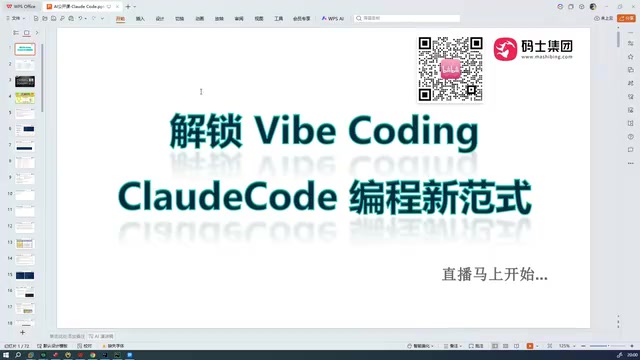
From "High-Tech Mystique" to "Accessible to Everyone"
AI programming tools have undergone a significant perception shift. Writing code and building intelligent agents (Agents) used to be seen as tasks requiring deep engineering expertise. Now, tools like Claude Code package those complex capabilities into relatively simple, intuitive interactions.
The core of this shift is that using the tool matters more than understanding its internals. For beginners, building hands-on experience and getting a feel for what the tool can solve is often far more effective than diving into technical details from the start. That said, principles still matter — in real project work, understanding how a tool operates helps you wield it more effectively and avoid blindly treating AI as a black box.

What is an Agent? An Agent is an AI program that can perceive its environment, make autonomous decisions, and execute a series of actions to accomplish a goal. In a programming context, an Agent typically means an AI system that can automatically plan task steps, call external tools (such as search engines, code executors, or file systems), and dynamically adjust its strategy based on intermediate results — rather than simply answering a one-off question. Claude Code operates in Agent mode: it doesn't just complete a snippet of code, but understands development intent, breaks tasks into subtasks, iterates on changes, and ultimately achieves a relatively complete programming goal. This is the core reason it's called an "AI programming assistant" rather than an ordinary code completion tool.
Learning Path: From Beginner to Enterprise-Grade Agent
Based on the source material, courses like this are typically structured around a progression: zero-to-beginner → hands-on projects → building enterprise-grade Agents. This learning curve is thoughtfully designed:
- Beginner stage: Get comfortable with the tool's basic operations and interaction patterns;
- Project stage: Build experience through concrete projects and understand how AI programming applies in real-world scenarios;
- Advanced stage: Attempt to build Agents designed for enterprise needs, handling more complex business logic.
It's worth noting that the material mentions supplementary learning resources, including course notes, hands-on code, and introductory courses in Java and AI for beginners. For those with no programming background at all, building foundational knowledge in a language like Java before jumping into AI programming tools is the more reliable route.

Enterprise-Grade Agents vs. Personal AI Assistants differ significantly in complexity. Enterprise scenarios typically require Agents to connect with internal databases, call multiple business system APIs, handle permission controls and error recovery, and maintain auditable operation logs with stable concurrency handling. Building such Agents usually requires understanding Multi-Agent architectures — where multiple specialized Agents collaborate, calling on each other to complete complex workflows that a single Agent couldn't handle alone. This is why the learning path positions "enterprise-grade Agents" as an advanced goal: it's fundamentally a systems design problem, not just a matter of prompt engineering.
A Realistic Take on "Bootcamp"-Style Learning Products
One thing worth mentioning: this source material is essentially promotional content for a course. It includes extensive marketing information — resource giveaways, QR codes for consultations, and attendance-based prize draws (phones, monitors, speakers, JD shopping cards, etc.). This kind of material has little to do with the actual learning content, and readers should make rational judgments when evaluating these products.
For anyone looking to learn Claude Code or other AI programming tools, here are a few things to focus on:
- Does the course provide runnable, hands-on code rather than just high-level concepts?
- Is there a systematic learning path that builds progressively from foundational to advanced topics?
- Prizes and giveaways in the marketing should not be a primary reason to choose a course;
- Prioritize official documentation and open-source community resources alongside any course for best results.

Conclusion
Claude Code represents the democratization of AI programming tools — it aims to make coding and Agent development more approachable. For beginners, it's a worthwhile entry point worth exploring. However, the learning journey still requires a genuine focus on building hands-on skills, and it's important to stay clear-headed about the marketing wrapped around various courses. Real growth comes from sustained project practice — not from hoarding resources or being lured in by giveaways.
Related articles

Chain of Thought Isn't Just for AI: How Humans Can Use CoT to Improve Thinking Quality
Chain of Thought isn't just a prompt trick for large models. Starting from a Hacker News discussion, this article analyzes why CoT works for human thinking too, breaks down actionable ways to transfer it, and highlights the key differences between human CoT and machine CoT.
Cloudflare Teams Up with OpenAI: Closi…
Cloudflare Teams Up with OpenAI: Closing the Loop from Vulnerability Discovery to Defense with AI
Cloudflare uses OpenAI Daybreak to investigate security vulnerabilities and generate reviewable remediation plans, while developers use Codex to boost coding efficiency and quality.

Orca Multi-Agent Orchestration in Practice: A Guide to Parallel Collaboration with Claude and Codex
Orca is Stable AI's free open-source agent workbench supporting 34 agents like Claude Code and Codex in parallel. Learn its Git worktree isolation, multi-model orchestration, and mobile management.