What Is DeepSeek Harness? A Complete Guide to LLM Harness Engineering

DeepSeek Harness unifies the engineering system beyond the model into a composable open-source framework with an 'everything is a plugin' philosophy.
DeepSeek has released the Harness developer preview and open-sourced the code, proposing that Harness is 'all the engineering infrastructure outside the model,' covering system prompts, tool calling, memory systems, sandboxes, context management, constraint mechanisms, feedback loops, and orchestration logic. Its 'everything is a plugin' design philosophy lets models, tools, skills, and UI components be freely swapped and combined, avoiding black-box all-in-one solutions. The article points out that AI Agent deployment success often hinges on the engineering system outside the model rather than the model itself, and Harness integrates these scattered engineering challenges into a unified framework—an open-source direction worth deep exploration.
Large language models are getting more capable by the day, yet why does real-world deployment always feel like it's "missing something"? DeepSeek's release of the Harness developer preview offers an answer worth paying attention to.
What Exactly Is Harness?
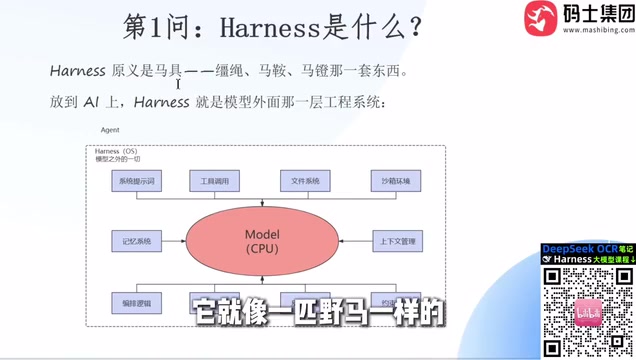
The word "harness" originally refers to horse tack—reins, saddle, stirrups, and all that gear. This metaphor is remarkably apt in the AI context: a large model is powerful on its own, but using it is like dealing with a wild horse. You need to put reins and a saddle on it before you can truly take the reins.
According to hands-on testing shared by a Bilibili content creator, DeepSeekAd's Harness is a developer preview, open for testing to Harness developers worldwide, with the source code released in tandem.
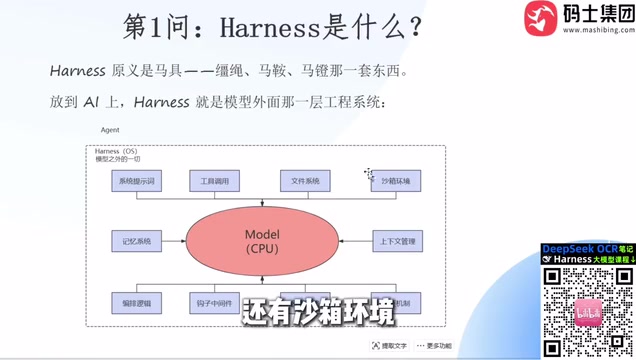
In the AI context, Harness refers to the engineering system layer surrounding the model. Its scope is remarkably broad: system prompts, tool calling, file systems, sandbox environments, memory systems, context management, constraint mechanisms, feedback loops, hook middleware, and orchestration logic—all of these fall under the Harness umbrella.
To sum it up in one sentence: The model handles judgment; Harness handles everything else.
If you're asked "What is Harness?" in an interview, this is the core answer: Harness is all the engineering infrastructure outside the model.
System Prompt is one of the most fundamental components of Harness. It refers to the fixed instructions injected into the model before a conversation begins, defining the model's role, behavioral boundaries, and output format. It serves as the model's "operating manual," directly determining the model's performance style and safety boundaries in subsequent interactions.
Tool Calling / Function Calling is the key mechanism that enables the model to interact with the outside world. The model itself can only generate text, but through tool calling, it can trigger searches, read and write files, execute code, call APIs, and more. Harness is responsible for wrapping these capabilities into interfaces the model can recognize and handling the return of call results.
Sandbox is a security mechanism that provides an isolated runtime space for the model. When the model needs to execute code or manipulate files, the sandbox ensures these operations don't affect the host system, while also facilitating auditing and rollback of behaviors.
Context Management addresses the model's "limited memory" problem—how to dynamically decide which information to retain, compress, or discard within a limited context window is one of the most challenging aspects of Harness engineering.
The "Everything Is a Plugin" Design Philosophy
DeepSeek Harness puts forward a core concept—"everything is a plugin."
This means that Agent capabilities such as models, tools, skills, sandboxes, storage, loops, and UI are all composed of plugins. Developers can freely swap, flexibly combine, and build their own Agent systems on demand.
The benefits of this architectural approach are obvious: modularity means extensibility and customizability. You don't have to accept a "one-size-fits-all" black-box solution—instead, you can select and assemble components based on your specific scenario.
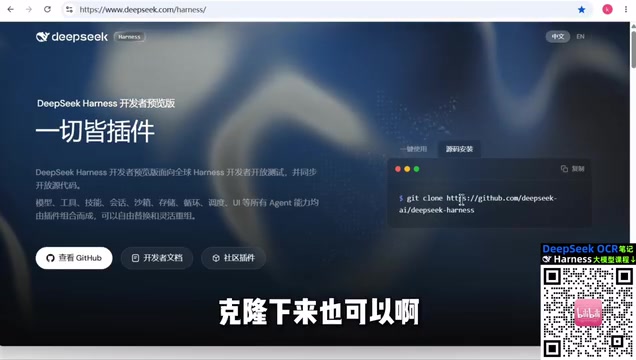
Installation is straightforward too—a single command gets you set up. If you want to study the source code, you can clone it directly from GitHub.
Plugin Architecture is not a new concept in software engineering. Its core idea is to define unified interface specifications so that different functional modules can be developed independently, deployed independently, and combined on demand. Adopting this architecture in an Agent system means every capability unit—whether it's a model adaptation layer, tool set, memory storage, or UI component—follows the same registration and invocation protocol.
The direct benefit of this design is replaceability: when a more powerful model or a better tool implementation emerges, developers only need to swap out the corresponding plugin without refactoring the entire system. Meanwhile, plugins communicate through standardized interfaces, which reduces coupling and allows teams to develop different modules in parallel. Compared to traditional "all-in-one" Agent frameworks, the plugin-based approach offers clear advantages in flexibility and long-term maintainability, though it also demands a higher level of abstraction in interface design.
Why Is the Concept of Harness Worth Paying Attention To?
Over the past year, discussions about AI Agents have mostly focused on model capabilities themselves—parameter scale, reasoning ability, multimodal understanding. But when it comes to actual project deployment, what truly determines success or failure is often the engineering system layer outside the model.
How should the memory system be designed? How should context be managed? What orchestration logic for tool calling is most efficient? How should constraint mechanisms and feedback loops be built? Without solving these problems, even the strongest model will struggle to deliver stable output.
Harness integrates these scattered engineering problems into a unified conceptual framework and, through open source, lets developers participate in co-building. For those working on AI projects, this is a direction worth exploring in depth.
Feedback Loop is an important mechanism in Harness that ensures stable Agent operation. It refers to the cyclical process where the system detects and evaluates model output, then feeds result signals back to the model. For example, when code generated by the model fails to execute, the error information is captured and re-injected into the context, guiding the model to make corrections. This "execute—detect—correct" closed loop is key to an Agent moving from "can talk" to "can do."
Hook / Middleware provides the ability to insert custom logic at key nodes in the Agent execution flow. Developers can mount hooks before model calls, after tool execution, during context assembly, and at other points to implement logging, permission checks, content filtering, performance monitoring, and more. Together, these mechanisms form Harness's "nervous system," enabling engineering teams to observe and intervene in Agent behavior at a fine-grained level.
Quick Start Recommendations
For developers who want to give it a try, here's a suggested path: first, run through the basic workflow with the one-click install command to get a feel for Harness's overall architecture; then pull the source code from GitHub and focus on studying the implementation of the plugin system and orchestration logic; finally, combine it with your own project scenarios and try replacing or customizing specific plugins.
Harness is still a developer preview, and features and interfaces may continue to iterate. Now is a great time to get involved and understand its design philosophy.
One-line Summary
DeepSeek Harness uses an "everything is a plugin" philosophy to unify the engineering system outside the model into a composable open-source framework.
Paragraph Summary
DeepSeek has released the Harness developer preview with open-source code, introducing the core concept that Harness is "all the engineering infrastructure outside the model," covering system prompts, tool calling, memory systems, sandboxes, context management, constraint mechanisms, feedback loops, and orchestration logic. Its "everything is a plugin" design philosophy allows models, tools, skills, UI, and other capabilities to be freely swapped and combined, avoiding black-box all-in-one solutions. The article notes that AI Agent deployment success often depends on the engineering system outside the model rather than the model's capabilities alone, and Harness integrates these scattered engineering problems into a unified framework—an open-source direction worth exploring in depth.
Related articles

How Big Can Stars Really Get? The Physical Limits of the Largest Stars
Red supergiants are the largest stars by volume, with radii up to 2,000 times the Sun, engulfing the inner solar system. But there is no precise upper limit on stellar size—models predict up to 15,000 solar radii. The most massive blue stars are far smaller than red supergiants—biggest and heaviest are two different things.

Apple HomeView Smart Display Full Feature Breakdown: Wall-Mount or Desktop, $299
Apple launches HomeView, a $299 smart display with wall-mount and desktop options, 12MP camera for facial recognition, smart home control, music playback, and recipe step-by-step cooking. Full breakdown of watch faces, apps, privacy, and cooking integration.

Where Did the Promised New Studio Go? Craft Computing Answers After Five Years
Craft Computing's host responds to viewer questions: the new studio promised five years ago was shelved as construction costs soared from $30,000 to $75,000, and was replaced by a 168-square-foot garage conversion.