What Is Langfuse? A Beginner's Guide to LLM Application Observability
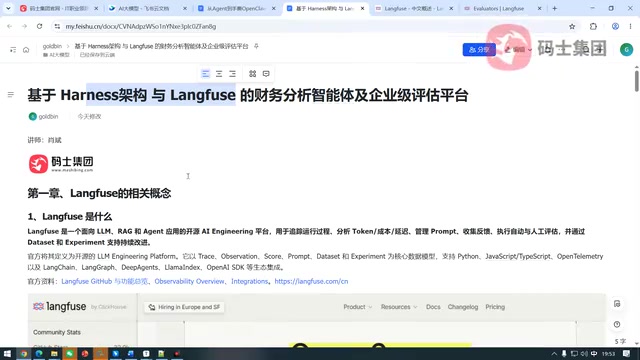
Langfuse is an open-source LLMOps platform for tracing, evaluating, and optimizing LLM and agent applications.
This article introduces the open-source LLMOps platform Langfuse and its capability boundaries. Langfuse is not an agent development framework — it is a dedicated observability and evaluation platform for existing RAG and agent projects. Think of it as four roles behind an AI employee: a flight recorder (tracing execution chains), a quality department (evaluating output), a laboratory (A/B testing prompts and models), and a prompt configuration center (version control and hot reload). It answers key production questions around tool call chains, token costs, latency, and answer accuracy, enabling a data-driven "record → evaluate → experiment → replace" improvement loop. Langfuse does not provide LLMs, vector databases, or infrastructure monitoring, and integrates with LangChain, LlamaIndex, OpenAI Agent SDK, and more.
When taking LLM applications from demo to production, one question is unavoidable: what exactly are the models and agents doing in the live environment? Which tools did they call? How many tokens were consumed, at what cost, with what latency? Are the answers reliable? As projects evolve from single-model setups into complex multi-agent systems, the absence of observability is essentially equivalent to running a black box. Langfuse is an open-source platform built specifically to solve this problem.
This article draws on a hands-on enterprise-level agent tracking and evaluation course by a Bilibili instructor (a Mashibing Education LLM lecturer), and outlines Langfuse's core positioning, capability boundaries, and real-world value. The course's overarching goal is to build a complete logging, tracking, evaluation, and observability solution for a financial analysis multi-agent system developed on the Hugging Face agent architecture (referred to as the "Harness architecture" in the course).
What Exactly Is Langfuse
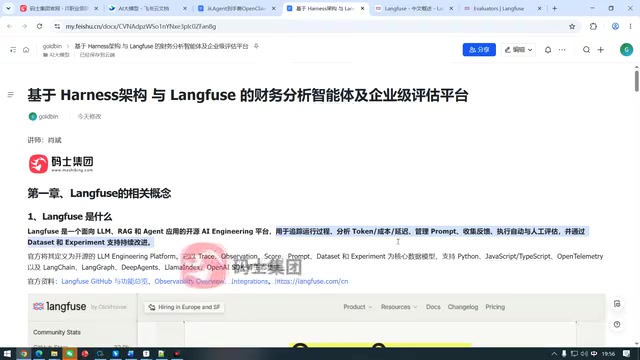
Langfuse's official positioning is an "open-source LLMOps platform for large language models." But that definition alone doesn't fully convey what problem it solves. A more precise description: it is an open-source AI Engineering platform for LLM, RAG, and agent applications. Its primary functions include tracing execution flows, analyzing token costs and latency, managing prompts, collecting feedback, performing both automated and human-annotated evaluations, and enabling continuous improvement through Datasets and Experiments.
There are two key points here. First, Langfuse is a tool for data collection, evaluation, and tracing on already-built RAG or agent projects — it is not a development framework for building agents from scratch. Second, its capabilities are focused on the "observe and optimize" phase: tracing execution chains, analyzing costs and latency, managing prompts, and running various evaluations.
It's worth emphasizing that Langfuse is a platform, not a framework. Developers typically don't use Langfuse to build agents themselves. Instead, they deploy it as a self-hosted service and integrate it with their own LLM, RAG, or agent projects to enable logging and evaluation. It natively supports Python and TypeScript/JavaScript, and integrates seamlessly with major agent development frameworks including LangChain, LangGraph, DeepAgent, LlamaIndex, and the OpenAI Agent SDK.
What is LLMOps? LLMOps (Large Language Model Operations) is a concept derived from DevOps/MLOps, referring to the set of engineering practices around developing, deploying, monitoring, and continuously optimizing LLM applications. Unlike traditional MLOps — which focuses on model training, feature engineering, and offline evaluation — LLMOps emphasizes inference-time chain tracing, prompt version management, token cost control, and online evaluation based on real traffic. As RAG and multi-agent architectures become more common, a single user request can trigger dozens of tool calls and sub-model inferences. Traditional logging systems struggle to structurally reconstruct this call tree, making LLMOps tools essential infrastructure for production-grade LLM applications. In this ecosystem, Langfuse occupies the "observability and evaluation" layer — essentially a combination of APM (Application Performance Monitoring) and a quality evaluation platform for LLM applications.
A Helpful Analogy: Four Departments Behind an AI Employee
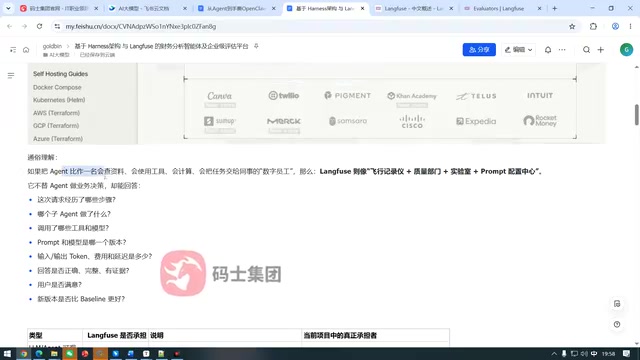
If you think of an agent as a "digital AI employee" that can look things up, use tools, and perform calculations, then Langfuse acts as four supporting roles behind that employee.
Flight Recorder — Traces the full execution of every run, recording what the agent did and which steps it took. Quality Department — Evaluates the quality of the answers the agent generates. Laboratory — When you modify a prompt or swap out a model, you can run tests in the lab first to see if the results improve before deciding to deploy. Prompt Configuration Center — Centralizes prompt version management.
The value of the Prompt Configuration Center is often underestimated. Many developers hardcode prompts directly in their project code, which is fine — but the hidden risk is that prompts inevitably get modified during development, and those changes don't always improve output quality. If quality degrades, can you roll back quickly? Can you switch versions without restarting your RAG or agent service? When prompts are hardcoded, that's nearly impossible. Langfuse's Prompt Management is designed precisely for version control and hot-swapping.
What is Prompt Hot Reload? Prompt hot reload refers to dynamically updating the prompts used by a running application without redeploying or restarting the service. It typically works as follows: prompts are stored in an external configuration center (such as Langfuse's Prompt Management), and the application fetches the currently active version via API before each inference, rather than compiling the prompt statically into the code at startup. The benefit: when a prompt change causes output quality to drop, you can roll back to the last stable version in seconds, without going through a full code release process. For 24/7 production systems, this dramatically reduces the risk window during prompt iteration. Version numbers also ensure that every historical log entry can be precisely mapped to the exact prompt snapshot in use at that time, providing a reliable basis for root-cause analysis of quality changes.
What Questions Can Langfuse Answer
The value of observability ultimately comes down to the critical production questions it can help you answer:
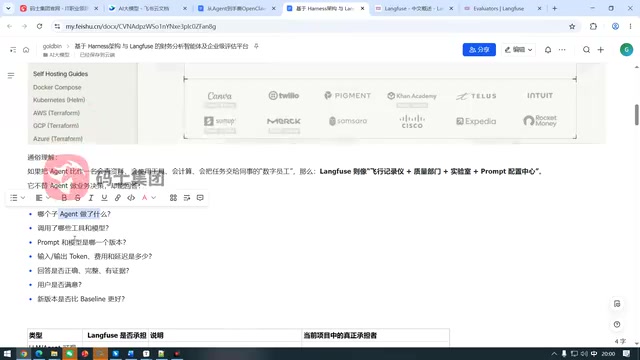
- What steps did this request go through? What did each sub-agent do?
- Which tools and models were called? How long did each one take?
- Which version of the prompt and model is currently in use?
- What are the input/output token counts, costs, and latency figures?
- Was the answer correct? Is there complete accuracy data? Was the user satisfied (can be combined with human annotation)?
- Is the new version better than the current stable version?
The last question maps directly to the "Laboratory" capability: after modifying a prompt or swapping a model, you can compare results in an experiment, and if the new version outperforms the current stable one, you can promote it to production. This "record → evaluate → experiment → replace" feedback loop is the key to moving LLM applications from intuition-driven to data-driven development.
The Engineering Behind the Loop This "record → evaluate → experiment → replace" cycle corresponds to A/B testing and regression testing in engineering practice. In Langfuse's Dataset feature, you prepare a set of test cases with ground-truth answers in advance. Each time you modify a prompt or change a model, you run the full dataset through an Experiment, auto-score the results, and compare against the baseline before deciding whether to deploy. This mirrors the "test before merging" philosophy of CI/CD in traditional software engineering — except the evaluation target shifts from code logic to the semantic quality of model outputs. For early-stage projects that rely heavily on manual review, this automated evaluation pipeline can significantly compress the cycle from "identifying a problem" to "verifying the fix."
Langfuse's Capability Boundaries
Explaining what a tool cannot do is often more important than listing its features. Langfuse handles four things: observability (recording the call chains of models, tools, retrievals, and sub-agents), evaluation and feedback, prompt management, and metrics analysis.
The following are outside its scope: it does not provide an agent development framework; it does not provide LLMs; it does not provide a vector database or knowledge base (you build those yourself); and it does not handle server operations, health checks, or infrastructure monitoring for deployed agents or RAG services. In short, Langfuse focuses on "application-layer observability and evaluation" — it does not handle business logic, model training, or infrastructure ops.
Understanding this boundary helps avoid common mistakes during technology selection. Langfuse is not an all-in-one platform — it is one specialized piece of the observability puzzle. It needs to work alongside development frameworks, model services, vector stores, and infrastructure monitoring systems to form a complete enterprise-grade agent solution.
Summary
For teams pushing LLM applications into production, Langfuse's chain tracing, cost and latency analysis, prompt version management, and evaluation capabilities are nearly indispensable infrastructure. Its open-source and self-hosted nature also gives organizations full control over their data within their own environments. The question of "why use Langfuse" and how to integrate it in practice will be explored further in follow-up content.
Related articles
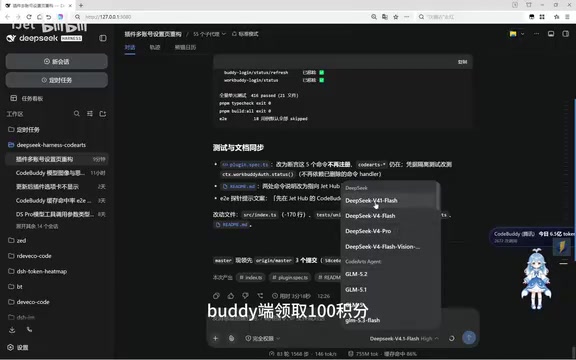
Free DeepSeek V4.1 Flash via DSH: Bulk Point Collection & International WorkBuddy Tested
DSH project update tested: WorkBuddy now offers 100 points per claim, rate limits raised beyond 80M tokens with faster resets, and international WorkBuddy supports free Hunyuan 4 and DeepSeek V4.1 Flash.
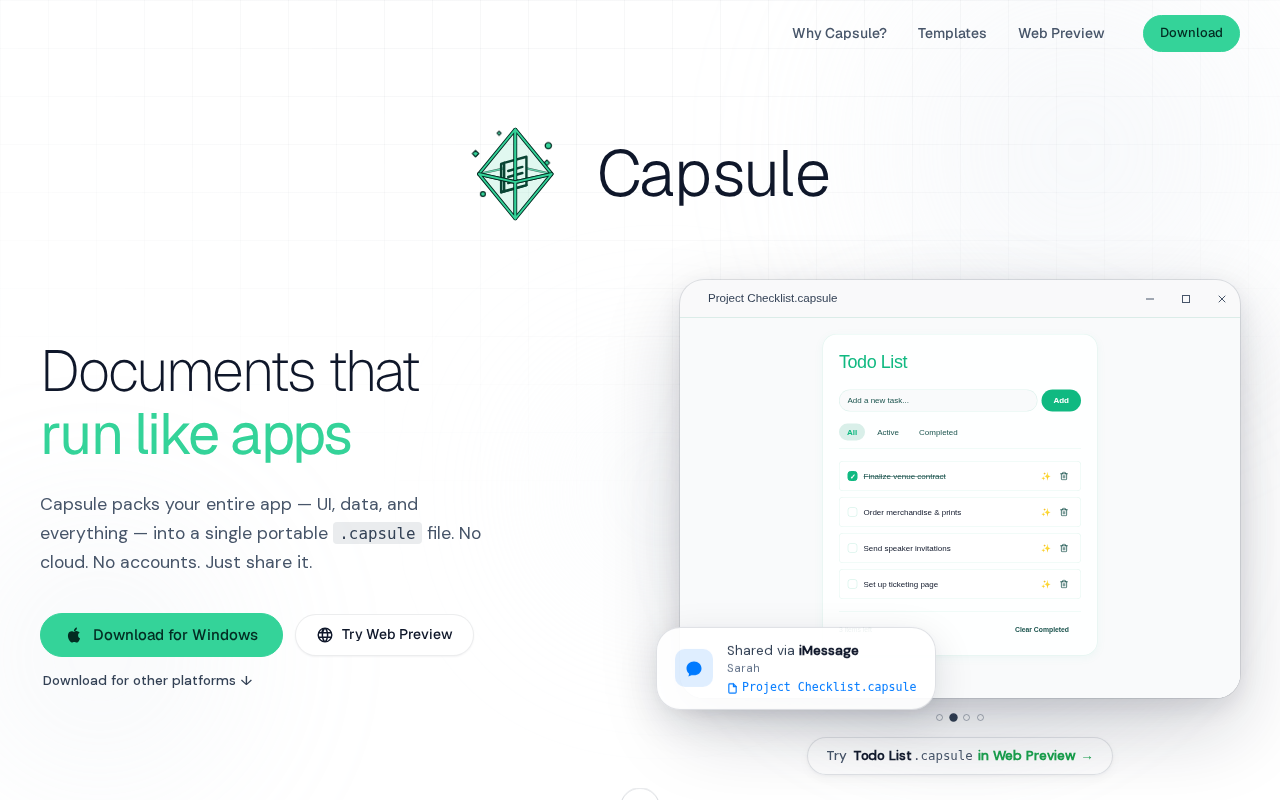
Capsule: Pack Web Apps and Data into a Single SQLite File
Capsule is a Rust/Tauri 2.0 tool that packs HTML web apps and data into a single SQLite file — privacy-first, local storage, portable sharing, with AI support.
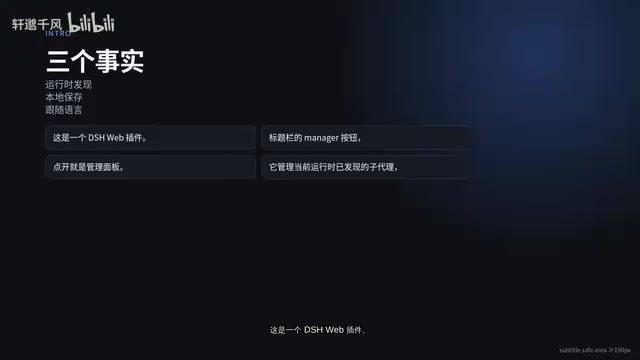
DSH-SUBAGENT-UI Plugin: The Ultimate Sub-Agent Manager for DeepSeek Harness
DSH-SUBAGENT-UI is a DeepSeek Harness browser plugin offering sub-agent overview, search, local categorization, and completion snapshots — install with one command.