What Is MCP? Understanding the Universal Protocol Connecting AI to Tools

MCP is the open protocol that lets AI connect to any external tool through a single unified standard.
Large language models are constrained by their training data and can't proactively access files, databases, or external services. The traditional fix required custom integration code for every tool — costs that scaled exponentially. MCP solves this with a unified client-server standard, letting AI plug into any compliant tool like a universal adapter. Open-sourced by Anthropic in 2024 and built on JSON-RPC 2.0, MCP enables runtime tool discovery and invocation, turning multi-step agent tasks into a standardized engineering pattern — much like USB and HTTP before it.
AI chatbots are impressively smart — yet they're often trapped inside a closed box. They can't see your files or calendar, and they have no access to real-time data. To become truly useful, AI must be able to connect to tools in the real world. The Model Context Protocol (MCP) was built precisely to solve this problem.
The Island Problem: Every Tool Speaks a Different Language
Large language models are genuinely capable, but their knowledge is locked within their training data. They can't proactively read your local documents, query a database, or help you book a meeting. The reason? Every tool has its own unique interface and "language."
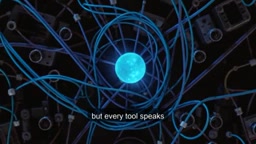
Before MCP, getting an AI to work with an external tool meant developers had to write custom integration code for every single connection. Connecting a calendar required one set of logic; connecting a database required another entirely. This "one-to-one custom" approach scales terribly: the more tools you add, the more integrations you have to maintain, and development costs spiral out of control.
MCP: A Universal Adapter for AI
The core idea behind MCP is to establish a universal standard — a shared language that lets AI communicate with virtually any tool. Think of it as a universal power adapter.

In this architecture, the AI acts as the client, and each tool runs a lightweight server. Both sides agree upfront on a simple, unified communication method, which dramatically reduces the complexity of integration. Developers no longer need to reinvent the wheel for every tool — as long as a tool follows the MCP standard and exposes a server interface, the AI can plug right in.
This is the real value of "one standard, unlimited tools": integrations go from an N×N Cartesian product of custom connections down to a single standardized protocol.
MCP was officially open-sourced by Anthropic in November 2024, and has since gained support from major AI applications including Claude, Cursor, and Zed. On the technical side, MCP uses JSON-RPC 2.0 for communication. An AI client sends a standardized request to an MCP server asking "what tools do you offer?" The server responds with a unified description of available functions and their parameter specifications. This "tool discovery + unified invocation" mechanism means the AI doesn't need to know the implementation details of any tool in advance — it can dynamically discover and use tool capabilities at runtime. Developers simply write a lightweight MCP server adapter for their system (a database, file system, third-party API, etc.), and every MCP-compatible AI client can immediately connect — no separate integration needed for each AI product.
From "Chatting" to "Doing": The True Backbone of AI Agents
With a unified interface in place, a single AI can complete a chain of tasks that were previously hard to imagine: reading your documents, querying a database, searching the web, and booking a meeting — all through the same clean interface.

This leap in capability is exactly what makes AI agents possible. An agent isn't just an assistant that chats with you — it's one that can genuinely take action across your tools.

Behind the scenes, MCP serves as the "port" connecting AI to the real world. It's a surprisingly simple idea, yet it quietly underpins the era of AI agents. When AI is no longer trapped inside a chat window — when it can call real tools to complete real tasks — its practical boundaries are finally opened up.
The defining characteristic of an AI agent is the "plan–execute" loop: the AI breaks a user's goal into subtasks, calls different tools to execute each one in sequence, and dynamically adjusts its next steps based on each result. MCP acts as the unified execution layer in this loop — whether the next step is reading a file, querying a database, or sending an email, the agent makes the call through the same interface, dramatically reducing the engineering complexity of orchestrating multi-step tasks. Compared to early "function calling" approaches that required hardcoding the logic for each tool invocation, MCP hands control of tool description and discovery back to the server side. This gives agents far greater dynamic extensibility, and makes complex, multi-tool composite tasks genuinely achievable.
Why MCP Deserves Your Attention
From an engineering perspective, MCP's significance isn't some dramatic technical breakthrough — it's that it uses standardization to reduce the friction between AI and the outside world. Standardization has historically been the prerequisite for ecosystem explosions: USB did it for peripherals, HTTP did it for the web. As more and more tools begin offering MCP servers, the map of capabilities AI can reach will keep expanding, while the burden on developers actually decreases.
For teams looking to build practical AI applications, understanding MCP's client–server model is a key that unlocks agent development. It transforms the question of "how do I get AI to use my tools?" from a bespoke engineering project into a standardized onboarding process.
The historical pattern of standardized protocols triggering ecosystem booms is well-documented in software: after USB unified peripheral interfaces, the hardware accessories market flourished rapidly; after HTTP established web communication standards, the barrier to building web applications dropped dramatically. MCP faces analogous challenges and opportunities. The ecosystem is still early — MCP server coverage across tools, security auditing standards (such as preventing malicious servers from tricking AI into harmful actions), and cross-vendor interoperability all remain open problems. But with Anthropic continuing to invest in open-source community development, and major players like Microsoft and Google paying increasing attention to the standard, MCP is evolving from a single company's technical proposal into a strong candidate for foundational AI tooling infrastructure. For developers, investing time to understand and practice MCP now means staking a position in a potential industry standard when the cost of doing so is still low.
Related articles

Chain of Thought Isn't Just for AI: How Humans Can Use CoT to Improve Thinking Quality
Chain of Thought isn't just a prompt trick for large models. Starting from a Hacker News discussion, this article analyzes why CoT works for human thinking too, breaks down actionable ways to transfer it, and highlights the key differences between human CoT and machine CoT.
Cloudflare Teams Up with OpenAI: Closi…
Cloudflare Teams Up with OpenAI: Closing the Loop from Vulnerability Discovery to Defense with AI
Cloudflare uses OpenAI Daybreak to investigate security vulnerabilities and generate reviewable remediation plans, while developers use Codex to boost coding efficiency and quality.

Orca Multi-Agent Orchestration in Practice: A Guide to Parallel Collaboration with Claude and Codex
Orca is Stable AI's free open-source agent workbench supporting 34 agents like Claude Code and Codex in parallel. Learn its Git worktree isolation, multi-model orchestration, and mobile management.