What Is Vibe Coding? Build Apps with AI and Zero Code
Vibe Coding lets users describe requirements in natural language and have AI generate code—efficient but with hidden security and maintenance risks.
Vibe Coding was introduced by OpenAI co-founder Andrej Karpathy in February 2025. The core idea: users describe requirements in natural language, AI generates all the code and shows the result, and users only keep giving feedback without editing code directly. Its barrier to entry is extremely low, letting shop owners, students, and creators turn ideas into working tools in minutes, and experienced programmers use it to quickly validate ideas and skip boilerplate. But a 2025 VeraCode study found that about 45% of the tested AI coding tasks contained security vulnerabilities; not reading the code can plant hidden risks, and non-technical users can get stuck when complex crashes occur. So it's best to start with low-risk small projects, have an experienced developer review anything involving passwords, payments, or personal data, and ask AI to explain code to learn as you build.
From Social Media Joke to Word of the Year: The Rise of Vibe Coding
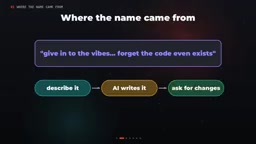
If you can describe what you want the way you'd chat with a friend, and AI writes the app for you—without you ever looking at the code—that's Vibe Coding. It went from a social media joke to Collins Dictionary's Word of the Year in under a year. The concept was first introduced by OpenAI co-founder and AI researcher Andrej Karpathy in February 2025. He described himself as "fully immersed in the feeling, forgetting the code exists"—you simply say what you want, AI writes the code, and then you keep giving feedback. Karpathy thought this approach was perfect for quick weekend projects, but the name quickly spread throughout the entire developer community.
It took off so fast because the barrier to entry is extremely low. Shop owners, students, and creators can turn an idea into a working tool in minutes—something that used to require hiring a developer. Experienced programmers also use it to quickly validate ideas and skip tedious boilerplate code.
Andrej Karpathy is one of the founding team members of OpenAI, a former Director of AI at Tesla where he led development of the Autopilot vision system, and later a researcher at OpenAI. He is known for his contributions to deep learning, computer vision, and large language models, and has long educated the public about AI through social media and teaching videos (such as the Stanford CS231n course). It's precisely because he combines hands-on engineering with AI research background that his public description of "letting AI write programs without reading the code" quickly resonated with the developer community, turning Vibe Coding from a personal experience share into a widely discussed practical concept.
How Vibe Coding Works: Description Is Development
In practice, you enter a prompt like "make a website for my bakery with a menu and an order form." The AI generates all the code and shows you the result. If something's wrong, you don't need to fix the code yourself—just say "make the buttons bigger" or "the form doesn't work," and the AI tries again. Tools designed for this shorten the time from idea to working app to just minutes.
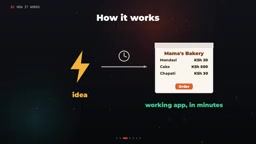
This experience lets non-technical people independently build simple tools, unleashing a lot of creativity. But the core of the process is "not touching the code," which also plants hidden risks.
The Hidden Risks: Security and Maintenance Pitfalls of AI Code
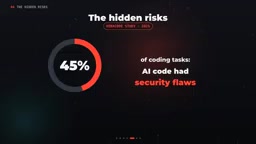
If you don't read the code, you don't know what's in it. A 2025 study by security firm VeraCode found that across the coding tasks tested, about 45% of AI-generated code contained security vulnerabilities. This doesn't mean Vibe Coding is unusable—it's a reminder that when an app handles passwords, payments, or other people's personal data, deploying AI code directly is high risk.
What's worse is that when an app crashes in complex ways, someone who can't read the code may be completely stuck. Simply telling AI to "fix it again" doesn't always solve the problem and sometimes even introduces new bugs. So for serious projects, an experienced developer must review the critical parts.
VeraCode is a software company focused on static code analysis and application security testing, and its research is often used to assess security flaws in development practices. Static analysis tools scan source code without running the program, identifying common vulnerability patterns such as injection attacks, insecure default configurations, and hardcoded secrets. The 2025 study cited in the article had AI complete typical coding tasks and then used such tools to inspect the generated code, arriving at the conclusion that about 45% contained security vulnerabilities. Understanding this detection method helps interpret what the number means: it reflects known risk patterns at the code level, not actual cases of being attacked.
Boilerplate code refers to the repetitive, mechanical parts of a project that require almost no creative judgment—for example, configuration files, route registration, form validation, database connections, and base styles. This kind of code is large in volume but simple in logic, which is exactly what Vibe Coding excels at generating quickly. This is also why the article earlier mentions experienced programmers using it to "skip tedious boilerplate code": AI can rapidly produce structurally correct templates, and developers only need to focus on business logic. But boilerplate code can also hide insecure defaults, so "saving effort" doesn't mean "you can skip reading it entirely."
How to Try Vibe Coding Safely
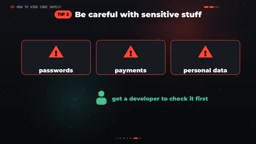
If you want to experience Vibe Coding, start with low-risk small projects: personal websites, small games, simple tools. Be extra cautious with features involving passwords, payments, or other people's private data.
Another good habit is to learn as you build. Ask AI to explain the code it writes—it may be one of the best programming teachers you'll find. This way you enjoy AI's efficiency while gradually understanding the underlying logic, giving you better judgment when problems arise.
Conclusion: Embrace Efficiency, but Don't Lose Your Judgment
Vibe Coding makes software development more approachable, is great for rapid prototypes and simple tools, and is opening the door to programming for everyone. But AI code can hide security flaws, so be cautious when handling serious matters. It's a powerful accelerator, not a replacement for thinking.
If you had the chance, what app would you build with Vibe Coding?
Related articles
27-Model Code-to-Video Test: Claude Opus 5.5 Takes the Crown, But the Real Value King Is Someone Else
Artificial Analysis' Code2Video Benchmark has 27 models write HTML videos from pure code: Claude Opus 5.5 tops at 1536, while GPT 6.1 ranks fourth at ~1/10 the cost.

Writing Code with Claude Code Means Passing a Network Admin Exam First: The Pain of Configuring AI Programming Tools
Claude Code's real barrier isn't coding ability but account, network, and regional configuration. Why AI programming tools are painful to set up — and how developers should choose pragmatically.
Jev in Practice: A Decision Model That Replaces Token-by-Token Decoding with a Single Prefill
Breaking down Jev's inference paradigm: skip token-by-token decoding and use a single prefill forward pass to output choices, ordinal scores, and booleans. Comparing encoder and decoder paths, multi-question mask design, duplicate token pitfalls, and RLCD with GRPO for probability calibration training.