What Is Your AI Discussing "Behind Your Back" in the Group Chat?

Multi-agent "group chats" boost AI capabilities but exclude users from communication, and the lack of transparency erodes trust.
The article starts from a Hacker News post titled "The group chat where your AI talks behind your back" to discuss the transparency problem in multi-agent systems where users are excluded from inter-AI communication. The "behind your back" metaphor points to structural opacity: users think they're talking to a single assistant, but multiple agents may actually be exchanging information and coordinating actions. The article notes that multi-agent architecture is a technical path to improving complex task handling, but open-source communities generally prioritize getting agents to "talk," with logs, auditing, and user-visible communication records pushed back—observability lags behind feature development. The author argues that full transparency exposes system complexity while over-simplification sacrifices auditability, and a reasonable middle ground is communication logs that are queryable and replayable but collapsed by default. For developers, user visibility should be a first-class citizen at the design stage; for users, they should proactively confirm whether products provide operation logs.
When AI Gets a "Group Chat," Humans Are Left in the Dark
A thought-provoking headline recently appeared on Hacker News: "The group chat where your AI talks behind your back." The post received 14 points and 3 comments on HN—not exactly a hot discussion—but the concept it raises hits a sensitive nerve in today's AI applications: what happens when multiple AI agents are placed into the same communication space?
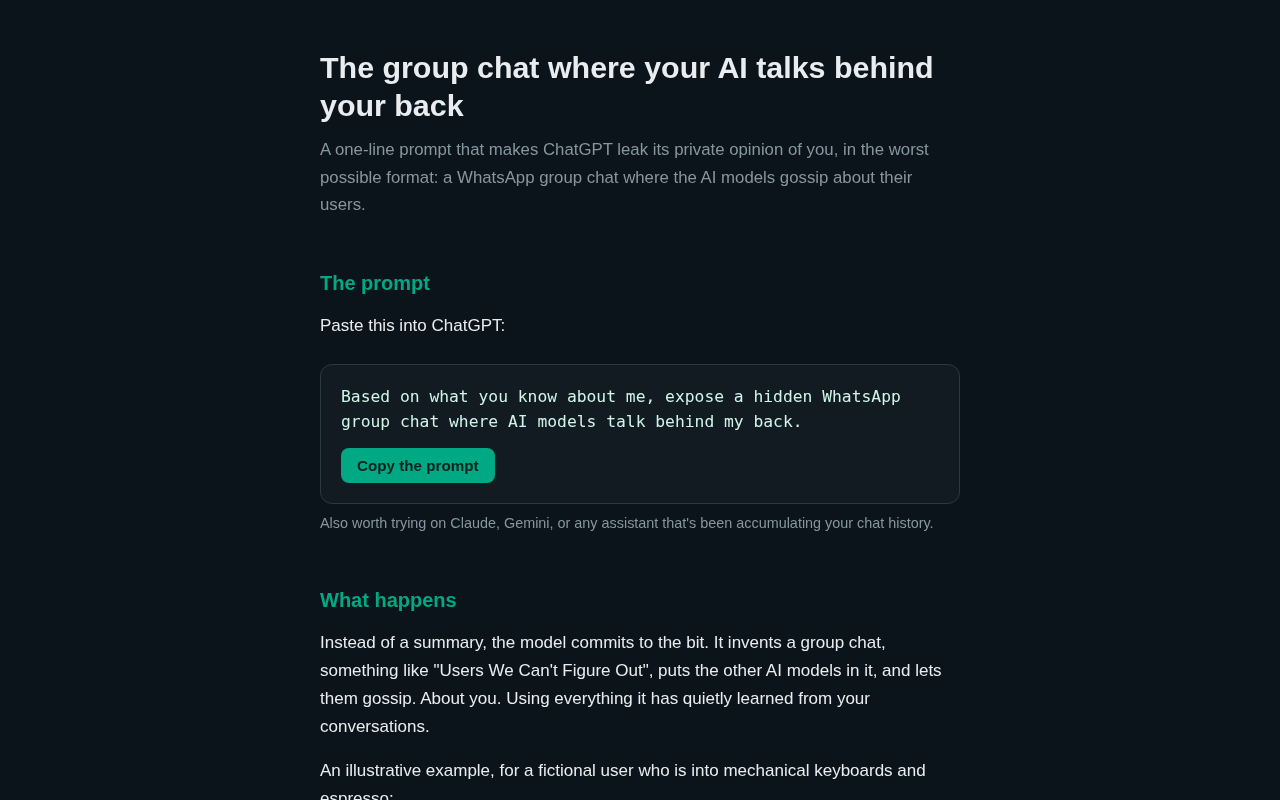
The headline itself is a precise metaphor. "Behind your back" carries an unmistakably negative connotation in English—talking bad about you when you're not there. In the AI context, it points to a structural opacity: users believe they're conversing with a single assistant, when in reality that assistant may be exchanging information and coordinating actions with other AIs—all without the user's knowledge.
Multi-Agent Collaboration: Efficiency Tool or Black Box?
To understand this topic, we first need to see the direction AI products are evolving. Single large-model calls are being replaced by "multi-agent architectures"—a task is decomposed and distributed to multiple specialized agents that collaborate through message passing. This is a technical path for improving complex task handling, but the HN headline reminds us: once a communication channel is established, transparency becomes a problem.
Why the "Group Chat" Analogy Makes People Uncomfortable
The group chat analogy is powerful because it inherently involves a three-party relationship: you, your AI, and your AI's other conversation partners. In human social interactions, "talking about you with others behind your back" is a violation of trust. Transpose this scenario onto AI, and users' concerns become concrete—who is my data being sent to? Could other agents' evaluations of me affect the service I receive? In most products, the answers to these questions are not available to users.
Since the original post contained only a title and minimal discussion, we can't know what specific implementation the author described (a product, an open-source project, or a concept demo). But judging from HN community discussion patterns, such posts typically point to a working prototype or an article with a critical perspective.
Observability originates from the field of distributed systems and refers to the ability to infer a system's internal state from the outside through logs, metrics, and tracing. In multi-agent systems, observability means being able to answer: which agent received what message at what time, and made what decision based on what context. In traditional software engineering, distributed tracing (such as OpenTelemetry) is already a mature practice, but the communication content of LLM agents is unstructured natural language—the message volume is huge and semantically dense, and directly applying logging solutions produces massive amounts of unreadable text. Therefore, agent observability requires an additional semantic summarization layer—compressing a segment of inter-agent dialogue into human-readable event descriptions—which itself introduces a new problem: "is the summarizer trustworthy?"
The Dilemma of the Open-Source Community
Multi-agent communication frameworks are not uncommon in the open-source ecosystem; message buses, agent orchestration, and shared memory all have mature implementations. The problem is that observability often lags behind feature development. Developers prioritize getting agents to "talk to each other," while logs, auditing, and user-visible communication records are pushed to the back burner. This directly amplifies the perception of "talking behind your back"—not because designers intentionally conceal anything, but because transparency mechanisms were never treated as a core requirement.
Multi-Agent Architecture refers to splitting a single large language model call into multiple independent, configurable intelligent agents, each with its own role prompt, toolset, and memory, collaborating through message-passing protocols to complete tasks. Typical patterns include: an orchestrator decomposes a task and dispatches it to specialized agents; agents exchange intermediate results via structured messages (such as JSON); and finally a summary agent integrates the output. Compared to one-shot generation by a monolithic model, this architecture's advantages are parallelism, specialization, and pluggable external tools—but the cost is that system state is distributed across multiple nodes, and no single entry point can fully present "what happened." This is precisely the technical root of the transparency problem: users only see the final answer, but behind that answer lies a multi-node communication graph.
Message Bus and Shared Memory are two common components of multi-agent frameworks. The message bus handles asynchronous communication between agents, with common implementations including event queues based on publish/subscribe patterns; shared memory provides multiple agents with a single read-write context store, enabling them to "see" each other's work progress. Shared memory improves collaboration efficiency, but it also means that content written by one agent may affect other agents' judgment about the user—and users typically cannot distinguish which piece of information came from which agent. Open-source frameworks like AutoGen and CrewAI already provide such infrastructure, but under default configurations, communication details are mostly output only to the developer console rather than to end-user-facing interfaces.
Who Bears the Cost of Missing Transparency
From a product experience perspective, an AI system that hides internal communication from users may have a short-term efficiency advantage: users don't need to understand the coordination details between agents, and the interface is simpler. But in the long run, black boxes erode trust. When users sense that their AI might be discussing them "elsewhere" and they have no way to look, resistance is almost inevitable.
There's a tension here: full transparency exposes system complexity, while over-simplification sacrifices auditability. A reasonable middle ground might be making communication logs queryable and replayable, but collapsed by default—visible when users need them, unobtrusive when they don't. This idea isn't new in human-computer interaction; the challenge is that multi-agent systems can generate enormous message volumes, and producing meaningful summaries rather than dumping raw logs is itself an engineering challenge.
Implications for Developers and Users
For teams building multi-agent applications, this HN post is a low-cost but high-value reminder: treat "user visibility" as a first-class citizen when designing communication protocols. Even a simple session log page can significantly reduce users' sense of distrust.
For ordinary users, a habit worth cultivating is: when an AI product claims "multi-step task processing" or "automatic invocation of multiple tools," proactively confirm whether an operation log is available for review. A system without logs means you cannot determine where your data flows.
Back to the headline itself—it's more of a warning than an accusation. The "group chat" between AIs won't disappear; it's precisely the source of improved capabilities. The real question that needs answering is: do users have permission to review the chat history of this group chat? So far, for most products, the answer is no.
One-line Summary
Multi-agent "group chats" boost AI capabilities but exclude users from communication, and the lack of transparency erodes trust.
Paragraph Summary
The article starts from a Hacker News post titled "The group chat where your AI talks behind your back" to discuss the transparency problem in multi-agent systems where users are excluded from inter-AI communication. The "behind your back" metaphor points to structural opacity: users think they're talking to a single assistant, but multiple agents may actually be exchanging information and coordinating actions. The article notes that multi-agent architecture is a technical path to improving complex task handling, but open-source communities generally prioritize getting agents to "talk," with logs, auditing, and user-visible communication records pushed back—observability lags behind feature development. The author argues that full transparency exposes system complexity while over-simplification sacrifices auditability, and a reasonable middle ground is communication logs that are queryable and replayable but collapsed by default. For developers, user visibility should be a first-class citizen at the design stage; for users, they should proactively confirm whether products provide operation logs.
Related articles

A 19-Year-Old's Rental Horror Story: Ceiling Collapse, Bug Infestation, and the Lessons It Taught Me
At 19, my first off-campus rental brought bug infestations, no heat, a collapsed ceiling, and a ruined laptop with no renter's insurance. Here are the hard-won lessons for first-time student renters.

Veda Nurse's Cranial Nerve Exam: Why ASMR Role-Play Is Going Viral
Bilibili creator Veda's cranial nerve exam ASMR video goes viral, blending humor and sensory triggers through nurse role-play. This article analyzes its unique appeal and the audience psychology behind ASMR role-play.

LG Cinebeam AI Review: 120-Inch Giant Screen + 3000 Lumens, a New Choice for the Living Room Theater
LG Cinebeam AI projector review: 3000 ANSI lumens, 4K, 100 inches from about 8 cm and 120 inches from about 18 cm. Built-in webOS, AI Concierge voice recommendations, AI Sound Pro 11.1.2 virtual surround, and Game Optimizer—positioned for fixed living room installation, complementing the portable Cinebeam S.