What It Means That Anthropic Lists AI Backlash as a Risk Factor in Its IPO

Anthropic listing AI backlash as an IPO risk factor signals the AI industry's shift toward risk management.
Anthropic has reportedly listed "AI backlash" as a formal risk factor in its IPO documentation, reflecting a broader industry shift from unlimited growth narratives to risk management. This disclosure acknowledges that public resistance—driven by employment anxiety, copyright disputes, and environmental concerns—could materially impact AI companies' business prospects. As AI firms prepare for public markets in 2025, balancing technological optimism with social responsibility and regulatory compliance becomes critical.
A Thought-Provoking IPO Signal
According to sources, AI unicorn Anthropic has listed "AI backlash" as a formal risk factor in its IPO (Initial Public Offering) documentation. This detail might seem unremarkable—after all, nearly every prospectus includes a lengthy list of risk factors—but for a company known for its "safety-first" approach to AI, formally acknowledging public resistance to AI technology in regulatory filings is an industry signal worth examining closely.
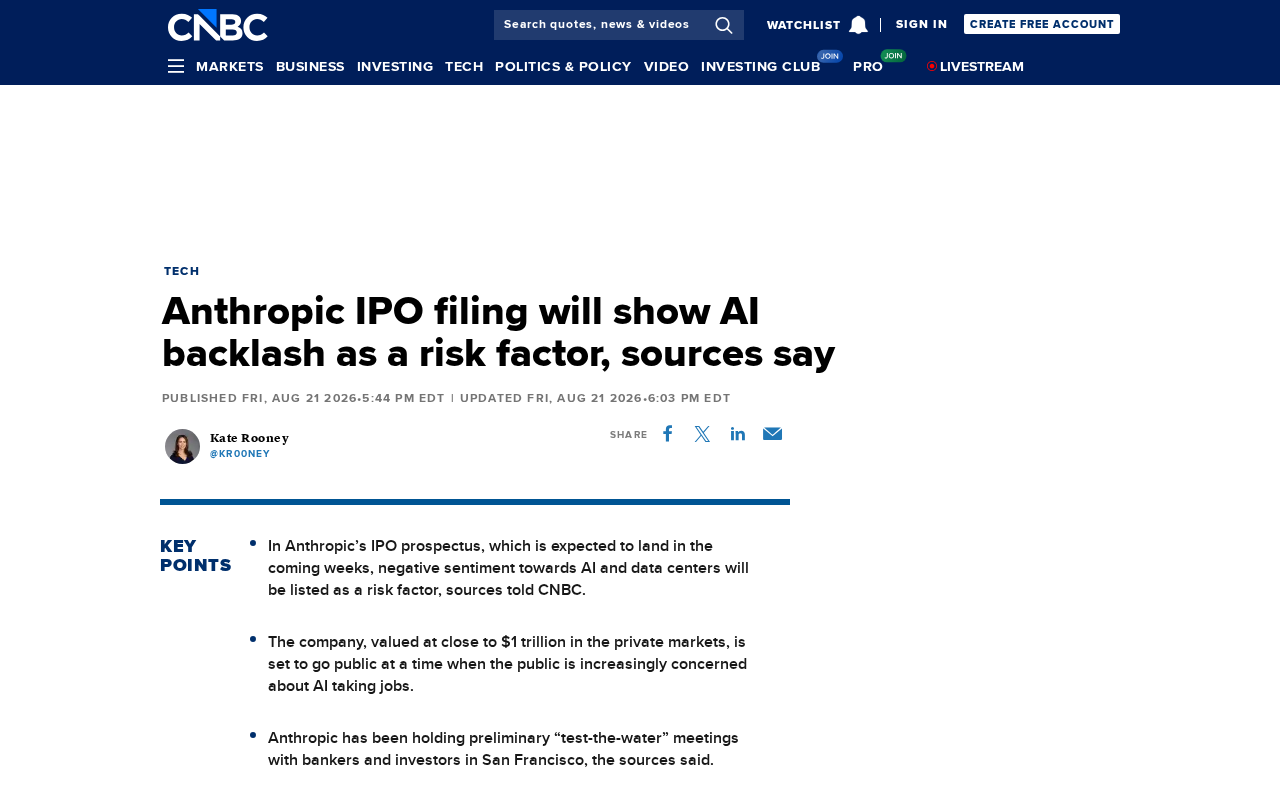
Under U.S. securities law, companies conducting an IPO must file an S-1 registration statement with the SEC (Securities and Exchange Commission). The "Risk Factors" section of this document is a legally mandated core chapter where companies must comprehensively and honestly list all known risks that could materially and adversely affect the company's business, financial condition, or stock price. This system originates from the disclosure principles in the Securities Act of 1933, designed to protect investors' right to information. If a company fails to adequately disclose known risks and the risk later materializes causing a stock price decline, the company may face securities fraud litigation. As such, risk factor drafting serves both a legal defense function and an investor communication function.
As the developer of the Claude series of large language models, Anthropic has consistently positioned itself as a leader in AI safety. Founded in 2021 by siblings Dario Amodei and Daniela Amodei, the core team largely came from OpenAI. The company's central technical philosophy is "Constitutional AI" (CAI), an alignment technique that guides AI model behavior through a preset set of human value principles. Specifically, during training, the model references these "constitutional provisions" for self-critique and correction, rather than relying entirely on item-by-item feedback from human labelers (RLHF). As of 2025, Anthropic's valuation has exceeded $60 billion, with its flagship Claude series forming a three-way competitive landscape alongside OpenAI's GPT and Google's Gemini in the enterprise AI application market. The company's major investors include tech giants such as Google, Salesforce, and Amazon.
By proactively disclosing AI backlash risk in its IPO filing, this move reflects the company's clear-eyed awareness of the current AI discourse environment and mirrors the deeper societal tensions facing the entire generative AI industry.
What Is AI Backlash?
From Technological Optimism to Public Vigilance
"AI backlash" refers to the pushback and resistance from the general public, regulators, and even industry practitioners against the rapid expansion of artificial intelligence technology. This sentiment stems from multiple sources:
- Employment anxiety: Generative AI's impact on white-collar jobs, creative work, and programming has triggered widespread concern.
- Copyright and data disputes: The legal legitimacy of training data sources for large models remains a focal point of ongoing litigation.
- Information security: Deepfakes and AI-generated misinformation pose threats to social trust.
- Energy consumption and environment: The power demands of large-scale data centers have raised sustainability questions.
Technological backlash is not unique to AI. Historically, nuclear energy faced decades of public resistance after the Three Mile Island and Chernobyl incidents; genetically modified foods (GMOs) still face strict restrictions in Europe; and social media encountered a global regulatory wave after the 2018 Cambridge Analytica scandal. For the AI industry, backlash signals since 2023 have been quite prominent: the Hollywood writers' and actors' union strikes made AI usage restrictions a core demand; The New York Times sued OpenAI for copyright infringement; the EU passed the world's first comprehensive AI regulatory framework (EU AI Act); and Italy temporarily banned ChatGPT. These events demonstrate that AI backlash is no longer merely a matter of sentiment—it is translating into concrete legal and commercial constraints.
When these concerns coalesce into a broader social sentiment, they can transform into real-world constraints on AI companies—whether through stricter regulation, consumer boycotts, or erosion of investor confidence.
Why Include It as an IPO Risk Factor?
Listing a factor as an IPO risk is standard practice within the U.S. securities regulatory framework. Companies are obligated to fully disclose uncertainties that could affect their operations and stock price to potential investors. Formally including "AI backlash" means Anthropic believes that a shift in public sentiment could materially impact its business prospects—not merely remain at the level of public discourse.
The Deeper Industry Implications of Anthropic Disclosing AI Backlash Risk
The Double-Edged Sword of the AI Safety Narrative
Anthropic's brand foundation rests on "responsible AI." The founding team largely came from OpenAI, championing safety-focused technical approaches like Constitutional AI. However, the more a company emphasizes safety, the more it must confront a paradox: the company must acknowledge that AI itself poses risks worth being vigilant about—otherwise "safety" loses its very premise. Including AI backlash as a risk factor is, in some sense, a natural extension of this narrative logic—it is both an honest disclosure and a reinforcement of the company's positioning.
Shifting Capital Market Attitudes Toward AI Companies
Over the past two years, AI has been the hottest theme in capital markets. But as valuations soar and commercial deployment falls short of expectations, investors have begun more cautiously evaluating the long-term sustainability of AI companies. Despite generative AI attracting hundreds of billions of dollars in investment during 2023-2024, the industry faces mounting commercialization challenges. First is the "revenue-valuation inversion" problem—most AI startups' annual recurring revenue (ARR) cannot remotely justify their astronomical valuations. Second is "moat anxiety"—as open-source large models (such as Meta's LLaMA series) continue to narrow the performance gap with closed-source models, competitive advantages at the pure model layer may prove unsustainable. Furthermore, while AI inference costs are declining rapidly, enterprise customers' willingness to pay and depth of usage have not yet met investors' optimistic expectations. Together, these factors are shifting capital market valuation logic for AI companies from "storytelling" to "showing numbers."
Listing societal backlash as a risk indicates that even leading AI companies must engage in "expectation management" at the prospectus stage, avoiding future trust crises that could arise from excessive optimism.
The AI Industry Narrative Shifts from Unlimited Growth to Risk Management
You may not have noticed, but this news currently comes from "sources" and has not been officially confirmed by Anthropic. Discussion has been relatively limited (only 10 upvotes and 3 comments on HackerNews). Therefore, we should remain cautious and avoid over-interpretation.
Regardless of how the final document is worded, this development points to a trend that is taking shape: the AI industry narrative is shifting from "unlimited growth" to "risk management." 2025 is widely viewed as a window for concentrated AI company listings. Beyond Anthropic, CoreWeave (AI infrastructure), Databricks (data and AI platform), and other companies are reportedly preparing for or have already completed IPOs. But the public market environment facing AI companies is vastly different from the 2021 tech IPO boom: the interest rate environment is higher, investors have stricter profitability requirements, and discussions of an "AI bubble" continue to intensify. In this context, the risk disclosure strategy in AI companies' prospectuses becomes especially important—they must demonstrate growth potential to attract investors while adequately disclosing risks to meet compliance requirements and manage market expectations, avoiding post-listing stock price crashes caused by expectation gaps.
As more AI companies move toward public markets, how to strike a balance between technological optimism, social responsibility, and regulatory compliance will become a key proposition in determining their long-term value.
For observers of the AI industry, Anthropic's IPO filing (if ultimately disclosed) may serve as an important reference sample—demonstrating how AI companies, in the most formal of settings, candidly confront the societal controversies that technology brings.
Key Takeaways
Related articles

Trump's Request to Rename the Atlantic Rejected by Google; 1Password Lets AI Agents Log In Securely
The Vergecast roundup: Trump's request to rename the Atlantic the 'Trump Ocean' was politely declined by Google's CEO; 1Password's new feature lets AI agents log into accounts without touching passwords; OPPO launches the world's first 200-megapixel phone, the Find X10 Pro Max. All three point to the boundaries of tech authorization and trust.

The Truth About American College Party Culture: The Risks Schools Won't Admit
Behind American college party culture, the administration's "don't ask, don't tell" attitude is amplifying freshman risks. This article analyzes how the pandemic strengthened Greek dominance, freshmen's difficulty accessing safety information, and the chain reactions caused by a culture of denial.

OpenAI Reportedly Raising $30B at $1.25T Valuation Ahead of IPO
OpenAI is planning a $30B funding round at a possible $1.25T valuation, paving the way for an IPO. If completed, it would set a private company valuation record. This article analyzes the funding size, pre-IPO logic, and industry signals.