Arena AI Agent: A Coding Agent Embedded in GitHub That Takes You from Idea to Shipping in Minutes
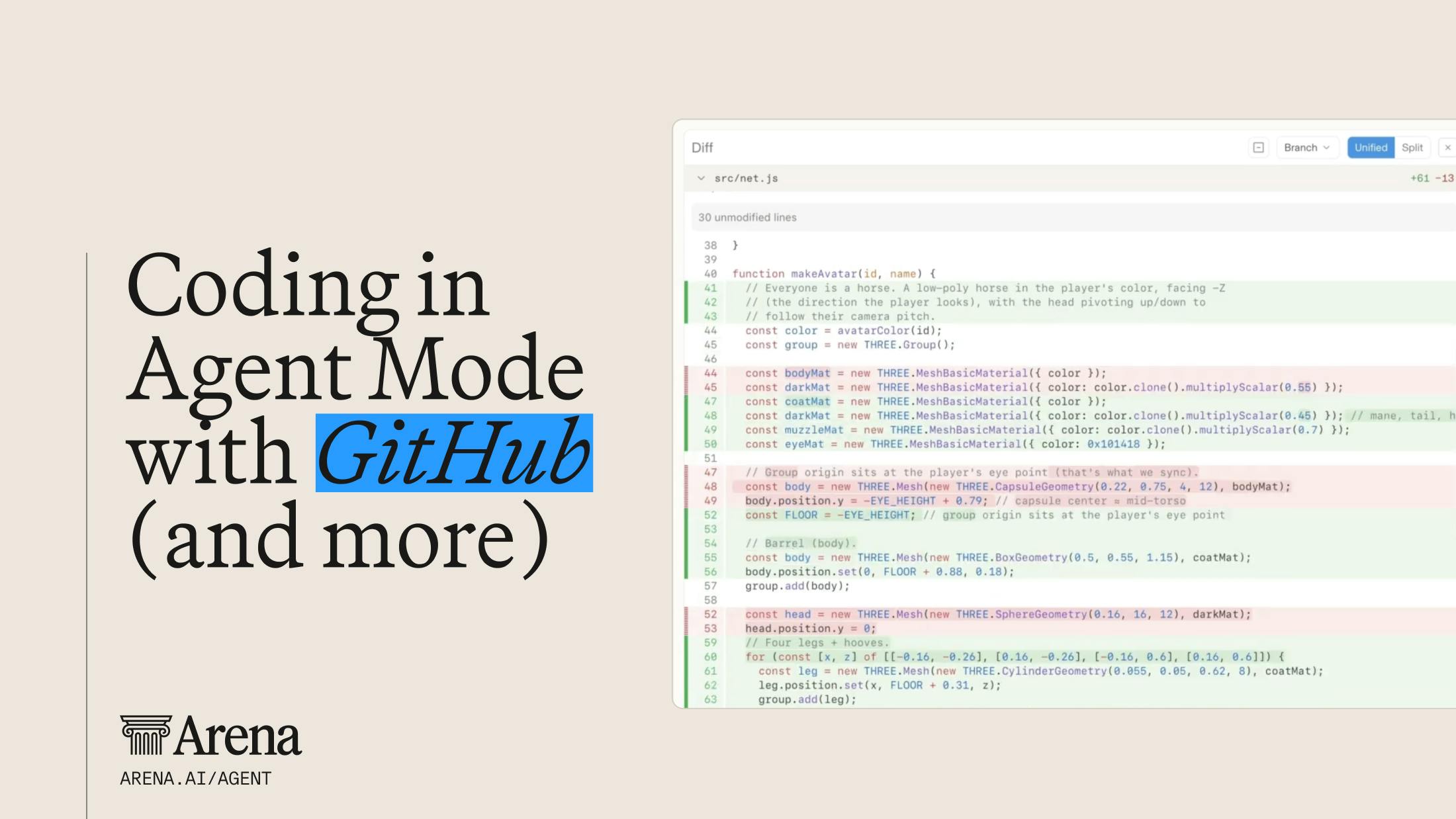
Arena AI Agent embeds a coding agent into GitHub for seamless idea-to-shipping workflow in the browser.
Arena AI Agent integrates a coding agent directly into GitHub, enabling developers to go from idea to shipped code without leaving the browser. By leveraging Agent Mode and deep GitHub integration, it creates a complete automation loop—connecting repos, completing tasks, and pushing results. Positioned between platform-native tools and independent agents, Arena addresses context switching costs but faces competitive pressure from GitHub Copilot Workspace, Devin, and Cursor.
In an era of countless AI programming assistants, how well a coding agent truly integrates into a developer's daily workflow has become the key metric for measuring its practicality. Arena AI Agent, which recently launched on Product Hunt, offers its own answer: embed the coding agent directly into GitHub, allowing developers to complete the entire journey from idea to shipped code without leaving their browser.
Making the Coding Agent Live Where the Code Lives
Arena AI Agent's core philosophy can be summed up in one sentence: For a coding agent to be truly useful, it must exist where work actually happens—on GitHub.
This insight strikes at a real pain point with current AI programming tools. Most AI coding assistants on the market today either exist as standalone IDE plugins or require users to constantly switch between web pages, terminals, and code repositories. This fragmented experience means developers spend time copying and pasting code, manually creating branches, and submitting PRs—the time saved by AI is often consumed by the overhead of context switching.
This phenomenon is known in software engineering research as "Context Switching Cost." According to a joint study by Microsoft Research and GitHub, developers experience more than 10 context switches between tools per day on average, requiring 10-15 minutes after each switch to re-enter a "Flow State." This means that even if AI tools cut code generation time by 50%, the net efficiency gain may be far lower than expected if developers need to constantly jump between IDEs, terminals, browsers, and code review platforms. This is why "deploying tools where work actually happens" has become a design consensus for the new generation of developer tools.
Arena's approach is to deploy the agent directly into GitHub—the central hub for developer collaboration. As of 2024, GitHub has over 100 million developer users and more than 420 million code repositories, making it the de facto standard platform for both the open-source world and enterprise development. GitHub is not just a code hosting tool; its collaboration model built around Pull Requests has profoundly reshaped modern software development workflows—code review, continuous integration, project management, and documentation maintenance all revolve around GitHub. This gives any tool with deep GitHub integration an inherently lower adoption barrier and higher user stickiness.
Through deep integration with GitHub and by leveraging its Agent Mode's underlying infrastructure, Arena achieves a coherent workflow loop: connect repository → complete coding task → push results—all without leaving the browser. Agent Mode here refers to an operational mode where AI no longer passively responds to single commands but can autonomously plan and execute multi-step tasks. Technically, Agent Mode typically encompasses four core capabilities: Task Decomposition, Tool Use, Environment Awareness, and Self-Correction. For example, when a developer issues the instruction "fix the validation bug on the login page," the agent needs to autonomously: locate relevant code files, understand existing logic, write fix code, run tests for verification, and create a Pull Request—a series of operations. This architecture is fundamentally different from traditional code completion models—the latter is "human-driven, AI-assisted," while Agent Mode is "human-supervised, AI-executed."
From Idea to Shipping: The Complete End-to-End Task Automation Loop
The product's tagline is refreshingly direct—"Get real work done, moving from idea to shipping in minutes." The keywords here are "real work" and "shipping."
Emphasizing Real Delivery Over Code Snippet Generation
Many AI programming tools excel at generating code snippets, but real software engineering involves far more than writing a few lines of code: understanding the existing codebase structure, following project conventions, working on the correct branch, passing CI checks, and ultimately merging into the main trunk. CI (Continuous Integration) is a core practice in modern software engineering—developers frequently merge code changes into a shared trunk, with each merge triggering automated build and test pipelines to catch integration errors early. A typical GitHub CI/CD workflow includes: developer commits code → triggers GitHub Actions automated workflow → runs unit tests, code style checks, security scans → creates Pull Request upon passing → manual code review → merges to main branch → automatic deployment. By targeting "shipping" (delivery) as the endpoint, Arena aims to cover the entire chain from task understanding to result delivery, meaning the AI agent needs to understand and participate in multiple stages of this pipeline, rather than stopping at the writing assistance phase.
Seamless In-Browser Development Experience
Keeping work within the browser is central to Arena's experience design. Developers don't need to configure complex local development environments or jump between multiple tools. For tasks like quick bug fixes, implementing small features, or handling to-do items, this ready-to-use model significantly reduces startup costs, allowing the efficiency advantages of AI programming assistants to be fully realized.
Arena's Position in the AI Programming Tool Competitive Landscape
From its Product Hunt category tags, Arena AI Agent positions itself at the intersection of Developer Tools, Artificial Intelligence, and GitHub. This space is currently intensely competitive—GitHub's official Copilot Workspace, Devin, Cursor, and various GitHub Actions-based automation agents are all vying for developer attention.
These competitors each represent different evolutionary paths for AI programming tools. GitHub Copilot Workspace is GitHub's official AI-native development environment, leveraging platform advantages for direct integration within the GitHub ecosystem, emphasizing full-process AI assistance from Issue to Pull Request. Devin, developed by Cognition Labs, positions itself as "the world's first AI software engineer," emphasizing end-to-end autonomous completion of complex engineering tasks with its own sandbox development environment and browser. Cursor is an AI-enhanced IDE built on VS Code that deeply integrates large language models for code understanding, generation, and refactoring, focusing on optimizing the local development experience. These three represent three different technical approaches—"platform-native," "independent autonomous agent," and "enhanced IDE"—while Arena has chosen a third-party deep integration path that sits between platform-native and independent agent.
It's worth noting that the "GitHub Actions-based automation agents" mentioned above rely on GitHub's built-in CI/CD and automation platform launched in 2019. GitHub Actions allows developers to define automated Workflows through YAML configuration files that execute automatically when triggered by GitHub events such as code pushes, Pull Request creation, or Issue comments. For AI coding agents, GitHub Actions provides a natural execution environment—the agent can run as an Action, gaining read/write access to code repositories, performing code generation, test execution, code review, and other operations, then feeding results back to developers in the form of Pull Requests or comments. This event-driven architecture enables AI agents to participate in the development collaboration process like team members.
Arena received 76 votes on Product Hunt, ranking 18th that day, with 3 comments. For developer tool products, this performance is moderate—indicating that the product concept has gained some recognition but hasn't yet generated explosive community buzz.
For products like this, the real test lies in reliability during actual use: Can the agent accurately understand ambiguous natural language task descriptions? Does the generated code conform to project standards? How does it perform in complex codebases? These are the critical factors that determine whether users transition from "trying it out" to "long-term adoption."
Trend Signals in AI Programming Tool Evolution
The emergence of Arena AI Agent reflects a clear direction in AI programming tool evolution: from code completion to end-to-end task automation.
Early AI programming assistants primarily solved the problem of "writing faster," while new-generation products like Arena focus more on "getting the whole thing done." This shift from assistive tool to autonomous agent is redefining how developers collaborate with AI. The developer's role may gradually shift from "writing code line by line" to "describing tasks, reviewing results, and maintaining quality control."
However, deep binding to GitHub is a double-edged sword. It delivers a seamless workflow experience, but also means the product's ceiling and moat largely depend on GitHub's own platform strategy. This touches on a classic problem in platform economics—"Platform Risk." Historically, many successful third-party tools faced existential crises after the platform launched similar features, with typical examples including Twitter restricting third-party client APIs and Apple integrating third-party app functionality into iOS. When the platform itself (GitHub Copilot) is building similar capabilities, third-party products need to find differentiated footholds in experience details, task success rates, or vertical scenarios. Common coping strategies include: going deep in vertical domains (such as focusing on specific programming languages or frameworks), building technical barriers through task success rates, developing multi-platform support to reduce single-platform dependency, or establishing user lock-in through community and open-source strategies.
Conclusion
Arena AI Agent represents a pragmatic attempt at making AI coding agents practical. Rather than pursuing flashy general-purpose capabilities, it focuses on a specific and real pain point—making the coding agent truly integrate into GitHub workflows to achieve seamless transition from idea to shipping. For teams and individual developers looking to reduce context switching and accelerate daily development tasks, tools like this are worth keeping an eye on. Of course, the product's ultimate value still needs to be validated through real-world project use.
Related articles

Free Unlimited Claude Code Solution: Agnes AI + CC Switch Setup Guide
No paid subscription needed — pair the free AI platform Agnes AI with the open-source tool CC Switch to provide a backend for Claude Code, enabling unlimited free calls to text, image, and video models. This guide covers the full setup, test results, and usage boundaries.

A Complete Zero-Cost Guide to Getting Started with Claude Code for Beginners in China
A beginner's guide to Claude Code for users in China: two installation methods (command line and IDE plugin), full configuration steps for replacing the official API with the free domestic LongCat model, and a hands-on demo of building a small tool with natural language, plus tips.

When the NSA Gets Involved: The AI Supply Chain Crisis Behind Open-Source CVEs and API Key Hijacking
Multiple open-source projects disclosed severe CVEs in one day, PHP flaws alarmed the FBI, and Railway and OpenCode were breached with API keys stolen. This article breaks down the vulnerability window, AI-accelerated exploitation, and the AI supply chain crisis behind the API key black market, with a developer defense checklist.