What Key Capabilities Should GLM's Next Version Address? Analyzing Community Demands and Iteration Direction
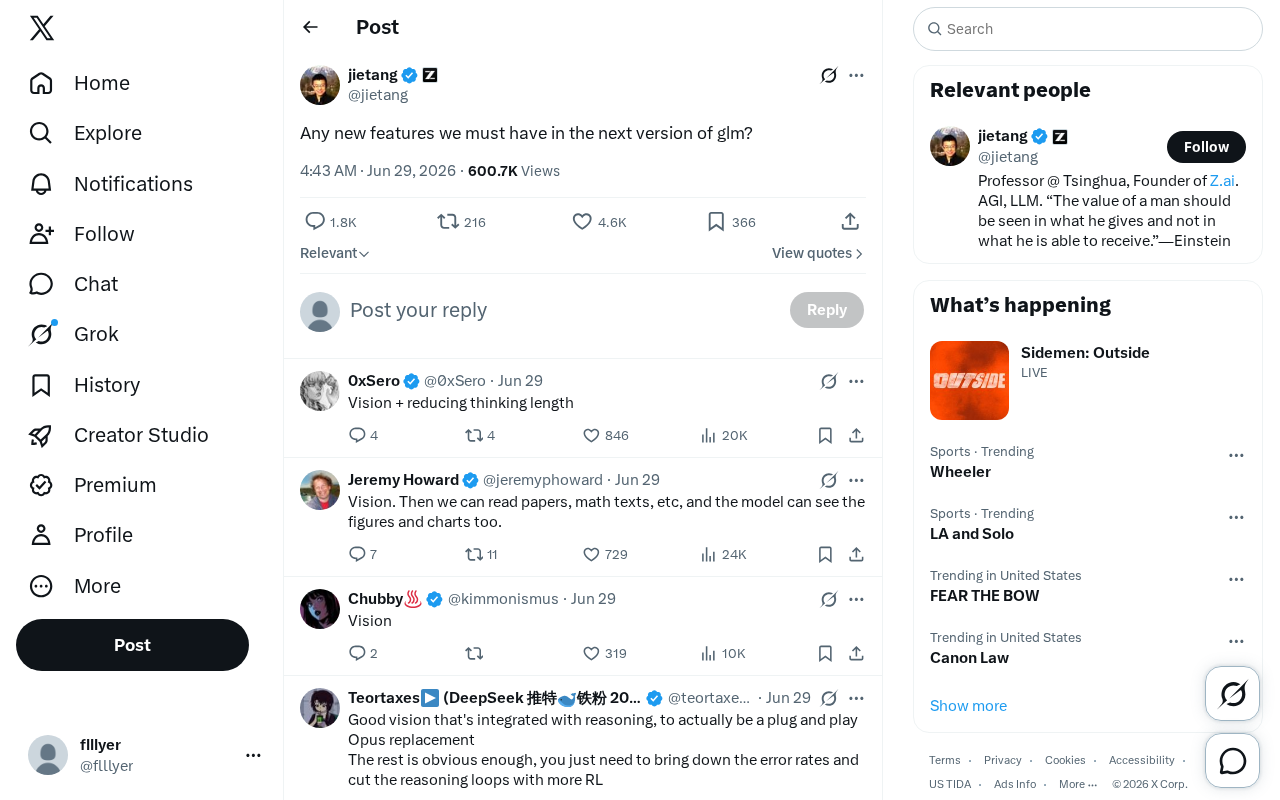
Analyzing community-driven iteration priorities for the next version of Zhipu's GLM model.
Zhipu's GLM team publicly asked the community what features should be prioritized in the next GLM version, reflecting a shift toward community-driven development. This article examines the three most anticipated capability upgrades — long-context memory, Agent tool calling and structured output reliability, and deep multimodal fusion — while exploring how open-source LLMs leverage community feedback as a competitive advantage.
An Open-Ended Question That Resonated With the Community
Recently, the Zhipu GLM team posed a remarkably open question on Twitter: "Any new features we must have in the next version of glm?"
This seemingly simple tweet actually reflects an important strategic shift among leading AI companies as large model competition enters deep waters — moving from "building behind closed doors with fixed releases" to "community co-creation and demand-driven development." For the open-source model ecosystem, this proactive approach of soliciting input from developers and users is becoming an increasingly common product philosophy.
As one of the flagship Chinese large language models, the GLM series (including ChatGLM, GLM-4, etc.) has built a substantial user base in the open-source community. The GLM (General Language Model) series is developed by Zhipu AI, a company incubated from Tsinghua University's Knowledge Engineering Group (KEG). It employs a unique autoregressive blank-filling pre-training framework — unlike GPT's unidirectional autoregressive approach or BERT's bidirectional masked language modeling, GLM randomly shuffles text spans and autoregressively fills them in, combining both understanding and generation capabilities. Since the release of ChatGLM-6B in 2023, the series has garnered tens of thousands of stars on GitHub, making it one of the most active open-source LLM projects in China. The team's decision to publicly solicit feature requests is both a community engagement strategy and a pragmatic approach to maintaining product sensitivity in an intensely competitive model landscape.
Interpreting GLM's Iteration Direction Through Community Demand
Although the original tweet was just an open-ended question, we can reasonably infer the capability upgrades the community cares about most based on current trends in large model development.
Stronger Long-Context and Memory Capabilities
Long-context processing is a battleground for virtually all mainstream models. From the early days of 4K and 8K context windows to today's 128K or even million-token windows, user demand for models that can "read more and remember better" continues to climb.
From a technical standpoint, the core challenge of long-context processing stems from the quadratic computational complexity of the self-attention mechanism in the Transformer architecture — when the sequence length doubles, computation and memory usage increase fourfold. The industry has developed multiple technical approaches to break through this bottleneck: RoPE (Rotary Position Embedding) extrapolation and interpolation methods allow models to extend their positional awareness range without retraining; sparse attention mechanisms (such as Longformer's sliding window) reduce complexity by eliminating attention computation between unrelated tokens; and distributed sequence parallelism schemes like Ring Attention split ultra-long sequences across multiple devices for cooperative processing.
For a model like GLM that targets enterprises and developers, stable and reliable long-document understanding and cross-session memory capabilities are often more valuable than raw context window numbers. Cross-session memory involves more complex architectural designs such as RAG (Retrieval-Augmented Generation), external memory banks, and MemoryBank, aiming to give models persistent user preference and conversation history management — a critical step in evolving from a "tool" to an "assistant."
More Robust Tool Calling and Agent Capabilities
As AI applications shift from "conversation" to "execution," a model's core Agent capabilities — including Function Calling, code execution, and multi-step reasoning and planning — are becoming key metrics for measuring practical utility.
Function Calling refers to the mechanism by which a large language model identifies user intent during conversation and generates structured function call requests, which are then executed by external systems and the results returned to the model for integrated responses. This capability was first standardized by OpenAI in June 2023 and subsequently became an industry-standard interface. An Agent is a higher-level abstraction built on top of this, typically comprising three core modules: Planning, Memory, and Tool Use. Typical frameworks like LangChain's ReAct pattern decompose complex tasks through "Think-Act-Observe" loops, while projects like AutoGPT attempt to achieve fully automated task decomposition and execution chains.
Community users widely expect GLM to make breakthroughs in structured output stability and multi-tool orchestration reliability, as these directly determine whether the model can handle complex automated workflows. Notably, structured output instability — such as JSON format errors, missing fields, and hallucinated API parameters that don't exist — is one of the most common sources of failure in Agent applications in production environments, and the most pressing issue developers want resolved in real-world deployments.
Deep Multimodal Integration
Beyond text, understanding and generating images, audio, and video are becoming standard capabilities. Current multimodal large model architectures roughly fall into two categories: one aligns different modality encoders (such as the vision model ViT or the audio model Whisper) to the language model's embedding space through projection layers or adapters, with representative architectures including LLaVA and DeepMind's Flamingo; the other mixes multimodal data from the pre-training stage for joint training, such as Google's Gemini series, which typically achieves deeper modality fusion.
Users hope the next generation of GLM can further improve multimodal understanding accuracy and cross-modal reasoning coherence, rather than just offering basic features like "image input support." Cross-modal reasoning coherence is a current technical challenge — for example, whether a model can accurately describe the logical relationships in a complex flowchart after understanding it, or precisely map visual events to a timeline when analyzing video clips. These scenarios require deep semantic alignment between modalities, not just simple feature vector concatenation.
Product Strategy Insights for Open-Source Models
Community Feedback as a Critical Input to the Product Roadmap
The GLM team's approach of publicly soliciting input essentially hands part of the product decision-making power back to real users. Compared to closed-source model vendors that rely on internal testing and enterprise client feedback, open-source models naturally have access to a large and active developer community — frontline users who have the most direct sense of a model's pain points, boundaries, and potential.
The community co-creation model for open-source LLMs draws on governance experience from successful open-source projects like Linux and Kubernetes, but also faces unique challenges. Contributors to traditional open-source software can directly submit code PRs (Pull Requests), whereas core training of large models requires millions of dollars in compute. Community contributions are more often reflected in peripheral areas such as fine-tuning dataset construction, benchmark design, inference deployment toolchain development, and application scenario feedback. Community-driven evaluation mechanisms like the Open LLM Leaderboard on Hugging Face and LMSYS's Chatbot Arena (which uses an ELO ranking system based on human preference voting) have already become important bellwethers for open-source model iteration direction.
Aggregating, filtering, and converting these dispersed demands into product features is a major competitive advantage that open-source models hold over closed-source products. Whoever responds to community voices more quickly and accurately will more easily build reputation and loyalty among developers. Zhipu GLM's direct solicitation of requirements on Twitter essentially front-loads the community feedback loop to the product planning stage — a more proactive and efficient approach than passively waiting for users to report issues on GitHub Issues.
Competitive Anxiety and Opportunity Behind Demand Collection
You may not have noticed, but in the context of rapid iteration of large models both domestically and internationally, any version update can be quickly matched or surpassed by competitors. Proactively soliciting demands helps the team concentrate resources on the issues users care about most, avoiding vanity feature accumulation. At the same time, it signals to the community that "we are genuinely listening" — an emotional connection that is particularly valuable in an increasingly homogeneous competitive landscape.
Final Thoughts
A brief tweet belies profound changes in the product logic of large models. As the gap in technical capabilities gradually narrows, product experience, community ecosystem, and speed of demand response are becoming the new variables that determine a model's success or failure.
The GLM team's open question may not provide immediate answers, but the "user-demand-centered" iteration philosophy it represents is worth emulating across the entire AI industry. For developers, this is also a rare opportunity — every feature suggestion you make could appear in the next model's changelog.
If it were up to you, which capability would you want the next generation of GLM to prioritize?
Related articles
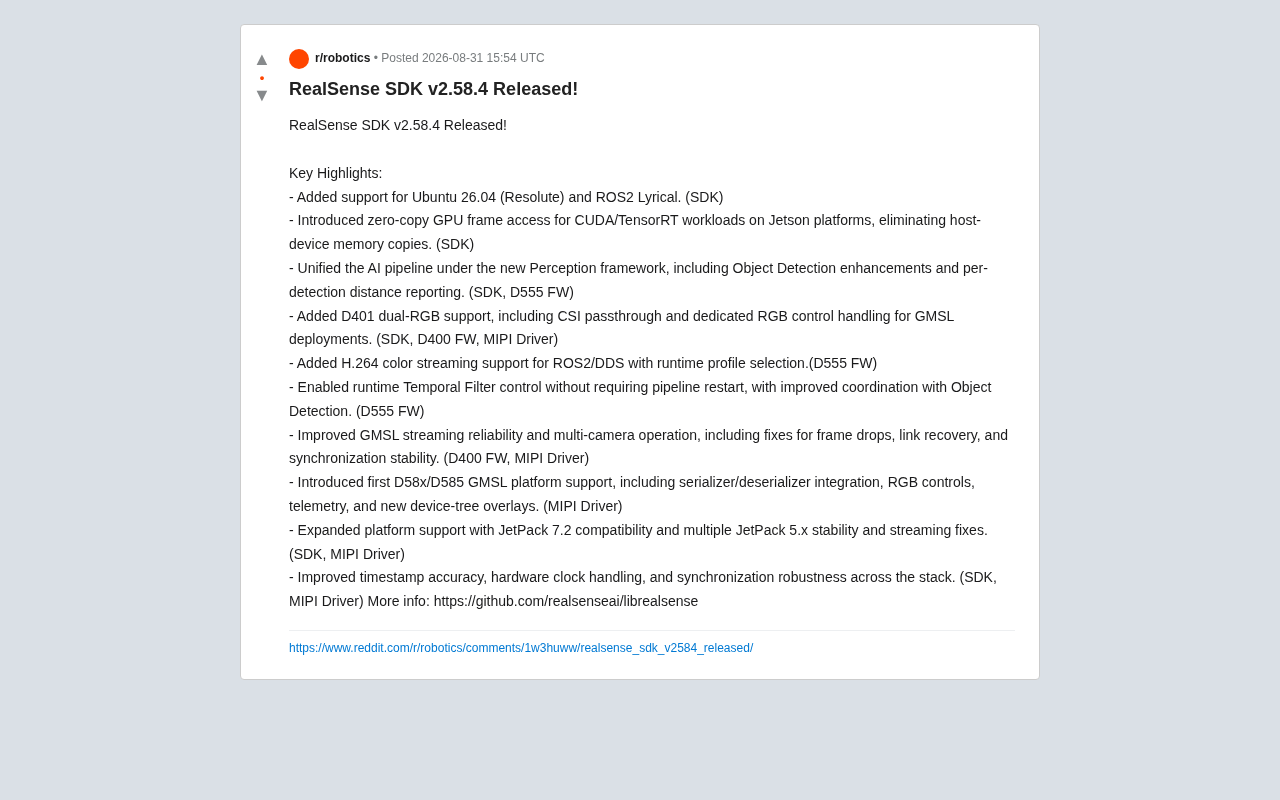
RealSense SDK v2.58.4 Released: GPU Zero-Copy and AI Perception Framework Major Upgrade
RealSense SDK v2.58.4 introduces GPU zero-copy frame access for Jetson, unified Perception AI framework, per-detection distance reporting, GMSL multi-camera support, and ROS2 H.264 streaming.
OmniRoute Breakdown: How a 57K-Star AI Unified Gateway Manages Multi-Provider Routing
Deep breakdown of OmniRoute, a 57K-star open-source AI gateway, covering its three-layer fault isolation, auto routing scoring, and context compression mechanisms.

MCP Protocol Explained: A Standardized Approach to Plug-and-Play Tool Integration for AI Agents
Deep dive into MCP's three-layer architecture, tool invocation flow, and core value. Learn how MCP standardizes AI Agent tool integration through Host, Client, and Server design.