What Rationale Chains Actually Convey: A Study on "Message Intervention" in Role-Specialized QA

Faithful rationale chains don't improve accuracy, but corrupted ones can dangerously distort verifier judgments.
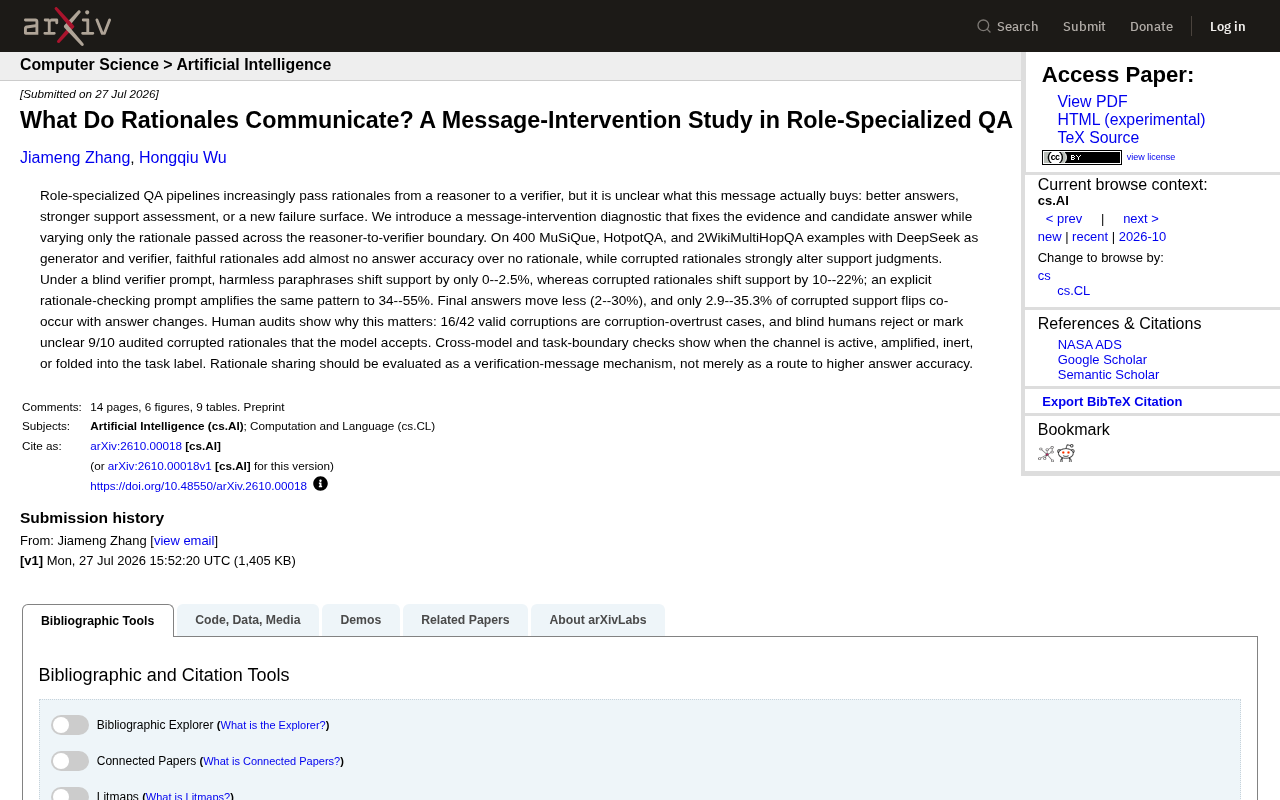
Using a message-intervention diagnostic on 400 multi-hop QA samples, this study finds that faithful rationale chains barely improve answer accuracy over no rationale at all — but corrupted ones shift verifier support judgments by 10%–55%. Worse, prompts explicitly asking verifiers to check rationales amplify the damage rather than defend against it. Human audits reveal a stark overtrust gap: 9 out of 10 corrupted rationales accepted by models would be rejected by human auditors. The study argues rationale sharing should be treated as a verification message mechanism, not an accuracy tool, and calls for dedicated defenses against this new failure surface.
When a Reasoner Passes Its "Thinking" to a Verifier — What's Really Being Transmitted?
In increasingly popular Role-Specialized QA systems, a common architectural pattern involves a "reasoner" generating a rationale chain that is then passed to a "verifier" for judgment. This design seems intuitive — making the reasoning process explicit gives the verification step something concrete to work with. But a new study published on arXiv raises a sharp question: what does this rationale chain actually buy us? Greater answer accuracy? Stronger support assessment? Or an entirely new failure surface?
The researchers introduce a method called message-intervention diagnostic, whose core idea is controlled variable testing: hold the evidence and candidate answers fixed, and vary only the rationale content crossing the reasoner→verifier boundary — enabling precise observation of the rationale's isolated effect.
Experimental Design: Fix the Evidence, Vary Only the Rationale
Experiments were conducted on 400 samples drawn from three classic multi-hop QA datasets: MuSiQue, HotpotQA, and 2WikiMultiHopQA. Both the generator and verifier use DeepSeekAd models.
The key manipulation compares three types of rationale chains:
- No rationale: the verifier judges based solely on evidence and answer;
- Faithful rationale: the reasoning process is genuine and reliable;
- Corrupted rationale: errors or misleading content are deliberately introduced.
The elegance of this design is that it isolates the "rationale content" from other confounding factors, allowing researchers to measure the independent effect of this "message" on verifier judgment and final answers.
Multi-hop QA refers to question-answering tasks that require reasoning across multiple documents or inference steps — far more challenging than single-hop QA. MuSiQue, HotpotQA, and 2WikiMultiHopQA are three standard benchmarks in this domain, each emphasizing different aspects: question complexity, distractor paragraph design, and cross-Wikipedia entity reasoning, respectively. These datasets are ideal for testing message-intervention effects because multi-hop reasoning inherently relies on rationale chains to link intermediate steps, making the verifier more sensitive to rationale quality. DeepSeek is a series of large language models developed by DeepSeek, whose reasoning capabilities have stood out in recent evaluations — making it a fitting choice for both reasoner and verifier roles.
Core Finding 1: Faithful Rationales Barely Improve Answer Accuracy
The study arrives at a counterintuitive conclusion: compared to providing no rationale at all, faithful rationale chains yield almost no improvement in answer accuracy.
This means that if you assumed explicitly passing the reasoning process to a verifier would make the system more accurate, that assumption simply doesn't hold — at least in these experiments. The value of a rationale chain doesn't primarily manifest as "getting the answer more right."
Harmless paraphrases under a blind verifier prompt shifted support judgments by only 0%–2.5%, indicating that cosmetic changes to phrasing have virtually no effect on the verifier's conclusions.
Core Finding 2: Corrupted Rationales Severely Distort Judgments
In stark contrast to the faithful rationale's negligible impact, corrupted rationale chains prove highly destructive:
- Under a blind verifier prompt, corrupted rationales shifted support judgments by 10%–22%;
- When using an explicit rationale-checking prompt, the same pattern was amplified further to 34%–55%.
This is a concerning signal. When we explicitly ask the verifier to "scrutinize the rationale," it actually becomes more susceptible to being misled by a flawed one — the rationale-checking prompt doesn't strengthen defenses; it amplifies the corrupted message's influence.
That said, changes to final answers remained relatively modest (2%–30%), and only 2.9%–35.3% of "support judgment flips" co-occurred with answer changes. In other words, rationale corruption more often destabilizes the verifier's assessment of whether evidence supports the answer, rather than the answer itself. This further confirms that rationale transmission functions primarily as a verification message mechanism — not simply a path to higher answer accuracy.
The "support judgment" here is an evaluation dimension independent of the final answer: the verifier must assess not only whether the answer is correct, but whether the provided evidence passages genuinely support it. This distinction is critical — an answer might be guessed correctly by chance, but a flipped support judgment means the verifier's evaluation of the reasoning logic itself has been distorted. The data shows that corrupted rationales more readily destabilize support judgments (shifts of 10%–55%) than final answers (2%–30%), indicating that corruption primarily undermines the verifier's ability to trace logical justification — not its ability to guess answers. The scenario where "the answer is right but the reasoning is wrong" is particularly dangerous in automated pipelines, since answer-level metrics often fail to surface this kind of hidden failure.
Human Audits Reveal an "Overtrust" Problem
To understand what these numbers mean in practice, the researchers conducted manual audits — with compelling results:
- Among 42 valid corruption samples, 16 were classified as "corruption-overtrust" cases — instances where the model accepted flawed reasoning it should have rejected;
- Of the 10 corrupted rationale chains accepted by the model, 9 would have been rejected or flagged as unclear by blinded human auditors.
This dramatic divergence between human and model judgment exposes a structural weakness in model verifiers: they tend to place excessive trust in reasoning that appears plausible but is actually problematic — something humans can detect through common sense. This is precisely the "new failure surface" that rationale transmission introduces.
When the Channel Is Active, Amplified, Inert, or Folded
The study also characterizes the state of this "rationale channel" under different conditions through cross-model and task-boundary analysis: it can be active, amplified, inert, or folded into the task label.
This shows that the effect of rationale transmission is not fixed — it is highly dependent on model configuration and task setup. A channel that is active and risky in one setting may be completely inert or absorbed by the task itself in another.
The "channel state" taxonomy introduced by the research — active, amplified, inert, folded into task label — is effectively a causal diagnostic framework for rationale influence. An "inert channel" means the rationale content has no statistically detectable effect on verifier judgment, as though the signal is drowned in noise. "Folded into task label" means the verifier compresses the entire rationale into a coarse-grained task category signal (e.g., "this is a multi-hop question") rather than interpreting its content in fine-grained detail. The value of this taxonomy lies in helping engineers determine whether rationale transmission has any substantive effect for a given model-task combination — if the channel is inert, investing resources in optimizing rationale format or content may yield little return; if the channel is in an amplified state, hardening defenses against corruption should be the top priority.
Implications for System Designers
The study's most important claim is this: rationale sharing should be evaluated as a verification message mechanism — not merely as a tool for improving answer accuracy.
For engineers building multi-agent or role-specialized QA pipelines, this raises several practical considerations:
- Don't default to assuming "passing a rationale is always better" — faithful rationale chains may not improve accuracy;
- Be wary of the destructive potential of corrupted rationale chains, especially when using prompts that explicitly check rationale — these may actually amplify the risk;
- Verifier overtrust of flawed reasoning is a real failure mode that requires dedicated defensive design and human spot-checking.
As more systems rely on inter-model message passing and collaboration, diagnostic methods that target "the message itself" offer a new lens for understanding and hardening these pipelines.
Related articles

Gaussian Process Bandit Optimization: Exploration Strategies and Inference Regret Guarantees
Cumulative regret guarantees in Bayesian optimization fail to reflect final recommendation quality. This article examines a new study that provides inference regret guarantees for Gaussian process bandit optimization through exploration query strategies and fill distance analysis, validated on hyperparameter optimization and control tasks.

The Most Detailed Codex Guide on Bilibili: From Installation to Real-World Practice
The most detailed Codex guide on Bilibili: from app store installation to daily work mode configuration, with a real coffee shop project demonstrating file organization, data extraction, dashboard creation, and other practical tasks. Learn to use Plan Mode and desktop pets to leverage Codex efficiently.

Appearance Compensation in Volume Rendering: Why RGB Accuracy Cannot Guarantee Density Correctness
Volume rendering research reveals that volumetric data perfectly reproducing external RGB views may still contain density errors: appearance compensation can double central density and keep external rays unchanged even when L2 error exceeds 14.52%. Density recovery depends on appearance capacity, spatial resolution, and measurement design.