What's the Difference Between Codex and ChatGPT? A Complete Guide to AI Coding Agents

Codex is an autonomous AI coding agent that executes tasks, while ChatGPT only advises.
This article explains the core differences between OpenAI's Codex and ChatGPT. While ChatGPT acts as a conversational advisor that explains code, Codex is an AI coding agent that autonomously reads projects, writes code, fixes bugs, and runs tests. The piece explores why developers must adapt to this paradigm shift from writing code to directing AI, and how the most valuable skills are evolving toward requirement decomposition and AI collaboration.
What Is Codex? More Than Just a Chatbot
Codex is an AI coding agent developed by OpenAI. Pay attention to the key word here — "agent." It's not a simple conversational tool, but an AI assistant capable of autonomously completing programming tasks.
The term "agent" is a core concept in artificial intelligence, referring to a system that can perceive its environment, make autonomous decisions, and take actions to achieve goals. Unlike traditional Q&A-style AI, agents possess capabilities such as autonomous planning, tool invocation, environment interaction, and feedback loops. In the programming domain, an AI agent can break down a high-level task into multiple sub-steps, execute them sequentially, and dynamically adjust its strategy based on results — forming a complete closed loop of "perceive → decide → act → feedback." This is the fundamental difference between Codex and an ordinary chatbot.
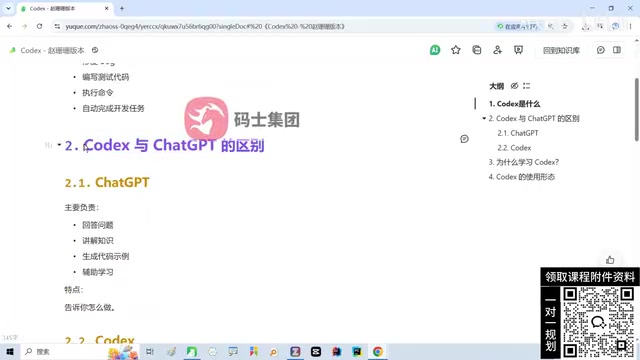
Specifically, Codex can help developers with the following tasks:
- Code generation: Automatically write code based on requirement descriptions
- Code reading and comprehension: Analyze the logic of existing project code
- Bug fixing: Locate issues and autonomously fix them
- Test execution: Automatically run test cases to verify code correctness
- Command and script execution: Perform various operations within the development environment
If all you want is for AI to generate a code snippet that you then copy-paste into your editor, tools like Doubao, DeepSeek, or ChatGPT can all get the job done. But Codex is positioned entirely differently — it's a tool that does the work for you, not just an assistant that answers questions.
Codex vs ChatGPT: Talking vs Doing
Many people wonder when they first encounter Codex: isn't this just ChatGPT? After all, Codex relies on ChatGPT's underlying large language model. But the two have fundamentally different positioning and capabilities.
From a technical architecture perspective, the large language model (such as the GPT series) underlying Codex provides the foundational capabilities for language understanding and code generation. However, Codex builds a complete task execution framework on top of this, including a sandbox environment, file system access, and command-line tool invocation. This architecture is similar to the relationship between an operating system and an application — the LLM is the "engine," while Codex is the complete "car" built around that engine. The engine may be the same, but the final product's form and capabilities are entirely different.
ChatGPT: Like a Teacher
ChatGPT's core interaction mode is conversation. If you ask it "How do I implement a login feature in Spring Boot?", it will:
- Explain the principles behind login functionality
- Provide example code
- Walk through the code logic
But that's where it stops. You still need to Ctrl+C, Ctrl+V the generated code into your development tool, then debug, test, and troubleshoot on your own. ChatGPT does the talking — you still do the actual work.

Codex: Like a Programmer Colleague
Codex works in a completely different way. When you tell it "Build the login feature for me," it will:
- Autonomously read your project code and understand the project structure
- Autonomously write the code for the login feature
- Autonomously test by running the code to check if it passes
- Autonomously debug by finding and fixing bugs
- Once everything passes, it tells you: "It's done."
Throughout this process, Codex acts like a programmer colleague sitting right next to you. You just need to describe the requirements, and it handles the execution. Codex does the hands-on work — you handle review and quality control.
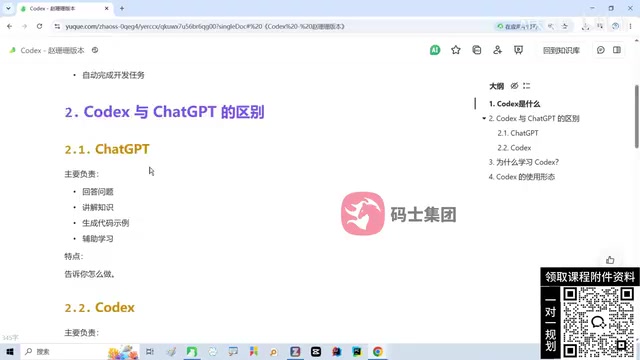
In one sentence: ChatGPT is an advisor; Codex is an executor. The former tells you how to do it; the latter does it for you.
Why Developers Must Learn to Use Codex
A Fundamental Shift in Development Is Happening
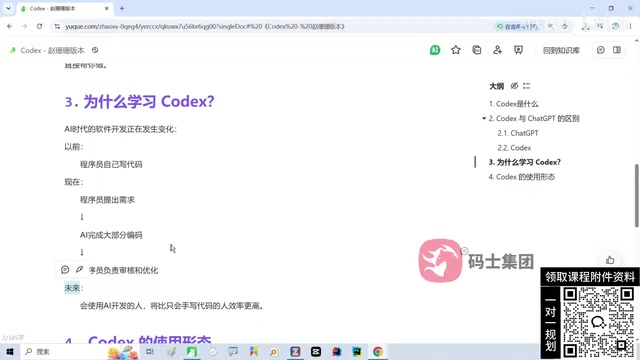
The way software development works is undergoing a paradigm shift:
- Before: Programmers wrote all code by hand, typing every single line themselves
- Now: Programmers describe requirements, AI coding agents complete most of the code, and programmers review and optimize
Looking back at the history of software development, this isn't the first paradigm shift. From machine code to assembly language, from assembly to high-level languages (like C and Java), from hand-written code to IDE auto-completion — each revolution freed developers from low-level repetitive work, allowing them to focus on higher-level design and decision-making. AI coding agents represent yet another elevation of the abstraction layer — developers evolve from "code writers" to "requirement describers and quality gatekeepers." History shows that each such transition dramatically boosted industry-wide productivity rather than eliminating practitioners.
This means that people who know how to use AI coding tools will be far more productive than those who write code purely by hand. This isn't a future trend — it's happening right now.
AI Won't Replace Programmers, but It Will Redefine What Skills Are Valuable
Some worry that tools like Codex will replace programmers, but that's not the reality. AI-generated code still needs human review:
- Is the code logic correct?
- Are there security vulnerabilities?
- Does performance meet requirements?
- Is the architecture design sound?
If you know nothing about programming, you simply can't perform these reviews. So programming fundamentals remain important — it's just that the core competitive advantage has shifted from "how fast you can write code" to "how well you can communicate requirements to AI."
This ability to "communicate requirements to AI" is known in the industry as "Prompt Engineering," but in the context of coding agents, it goes far beyond writing a good prompt. It includes: how to decompose complex business requirements into atomic tasks that AI can execute, how to provide AI with sufficient context, how to set acceptance criteria so AI can self-verify, and how to effectively guide iterations when AI output falls short. This is essentially a new form of "technical management capability."
The most valuable developers of the future won't be those who can type 5,000 lines of code a day, but rather those who are best at describing requirements to AI, breaking down tasks, and reviewing results.
Codex Isn't the Only Option, but It Represents the Direction
Codex isn't the only AI coding agent on the market today. There's also Claude Code, Cursor's Agent mode, Trae, and others. They all share the same core philosophy: shifting from "humans write code" to "humans direct AI to write code."
The AI coding agent space is currently fiercely competitive: Anthropic's Claude Code excels at ultra-long context understanding and precise code reasoning, capable of handling complex refactoring tasks across large codebases; Cursor deeply integrates Agent mode into the VS Code editor, achieving a seamless "conversation as editing" experience; ByteDance's Trae is deeply optimized for the Chinese developer ecosystem with more accurate understanding of Chinese-language requirements. There's also GitHub Copilot Workspace (offering end-to-end automation from Issue to PR), Cognition AI's Devin (billed as "the world's first AI software engineer"), and Replit Agent (focused on rapid full-stack application scaffolding). While these tools take different implementation paths, they're all validating the same hypothesis: future software development will use natural language as the primary interaction interface, and code will become AI's "output artifact" rather than a human "handcraft."
The significance of learning Codex lies not just in mastering a single tool, but in adapting to this entirely new development paradigm. Regardless of which tool you ultimately choose, understanding how AI coding agents work will become an essential skill for developers.
Summary
Codex represents a major leap in AI programming tools — from "assisted answering" to "autonomous execution." It's not a simple upgrade to ChatGPT, but an entirely new model of development collaboration. For developers, embracing AI coding agents early and learning to collaborate with AI in programming will be key to maintaining technical competitiveness.
Of course, no matter how powerful the tool, it still requires users with solid technical foundations. AI handles execution; humans handle decisions — that's the right way to approach human-AI collaboration.
Key Takeaways
Related articles

Three AI Researchers Debate: How Far Are We from Recursive Self-Improvement?
Three AI researchers including former OpenAI co-founder John Schulman debate recursive self-improvement and intelligence explosion, dissecting continual learning, distillation, RL success, and ASI timelines.

AI Recursive Self-Improvement (RSI): How Far Are We from the Real Thing?
How close is RSI (Recursive Self-Improvement) to reality? We analyze Acer AI's RSI Agent, a Shotcut watermark task, OS World 20 results, and OpenAI's automated researcher goal.

AI Coding Platforms Are Exploding in Popularity: Can Non-Technical People Really Build Money-Making Products?
An AI coding competition unexpectedly drew 1,000+ signups, sparking debate on whether non-technical people can build profitable products with AI. We break down the opportunities and the hype.