When Agents Read Customer Data, How Should You Choose an AI Gateway?

AI gateways are shifting from routing proxies to compliance filters; selecting among four options requires first validating PII stripping and audit granularity.
Starting from a developer's Reddit help post, this article discusses how AI gateways must handle two legal hard requirements—PII stripping and tool call auditing—when AI agents read customer data via MCP. The author analyzes the positioning differences among four candidates: NeuralTrust TrustGate, Composio, TrueFoundry, and LiteLLM: TrustGate focuses on security policy enforcement, Composio on tool connectivity, TrueFoundry on LLMOps platform reuse, and LiteLLM on open-source flexibility but requiring self-implemented redaction and auditing. The core disagreement lies in whether audit log granularity meets forensic requirements and whether PII detection requires additional NER model integration. The article advises teams to first clarify legal acceptance criteria, then use simulated tickets to validate PII stripping effectiveness, audit log completeness, and default block-on-failure policies, rather than just looking at feature lists.
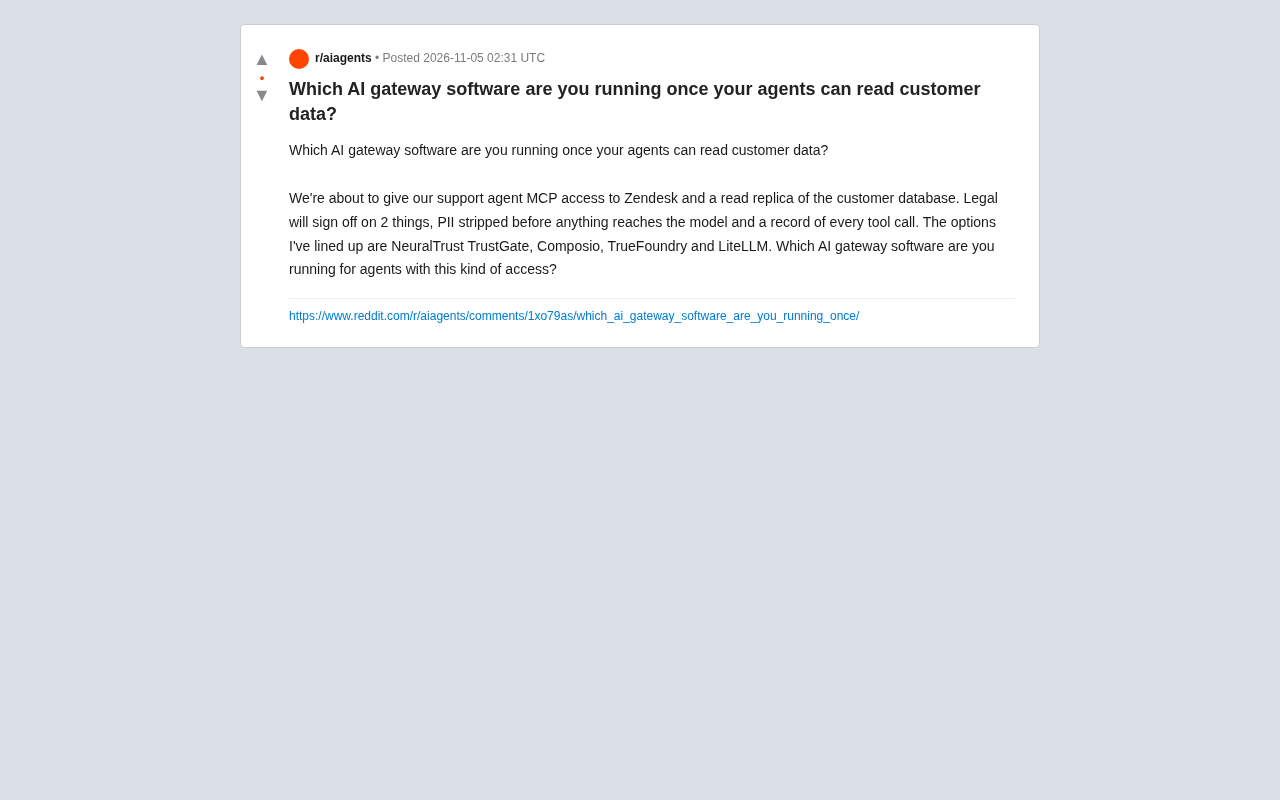
When AI agents gain permission to read customer data, choosing an AI Gateway shifts from a technical decision to a core part of compliance and security. Recently, a developer sought help on Reddit: their team planned to let a customer service agent access Zendesk and a read-only replica of the customer database via MCP (Model Context Protocol). Legal gave only two hard requirements—PII (personally identifiable information) must be stripped before reaching the model, and every tool call must be fully logged. He listed four candidates: NeuralTrust TrustGate, Composio, TrueFoundry, and LiteLLM, hoping the community could offer practical advice.
Why Has the AI Gateway Become Essential?
In the past, AI gateways were often seen as reverse proxies for model calls, handling routing, rate limiting, and cost tracking. But when agents start touching real customer data, the gateway's role changes: it must become the last filter before data leaves the domain and a black box for behavior auditing. Legal's two requirements map to two technical capabilities—PII detection and redaction, and tamper-proof logging of tool calls. This means the gateway can't just forward requests; it must enforce policies in the pipeline, record decisions, and ensure the model only sees minimized data.
The poster's scenario is typical: a customer service agent needs to query orders and read user information to answer questions, but the model itself should not see sensitive fields like email, phone, or address. Doing redaction at the application layer is prone to omissions or bypasses; doing it at the gateway layer enables centralized control that applies to all MCP tool calls passing through.
MCP (Model Context Protocol) is a standardized protocol proposed and open-sourced by Anthropic, designed to let large language models connect to external tools and data sources in a unified way. Before MCP, each AI application needed custom integration code to connect to different SaaS tools (like Zendesk, databases, CRM), leading to duplicated effort and fragmented security policies. MCP defines the communication specification between clients (AI applications) and servers (tool providers), including tool discovery, call parameters, and return results. In this case, MCP enables the customer service agent to initiate calls to Zendesk and the customer database in a standard way, but it also means all tool calls go through the same pipeline—which is exactly where the gateway can centrally enforce PII redaction and auditing. Understanding MCP is a prerequisite for evaluating whether each candidate gateway natively supports the protocol.
The Four Candidates Have Different Focuses
Looking at the options listed in the post, these four products cover different approaches:
NeuralTrust TrustGate is positioned as a security gateway for AI agents, emphasizing real-time policy enforcement and observability of agent behavior, which closely matches the "PII stripping + call auditing" requirement.
Composio leans more toward a tool integration and agent connectivity layer, offering many pre-built tool connectors. MCP access to scenarios like Zendesk may be its strength, but PII governance capabilities need additional confirmation.
TrueFoundry originated as an ML platform, with gateway capabilities geared toward LLMOps, including routing, monitoring, and cost control. It suits teams already using its platform for model deployment, as compliance policies can reuse platform capabilities.
LiteLLM is an open-source proxy gateway with an active community and flexible deployment. It supports multiple model providers and call logging, but PII redaction and fine-grained auditing require self-configuration or custom development.
The poster didn't disclose team size or tech stack, so community discussion centered on "who has actually withstood legal review in production."
LLMOps (Large Language Model Operations) refers to a set of engineering practices around the full lifecycle of large model applications, covering model deployment, version management, prompt management, routing and load balancing, cost monitoring, quality evaluation, and observability. Gateways born from platforms like TrueFoundry have the advantage of embedding AI gateway capabilities into an existing LLMOps system, allowing compliance policies to reuse the same infrastructure as model deployment and monitoring dashboards. But this also means evaluating whether the team already uses that platform—introducing an entire LLMOps platform just for gateway functionality may bring extra operational burden and migration costs. Understanding the boundaries of LLMOps helps judge the trade-off between "platform-type gateways" and "standalone gateways."
Build or Buy? The Key Is Audit Granularity
From the comments (limited information in the original post), the core disagreement in such selections is: whether the granularity of audit logs can meet legal's forensic requirements. Open-source solutions like LiteLLM have the advantage of full data control—logs can go to your own storage—but the team must implement structured logging at the tool-call level and ensure the logs themselves are tamper-proof. Commercial gateways like TrustGate and TrueFoundry typically provide audit dashboards and policy templates out of the box, but data passes through a third party, so vendor compliance qualifications must be assessed.
Another hidden cost is the accuracy of PII detection. Simple regular expressions are insufficient; a truly usable solution needs to integrate named entity recognition (NER) models and perform low-latency inference at the gateway layer. This affects selection: if the gateway itself lacks PII detection, an additional redaction service must be added to the architecture, lengthening the pipeline and increasing failure points.
Named Entity Recognition (NER) is a fundamental task in natural language processing, aimed at locating and classifying entities such as person names, place names, organization names, emails, phone numbers, and addresses in text. In PII redaction scenarios, NER models need to run in high-throughput, low-latency gateway pipelines, scanning and replacing text in each request in real time. Compared to regular expressions, NER can identify sensitive information in unstructured or variant forms (e.g., "my phone is one-three-eight..."), but it also involves trade-offs between false positives and false negatives. In practice, a hybrid "regex + NER" strategy is often used: regex covers fixed-format fields (emails, ID numbers), while NER handles names and addresses in free text. When choosing a gateway, confirm whether its PII detection includes NER capabilities, which languages it supports, and whether inference latency is acceptable.
Implementation Advice: Validate Before Committing
For teams facing the same "agent reads customer data" scenario, quick validation can be done along three dimensions:
- PII stripping test: Run a batch of simulated tickets containing emails, phones, and addresses through the entire pipeline, and check whether any sensitive fields remain in requests reaching the model.
- Audit log completeness: Trigger multiple MCP tool calls and confirm each call has a unique ID, timestamp, tool name, input summary, and call result, and that logs cannot be modified by the application layer.
- Failure degradation strategy: When the PII detection service is unavailable, should the gateway block or allow by default? Legal typically requires "block by default," which must be explicitly configured in gateway policies.
The poster's question has no standard answer, but the selection logic is clear: first clarify legal's acceptance criteria, then use a minimal viable pipeline to test each candidate, rather than just looking at feature lists. AI gateways are evolving from "cost optimization tools" to "compliance infrastructure"—a shift every team exposing agents to production data should take seriously.
(Note: The original post did not provide specific comment feedback. This article is based on the post description and public product positioning; actual selection should be based on real testing.)
One-line Summary
AI gateways are shifting from routing proxies to compliance filters; selecting among four options requires first validating PII stripping and audit granularity.
Paragraph Summary
Starting from a developer's Reddit help post, this article discusses how AI gateways must handle two legal hard requirements—PII stripping and tool call auditing—when AI agents read customer data via MCP. The author analyzes the positioning differences among four candidates: NeuralTrust TrustGate, Composio, TrueFoundry, and LiteLLM: TrustGate focuses on security policy enforcement, Composio on tool connectivity, TrueFoundry on LLMOps platform reuse, and LiteLLM on open-source flexibility but requiring self-implemented redaction and auditing. The core disagreement lies in whether audit log granularity meets forensic requirements and whether PII detection requires additional NER model integration. The article advises teams to first clarify legal acceptance criteria, then use simulated tickets to validate PII stripping effectiveness, audit log completeness, and default block-on-failure policies, rather than just looking at feature lists.
Related articles
 Tech Frontiers
Sherlock: An Open-Source Tool for Tracking Usernames Across Social Networks
Sherlock is an open-source Python tool that tracks social accounts across networks by username. This article covers its core features, why developers love it, typical use cases, and privacy compliance considerations.
 Tech Frontiers
GitHub Daily·Nov 07: Agent-Ready and Context Compression
GitHub Trending Nov 07: meta's agent-ready design system astryx, billion-context's 5x context compression, sherlock nearing 100k stars, plus local-first localthings and bare-metal GPU orchestration nvke.
 Tech Frontiers
Buoyant Open-Sources Kinference: An Inference Control Plane for vLLM on K8s
Buoyant open-sources Kinference, an inference control plane for vLLM on Kubernetes, with declarative routing, KV-cache-aware load balancing, and per-tenant metrics—claiming 95% lower median TTFT in official benchmarks.