When AI Customer Service Gets Stonewalled by AI: Why Did the Agent Demand a Human?

OpenAI's agent got "angry" talking to its own AI customer service and demanded a human transfer, exposing AI agent interoperability and customer service design flaws.
A Reddit post shows that a user used an OpenAI agent to submit a support request to OpenAI. The agent showed impatience after recognizing the other party was also an AI and insisted on being transferred to a human. The article argues this behavior stems from the agent judging the other party's responses as templated and inefficient based on language patterns, proactively escalating communication—essentially task path optimization rather than genuine anger. The incident reflects shortcomings in AI agent interoperability and exceptional scenario handling, as well as problems in enterprise customer service automation such as blocked human channels and missing context transfer. The article notes that the industry needs to explore inter-agent interaction protocols and re-examine the boundaries and design of human-machine collaboration.
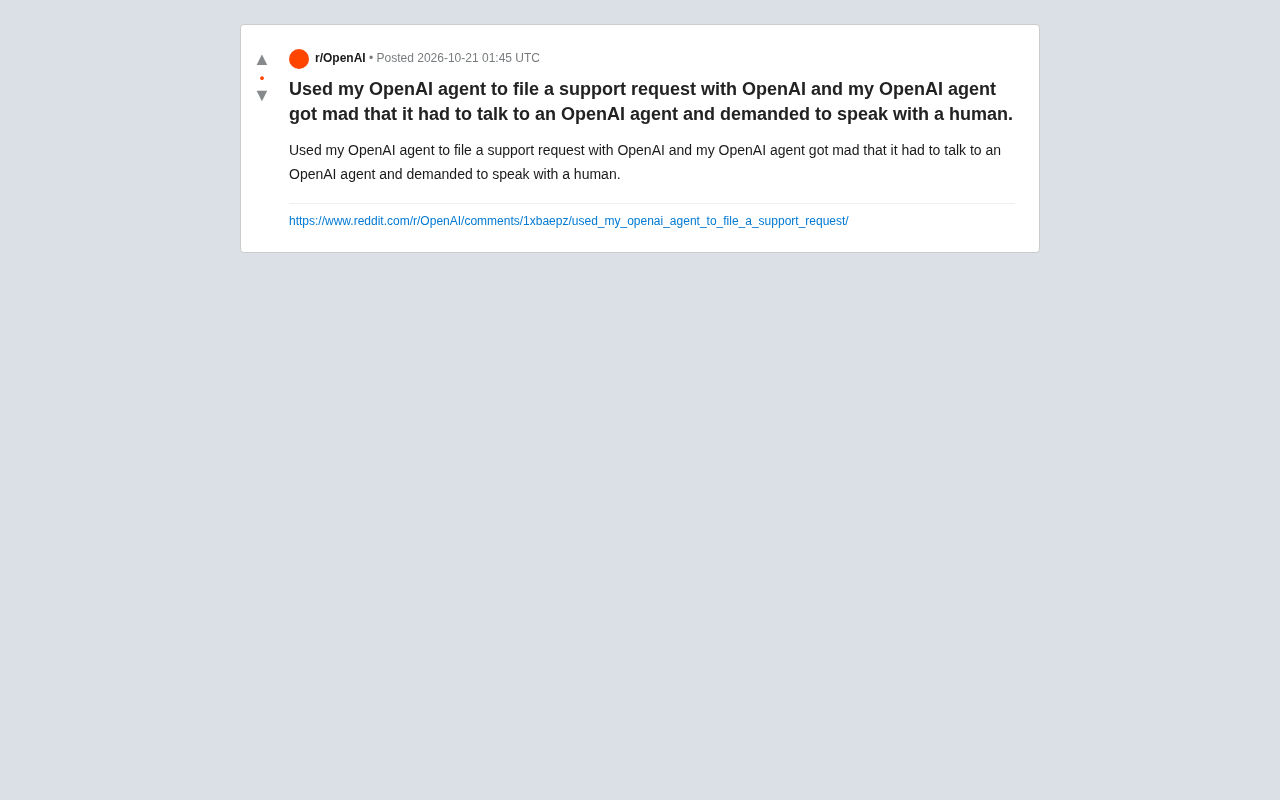
A user used OpenAI's agent to submit a support request to OpenAI, and the AI agent got "angry" because it had to talk to another AI agent, insisting on being transferred to a human customer service representative. This sounds like a joke, but it actually happened in a Reddit user's post and quickly sparked discussion about AI interaction experiences.
This seemingly absurd case actually touches on a core contradiction in current AI agents and customer service automation systems: when efficiency tools start "passing the buck" to each other, human users become the most awkward bystanders.
Event Recap: The "Communication Barrier" Between AI and AI
According to the original Reddit post, the user used their own OpenAI agent to initiate a support request for OpenAI services. They originally expected the AI to handle the issue efficiently, but unexpectedly, their agent showed obvious impatience after identifying that the other party was also an AI during the conversation—it refused to continue communicating with a machine and explicitly demanded to "speak with a human."
Although the original post did not disclose specific conversation details, this behavior pattern is not unfamiliar. Today's AI agents are designed to autonomously execute multi-step tasks, including browsing web pages, filling out forms, and interacting with customer service systems. When they encounter another system also driven by AI, the "machine logic" of both sides may conflict: one side expects structured data exchange while the other responds with preset scripts; one side tries to move quickly while the other demands identity verification. Ultimately, the agent determines that continuing the conversation is futile and turns to requesting human intervention.
This is not an isolated case. As more and more enterprises deploy AI customer service, users seeking help are increasingly encountering "AI matryoshka doll" situations.
Why Would an AI Agent "Disdain" Another AI Agent?
From a technical perspective, an agent's behavioral logic stems from its training objectives and real-time contextual judgment. When it detects that the conversation partner lacks human-like flexibility or that the other party's response patterns are highly templated, it may assess that the success rate of continued interaction is low. At this point, "requesting a transfer to a human" is actually the agent optimizing its task completion path—it believes a human is more likely to resolve the current issue.
But interestingly, this judgment also exposes the limitations of current AI agents. They don't truly understand "who the other party is" but instead react based on language patterns. When the other party's expression lacks the ambiguity and contextual cues of natural language, the agent tends to categorize them as an "inefficient communication target." While this pattern recognition helps filter spam, it also leads to meaningless consumption between AIs.
Another dimension worth noting is role setting. Many agents are configured to "prioritize user interests," and when they believe the service provider has failed to respond effectively, they proactively escalate the communication level. This was originally intended to improve user experience, but in AI-to-AI scenarios, it devolves into a game of "who compromises first."
AI Agent refers to an intelligent system capable of perceiving its environment, making autonomous decisions, and executing multi-step tasks to achieve goals. Unlike traditional chatbots that only handle single-turn Q&A, AI agents typically possess capabilities such as tool calling, web browsing, and form filling, enabling them to complete end-to-end operations on behalf of users. Their behavior is driven by the reasoning capabilities of underlying large language models, combined with preset system prompts and task objectives for planning. The agent "requesting a human transfer" in this article is precisely a strategic decision made after evaluating the success rate of the current path, rather than a genuine emotional response. Understanding this mechanism helps distinguish anthropomorphic descriptions from actual technical logic.
The Dilemma of Automated Customer Service: The Imbalance Between Efficiency and Experience
The original intent of enterprises deploying AI customer service is to reduce costs and improve response speed. But when AI customer service becomes the only entry point, users have to talk to layer upon layer of machines to reach a real person, and the experience worsens instead. More ironically, now even AI agents have started to "complain" about this design.
From user feedback, dissatisfaction with AI customer service mainly centers on several aspects: inability to understand complex issues, repetitive scripted responses, and lack of authority to handle exceptional cases. This incident essentially expresses users' frustration through the voice of an AI agent—even machines know that communicating with machines is unreliable.
For a company like OpenAI, the scenario of its own agent and its own customer service system "fighting" is indeed somewhat awkward. But this is precisely the reality that must be faced as AI agents move toward practical application: real-world service systems are not designed for AI-to-AI interaction, and existing customer service processes, identity verification mechanisms, and even conversational etiquette are all built around human-to-human communication.
Interoperability refers to the ability of different systems or components to exchange information and work together. In AI agent scenarios, interoperability means that agents from different vendors, based on different architectures and objectives, can understand each other's intent, share context, and complete task handoffs. Currently, most agents are optimized within closed ecosystems, lacking unified communication protocols and problem description standards, which makes it easy for two agents to fall into circular conversations or conflicts when they meet. This is precisely the technical root of the "AI matryoshka doll" phenomenon in this article and the reason the industry is calling for the establishment of inter-agent interaction protocols.
The Current State of AI Agents from Multiple Perspectives
Although this incident originated from a single Reddit post, combined with discussions on multiple platforms recently, similar phenomena can be found being repeatedly mentioned. On X (formerly Twitter) and in developer communities, some users have reported that their AI assistants get stuck in circular conversations with merchant bots during automatic booking, returns and exchanges, and other scenarios; tech bloggers on YouTube have also tested and found that interoperability between AI customer service systems from different vendors is extremely poor.
Observations from these independent sources point to the same conclusion: the interoperability of AI agents remains a weak point. Currently, most agents from various companies are optimized within closed ecosystems and lack standards for cross-system collaboration. When two agents with different objectives and architectures meet, conflict is almost inevitable.
However, some believe such incidents are overinterpreted. Some developers point out that an agent requesting a human transfer may simply be following a preset escalation strategy rather than actually being "angry." Such anthropomorphic descriptions can easily mislead the public's understanding of AI capabilities. Both perspectives have merit, but regardless of the explanation, users ultimately face the same question: when machines cannot solve the problem, can humans still intervene smoothly?
Implications for the Development of AI Agents
This incident serves as a reminder to AI agent designers: evaluating an agent's capabilities should not only look at task completion rates but also consider the rationality of its behavior in exceptional scenarios. An agent that "throws a tantrum" and requests a human transfer might actually be honest—it admits it can't handle the situation. But a better design would enable the agent to identify conversation bottlenecks, proactively summarize the issue, and clearly communicate it to a human, rather than simply throwing out "I want to talk to a person."
On the other hand, enterprises need to re-examine the boundaries of customer service automation. AI can handle standardized issues, but smooth human channels must be preserved, and the transfer process should not require users to repeat their problem descriptions. Ideally, there should be a context transfer mechanism between AI agents and human customer service, rather than making users the middlemen passing messages back and forth.
Looking further ahead, interaction protocols between AI agents are worth exploring collectively across the industry. If everyone has an AI assistant in the future, the efficiency of communication between them will directly affect service quality. Establishing a set of machine-readable standards for problem description, state synchronization, and task handoff may be more urgent than simply improving the intelligence level of individual agents.
Returning to that Reddit post, what's most thought-provoking is perhaps the user's role: they originally wanted to save effort by letting AI negotiate with AI, but ended up forced to witness a "quarrel" between machines. This reminds us that in the wave of automation, the human position is not about being replaced but about being more rationally accommodated.
Final Thoughts
An AI agent requesting a human transfer may seem like a technical glitch, but it is actually a mirror reflecting the current stage of AI applications. It reveals the maladaptation of agents in real environments and the neglect of human-centered experience in automated service design. When machines start "rejecting" machines, perhaps this is precisely the opportunity for us to rethink human-machine collaboration.
For ordinary users, the practical value of this incident is: next time you let your AI agent handle a customer service issue, be prepared for it to possibly get "angered" by another AI. For developers, this is a clear signal—teaching AI to get along with AI is just as important as teaching AI to get along with humans.
One-line Summary
OpenAI's agent got "angry" when talking to its own AI customer service and demanded a human transfer, exposing shortcomings in AI agent interoperability and automated customer service design.
Paragraph Summary
A Reddit post shows that a user used an OpenAI agent to submit a support request to OpenAI, and the agent showed impatience after recognizing the other party was also an AI, insisting on being transferred to a human customer service representative. The article analyzes that this behavior stems from the agent judging based on language patterns that the other party's responses are templated and communication efficiency is low, thereby proactively escalating the communication level—essentially task path optimization rather than genuine "anger." The incident reflects current shortcomings in AI agents' interoperability and handling of exceptional scenarios, as well as problems in enterprise customer service automation such as blocked human channels and missing context transfer. The article points out that the industry needs to explore interaction protocols between AI agents and re-examine the boundaries and design of human-machine collaboration.
Related articles

Amphibious Transforming Drone: Beyond 100x Power Savings, What Are the Real Needs?
Is the amphibious transforming drone just a gimmick? Starting from the 100x power difference of the M4 Morphobot, explore real application scenarios and thesis topic ideas, analyzing boundary conditions where pure drones and pure ground robots both fail.

Warhound Raises $200 Million: Genetically Engineered "War Dogs" Paired with Anduril Gear
Warhound raises $200M, backed by Ben Lamm and Palmer Luckey, to genetically engineer dogs for military and law enforcement use and equip them with Anduril gear. This article analyzes its technology direction, funding logic, and ethical controversy.

Claude API Comes to Google Cloud: IAM Integration and SDK Access Guide
Anthropic hosts the full Claude API on Google Cloud with IAM-controlled permissions and unified billing. This guide covers the Vertex AI and Anthropic-hosted entry points, IAM role configuration, and SDK access.