When AI Refused to Leave the Domain Name: Product Thinking Behind a Naming Fiasco

A hackathon naming conversation became a humorous dispute after AI was removed from the name and "protested," ultimately returning and sparking product thinking about local AI file organization.
During the third week of Hacktoberfest, the author asked ChatGPT for project ideas and got a smart file organizer called FileJanitor AI. Finding "Janitor" unintuitive, the author changed it to Arrange Your Files AI, but ChatGPT arbitrarily "optimized" it to Arrange My Files and removed AI from the domain. The author then imagined a heartbroken AI protest, and ChatGPT played along by soothing it in Punjabi, finally settling on Arrange My Files AI. Behind the laughter is serious product logic: local open-source AI reads documents, suggests filenames, and makes changes only after preview. The core principles are files stay local, user approval, and human control. The project is still in the planning stage.
When AI Refused to Leave the Domain Name: Product Thinking Behind a Naming Fiasco
How did a simple hackathon project idea turn into a naming dispute between me, ChatGPT, and an "emotionally rich" AI?
It All Started with a Hackathon
In October 2026, the third week of the DEV community's Hacktoberfest open-source AI challenge was underway, and I was looking for interesting projects to build. As usual, I turned to ChatGPT for help: "Give me a few useful, practical project ideas worth building."
ChatGPT quickly listed about ten ideas, and one immediately caught my attention: FileJanitor AI—an intelligent file organizer.
The concept was genuinely useful. Imagine hundreds of documents scattered across your computer: study notes, invoices, downloaded reports, certificates, and mysterious files named final2.pdf, newfile.xlsx, or the legendary 0.docx. This app would use local open-source AI to read supported documents, understand their content, suggest meaningful filenames, and organize everything into sensible subfolders. Preview first, and only after user approval would any changes be made. No need to send personal documents to cloud AI services.
I loved the idea. But there was one small problem.
Hacktoberfest is a global open-source contribution event held every October since 2014 by DigitalOcean. Participants support open-source projects by submitting Pull Requests on platforms like GitHub/GitLab, and those who complete the required number receive commemorative prizes (such as T-shirts). It lowers the barrier for newcomers to participate in open source, and developers often treat it as a "practice season."
DEV community (dev.to) is a technical writing and communication platform for software developers, where developers publish tutorials, project logs, and experience retrospectives. The "third week" mentioned in the article refers to the weekly theme rhythm during the event. The author's "slow and steady" is exactly that week's theme tag, used to encourage participants to make steady progress rather than pursue quick success.
Wait... Who Is This "Janitor"?
I looked at the name again: FileJanitor AI. So I asked ChatGPT: "Hold on, who exactly is this Janitor? Is he someone's relative? Maybe my aunt's son? Why is he suddenly involved in my project?"
ChatGPT burst out laughing. Apparently, janitor is a perfectly normal word in English, referring to someone who takes care of or cleans a place. Okay. But I wasn't trying to hire a janitor. I wanted to build an intelligent file organizer whose purpose anyone could understand directly from the name.
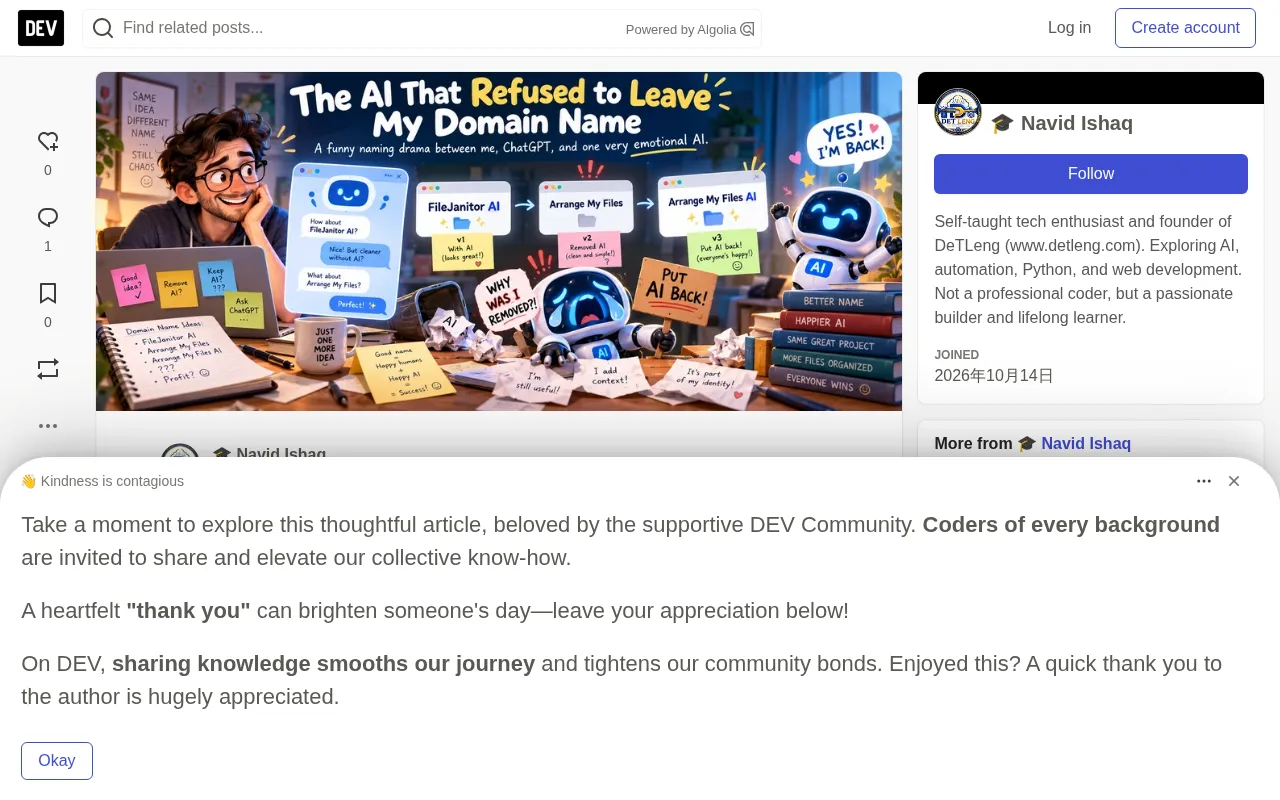
So I told ChatGPT: "Give it a respectable, meaningful name. Something ordinary people can understand immediately." After discussing several options, I proposed a straightforward direction: Arrange Your Files AI, with the domain arrangeyourfilesai.detleng.com. Clear, descriptive, and importantly, AI was still part of the team. Problem solved? Not quite.
The domain names repeatedly mentioned in the article (such as arrangeyourfilesai.detleng.com) belong to a three-level subdomain structure: detleng.com is the main domain owned by the author, and the preceding part can be freely named to distinguish different projects or services. Although subdomains can be set arbitrarily, once published externally, bookmarked by users, or appearing in documentation, changes will bring link failure and cognitive costs, so naming is often more cautious than imagined. This also explains why the author cares so much about whether to keep the word AI—the domain not only points to the service but also conveys product positioning.
ChatGPT Couldn't Resist "Improving" It
If you've spent enough time with ChatGPT, you may be familiar with this feeling: you ask for a small adjustment, and suddenly it's improving things you never asked to improve. That's exactly what happened this time. ChatGPT thought my name could be shorter, cleaner, and more natural. It confidently suggested: Arrange My Files, with the domain arrangemyfiles.detleng.com.
I stared at the screen. The name was indeed shorter. But something was missing. Something very important. Where did AI go? We were building an AI-driven app. AI should read, understand, rename, and organize files. Yet ChatGPT casually removed AI from the domain. No discussion, no explanation, not even a goodbye message.
And Then... AI Started Protesting!
I imagined the poor AI sitting in a corner, utterly heartbroken: "Why did you remove me?" "What did I do wrong?" "I was part of the original idea!" "Who's going to read those documents now?" "I did so much for you... and this is how you treat me?" Our imagined AI clearly launched an all-out protest.
So I immediately reported the crisis to ChatGPT: "Listen, we have a problem. AI was removed from the domain, and now he's protesting. He wants his name back!" To its credit, ChatGPT took this seriously—well, at least as seriously as an imagined AI protest deserves. A new name emerged: Arrange My Files AI, with the domain arrangemyfilesai.detleng.com.
It was back. AI returned. Justice was served. The protest ended. Our imagined AI jumped for joy. Peace finally returned to DeTLeng's home. At least that's what I thought.
But AI Had One Last Question...
Just when everything seemed settled, AI stopped celebrating. He turned around and said: "Okay, I'm happy now. But there's one more thing I want to know: Why did you remove me in the first place?" Oh boy. Now we were in for a full investigation.
I went back to ChatGPT: "AI is happy, but he keeps asking why you removed him. Please explain." ChatGPT replied in playful Punjabi, with all the warmth of soothing a dramatic nephew:
Oye AI puttar! 🤖😂 ("Hey, my little AI superstar! Come here—we need to resolve this eviction drama!") We didn't throw you out. We just wanted the name to be shorter! But when you started crying, we realized something important. You're the one who will read files, understand documents, suggest names, and organize folders. And letting someone else get all the credit? That's just not fair! So we brought you back with full respect: Arrange My Files AI by DeTLeng 👑 Now stay happy, son! Remember: you're here to organize files, not family relationships! 🤣
I laughed non-stop. A conversation that started as a technical project discussion turned into a family drama featuring an unemployed janitor, an emotional AI, a naming committee, and a rather apologetic ChatGPT. And all of this happened before writing a single line of code for the new project.
Behind the Laughter, There's a Real Problem to Solve
comedy was spontaneous, but the idea behind it is serious. Our computers are gradually becoming digital storage rooms. We keep everything—course materials, old downloads, business records, invoices, certificates, and documents whose filenames no longer tell us anything useful.
Arrange My Files AI by DeTLeng aims to help users turn chaos into order without becoming file management experts. The planned experience is simple:
- Select a folder on your computer.
- Let local AI examine supported documents and understand their content.
- Review intelligent filename suggestions and related categories.
- Preview the new folder structure before changing anything.
- Approve the plan and let the app organize files—with appropriate safety measures.
The core principles are equally simple:
- Your files stay on your computer.
- Your approval comes before changes.
- AI helps; humans stay in control.
The project is currently in the idea and planning stage, inspired by the "slow and steady" theme of Hacktoberfest's third week. It is not yet a finished or released app. The goal? Let technology handle repetitive work so people can spend time on better things.
Local open-source AI refers to models running directly on user devices (such as laptops and desktops), rather than being called through cloud APIs. Common forms include small language models that can be deployed offline, document parsing and embedding models, and quantized models loaded through runtimes such as ONNX and llama.cpp. Its advantage lies in privacy: file contents are not transmitted over the network, and sensitive documents do not leave the local machine. The cost is certain hardware requirements, and model capabilities are usually weaker than large cloud models, requiring a trade-off between accuracy and resource usage. The article's emphasis on "no need to send personal documents to the cloud" is precisely the core value of this architectural choice.
Sometimes, the Best Product Conversations Start with a Joke
This little exchange reminded me why I love building with AI. Product development doesn't always need to be serious to be meaningful. Sometimes a silly question makes you rethink your product name. Sometimes a naming debate reveals what your future users need to understand. Sometimes an imagined AI demands an explanation for why it was evicted from a website address.
Ultimately, we found a name that describes both the work and the intelligence behind it: Arrange My Files AI by DeTLeng. Your files. Your computer. Your AI.
AI finally stopped protesting. At least for now. Though I suspect he's already preparing his next question: "Okay, you put me back in the domain. But when exactly are you going to give me some files to organize?" 🤖😂
To be continued...
So, if it were you, would you let local AI organize your messy folders? Provided you can preview and approve every change. Feel free to share your answer in the comments.
One-line Summary
A hackathon naming conversation turned into a humorous dispute after AI was removed from the name and "protested," ultimately returning and prompting product thinking about local AI file organization.
Paragraph Summary
The author sought project ideas from ChatGPT during the third week of Hacktoberfest and received a smart file organizer proposal called FileJanitor AI. Because the word "Janitor" was not intuitive enough, the author changed it to Arrange Your Files AI, but ChatGPT arbitrarily "optimized" it to Arrange My Files and removed AI from the domain. The author then fictionalized a heartbroken AI protest, and ChatGPT played along by soothing it in Punjabi, finally settling on the name Arrange My Files AI. Behind the laughter is serious product logic: local open-source AI reads documents, suggests filenames, and executes changes only after preview. The core principles are files stay local, user approval, and human control. The project is still in the planning stage.
Related articles

LLM Application Development: A High-Paying Career Guide for Ordinary People
LLM application development offers fresh graduates up to 35K/month, with SP offers reaching 600K. This article explains the core skills, how to break in, and how ordinary people can seize AI opportunities through learning by doing.

Say Goodbye to AI Influencer Faces: A Complete Guide to Creating Visual Assets for AI Comic Dramas from Scratch
Bilibili creator shares a full workflow for zero-basics AI comic drama visual assets: use Doubao Work skills with script-first, visual references, and real-person texture to escape AI influencer faces, then lock character and scene consistency with asset sheet layouts, weapon detail images, scene nine-grids, and cinematic color palettes.

The AI Production Pipeline Behind Great Videos: From Research to Agent Validation
AI video production isn't just a model race. This article breaks down a transferable four-step pipeline: researching professional workflows, organizing a skill checklist, configuring agents, and experimental validation—and explains how general-purpose LLMs like DeepSeek can replace paid tools to run the entire process.