Perplexity Launches Orchestrator API: Unified Multi-Model Access with Failover
Perplexity launches the Orchestrator API, unifying access to multiple models via a single endpoint with built-in failover and explainable routing.
Perplexity has launched the Orchestrator API, letting developers call OpenAI, Anthropic, Google, xAI, and open-weight models through one endpoint, eliminating the overhead of multiple SDKs, keys, and bills. It includes same-model multi-provider failover to reduce single-point dependency risk and unified billing to consolidate cost accounting. The preview perplexity/auto routing claims to choose a "described" route for each request, making decisions understandable. The article notes the platform itself becomes a new dependency and routing dimensions remain undisclosed.
Perplexity is turning "multi-model orchestration" into a standardized service. Its newly released Orchestrator API lets developers call OpenAI, Anthropic, Google, xAI, and open-weight models through a single endpoint, with built-in multi-provider failover for the same model, unified billing, and a preview-stage perplexity/auto routing option.

One endpoint covering the major model camps
In the past, integrating multiple model providers meant maintaining multiple SDKs, multiple API keys, and multiple bills. The core value of the Orchestrator API is that it consolidates this fragmentation into a single interface layer: developers only need to connect to Perplexity's endpoint to switch between OpenAI, Anthropic, Google, xAI, and open-weight models.
This is not a simple "aggregation proxy." The official description explicitly mentions "same-model provider failover"—that is, when a model becomes unavailable on one provider, the request can be switched to another provider offering the same model. For teams that treat model calls as a production dependency, this layer of abstraction directly affects service availability.
Unified billing is another capability that is easy to underestimate. In a multi-model architecture, cost accounting often requires reconciling across multiple backends; by consolidating billing into a single outlet, teams can more clearly compare the calling costs of different models and reduce communication overhead between finance and engineering.
Open-weight models refer to models whose parameters can be publicly downloaded and that can be deployed and fine-tuned on your own infrastructure, such as Meta's Llama series, the Mistral series, and open-source models like Qwen from Chinese vendors. In contrast are closed-source models that can only be called through vendor APIs (such as GPT, Claude, Gemini). For developers, the value of open-weight models lies in keeping data in-domain, enabling customized fine-tuning, and keeping long-term costs controllable; for the orchestration layer, supporting open-weight models means integrators are not limited to large cloud vendors—they can also be hosted on inference platforms like Together and Fireworks. This is precisely the premise that makes "same-model multi-provider" possible: the same open-source model is often offered simultaneously by multiple inference service providers.
perplexity/auto: letting routing decide for itself
More noteworthy in this release is the preview-stage perplexity/auto routing. According to the official description, it sends each request to "a described route"—in other words, the routing decision is not a black box but comes with explainable rules or descriptive information.
This is critical for real-world engineering deployment. If automatic routing is completely unobservable, teams will struggle to troubleshoot issues like "why did this request go to the cheap model yet get the wrong answer." Described routing means developers have an opportunity to understand the traffic-splitting logic and adjust their calling strategies accordingly.
However, it should be objectively noted that perplexity/auto is still in preview, and the available material does not disclose the specific dimensions used for routing decisions (for example, whether traffic is split by task complexity, cost budget, or latency requirements). The absence of these details means it is currently difficult to assess its applicable boundaries in real business scenarios.
Auto routing is a common abstraction at the model-calling layer: the system automatically selects the "most suitable" model based on request characteristics rather than having developers hardcode model names. Common routing dimensions include task type (classification, code, long-form reasoning), prompt complexity, token length, latency budget, and cost ceiling. Industry examples include OpenRouter's automatic routing and dedicated model-routing products such as NotDiamond. The benefit of auto routing is dynamically balancing quality and cost; the risk is reduced observability—if the routing logic is opaque, teams cannot determine whether a failure is due to model capability or the router selecting the wrong model. Therefore, "explainable routing with descriptions" has substantive engineering significance.
Why failover has become essential
Making failover a first-class API capability reflects a common pain point of today's multi-model architectures. Model services are not always stable, and different providers may differ in availability, rate-limiting policies, and response performance for the same model. For AI applications already in production, the risk of single-point dependency directly translates into user experience.
The Orchestrator API builds this fault-tolerance layer on the platform side, so developers do not have to implement multi-provider switching logic, retry strategies, and state management themselves. The value of such capabilities scales with call volume—the larger the call volume, the higher the maintenance cost of building this orchestration layer yourself.
From an industry perspective, this also continues the trend of "infrastructure-ization" at the model-calling layer: application teams are increasingly less likely to bind directly to a single model vendor and instead use an orchestration service to preserve choice and flexibility.
Failover in distributed systems refers to the mechanism of automatically switching to a standby replica when the primary node or primary link fails. In the model-calling context, it includes two layers: first, provider-level switching, where the same model is redirected to provider B when unavailable on provider A; second, model-level degradation, where an overall unavailable model A falls back to a similar-capability alternative model. Engineering implementations typically require health probes, circuit breakers, retry strategies with backoff, and idempotency guarantees to avoid duplicate billing or duplicate side effects caused by switching. Building this layer on the platform side means centrally maintaining fault-tolerance code that every team would otherwise have to implement repeatedly—one of the core reasons orchestration services are viewed as "infrastructure."
Several trade-offs worth weighing
While a unified entry point brings convenience, it also introduces new dependencies. All model calls pass through Perplexity's layer, meaning the platform itself becomes a new single point of failure; its stability, rate-limiting policies, and pricing changes all affect downstream applications.
In addition, although unified billing simplifies reconciliation, it may also reduce developers' sensitivity to price fluctuations from individual providers. For cost-sensitive teams, it is still necessary to build their own cost monitoring on top of the routing layer.
Overall, the Orchestrator API addresses real engineering friction that exists in the multi-model era. Its actual quality depends on failover switching speed, the transparency of perplexity/auto routing, and the reliability of the platform layer itself—all of which await validation through more real-world usage data.
One-line Summary
Perplexity launches the Orchestrator API, enabling unified calls to multiple models through a single endpoint with built-in failover and explainable routing.
Paragraph Summary
Perplexity has launched the Orchestrator API, which lets developers call OpenAI, Anthropic, Google, xAI, and open-weight models through a single endpoint, eliminating the fragmentation costs of maintaining multiple SDKs, multiple keys, and multiple bills. The platform includes built-in multi-provider failover for the same model: when one provider becomes unavailable, requests can be switched to another provider offering the same model, reducing single-point dependency risk in production. Unified billing consolidates multi-model cost accounting into a single outlet. In addition, the preview-stage perplexity/auto routing claims to select a "described" route for each request, making traffic-splitting decisions understandable and traceable for developers. The article also notes that the unified entry point makes the Perplexity platform itself a new dependency, and the decision dimensions of automatic routing have not yet been published, so its actual quality still requires validation through more usage data.
Related articles
When Claude Writes 90% of the Code, Should Developers Say Goodbye to Hand-Writing?
Tech creator Theo discusses how AI tools like Claude now write over 90% of code: hand-writing is fading, nostalgia is fine but shouldn't belittle AI builders—curiosity and adaptability are the next generation's core edge.
13 Best Agent Gateways in 2026: MCP, A2A, and LLM Traffic Governance
MarkTechPost ranks the 13 best Agent gateways in 2026 by model traffic, MCP tool traffic, and A2A traffic governance, covering Kong, Bifrost, AgentCore, Arcade, with verified pricing and deployment options, revealing trade-offs omitted from vendor marketing.
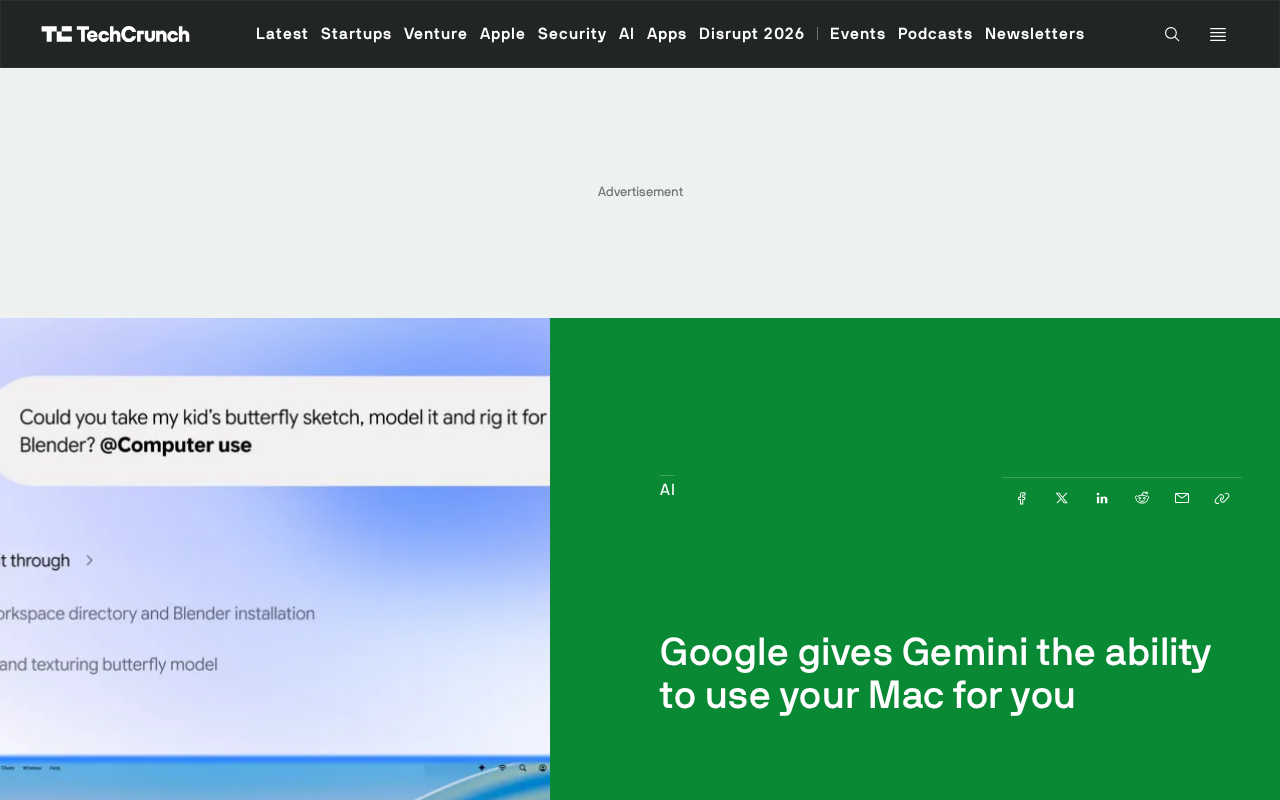
Google Gemini Comes to Mac: AI Agent Now Operates Your Computer for You
Google's latest Gemini update brings AI agent capabilities to Mac, letting it organize files, fill forms, and handle multi-step workflows—moving AI from conversation to operating your computer.