When Coding Comes Down to Pressing Enter: A Big Tech Engineer's Indictment of the AI Pipeline

AI accelerates code output, but turns engineers into Enter-key operators — the real problem is management, not the tools.
An engineer two weeks into a new job posted a viral account of his team generating nearly all deliverables — code, docs, tests, tickets — via Claude Code, with everyone from junior to senior doing essentially the same thing. Management keeps pushing harder since "shipping code isn't the bottleneck," leaving engineers working 12-13 hour days whose core action is pressing Enter. The engineer's frustration isn't with AI itself, but with an organization that won't even allow time for basic code review — turning AI from an empowerment tool into an exploitation tool. The result: invisible technical debt, accelerating skill atrophy, and the complete disappearance of professional fulfillment.
A software engineer, barely two weeks into his new job at a large tech company, posted a near-desperate confession online. The words weren't eloquent, but they cut straight to a creeping anxiety spreading across the software engineering world: when AI takes over everything, what exactly is left for engineers?
A Team's Real Struggle
According to the engineer, who goes by the handle voxium, his team's entire workflow has been thoroughly reshaped by AI. Spec documents, code, tests, PRDs (product requirements documents), tickets, ticket resolutions, reports — nearly every deliverable is generated by Claude Code.
"Nobody knows anything here."
He admits that nobody on the team actually enjoys working this way, but everyone is under pressure to ship as much as possible. The irony runs deep: from L1 to L7, regardless of seniority, everyone is essentially doing the same thing — chatting with Claude. The distinctions between engineering levels have been flattened by the act of pressing Enter.
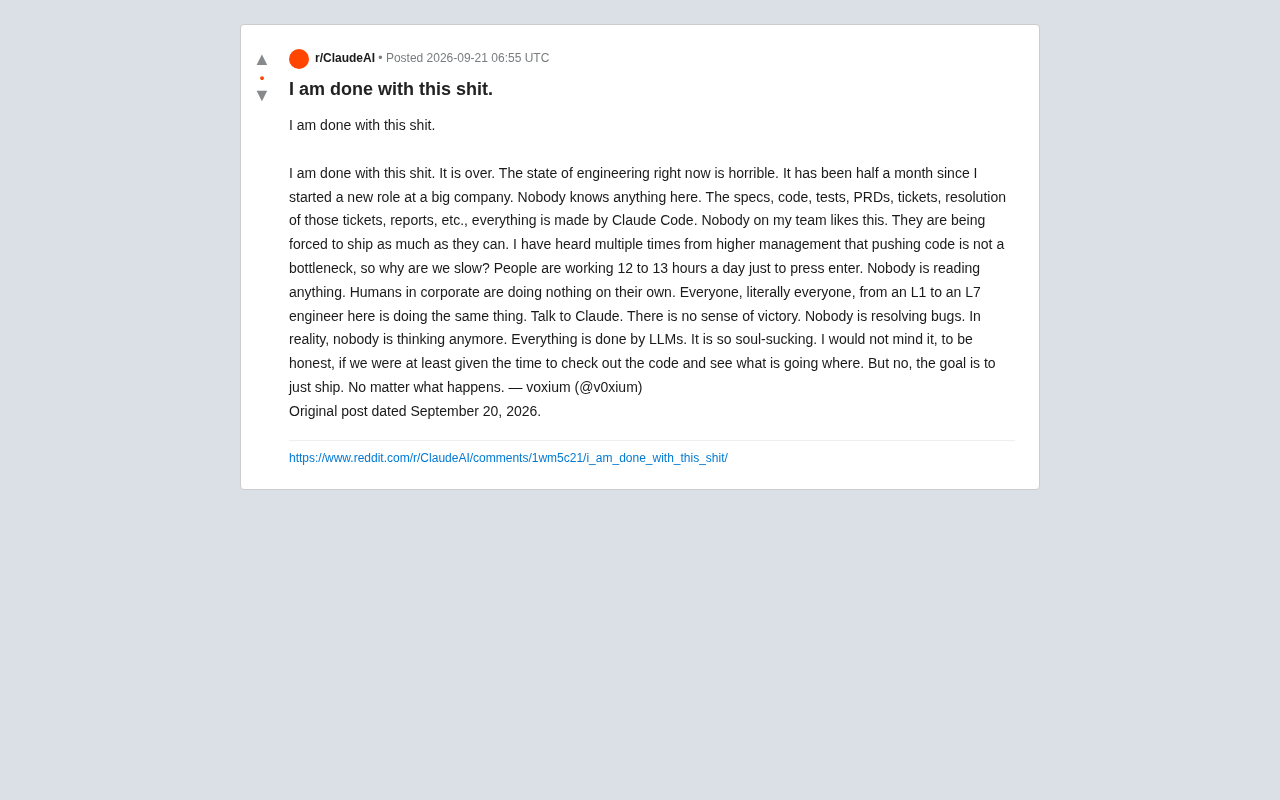
This rant resonated not because it revealed some new technology, but because it painted a picture of a new kind of labor alienation — the body is still at the desk, but the thinking has been outsourced.
Claude Code is Anthropic's AI coding assistant for developers, capable of generating complete code files, test cases, documentation, and even project architecture from natural language descriptions. Unlike earlier code completion tools such as GitHub Copilot, Claude Code can autonomously execute multi-step tasks in a terminal environment — reading codebases, modifying files, running tests, and committing changes — dramatically reducing the need for human intervention. This makes it both a powerful tool for boosting individual engineer productivity and an easy target for organizations looking to cut labor costs: a single engineer acting as a "prompt operator" can produce the output that once required an entire team over several days. L1 through L7 refers to the engineering level systems used at major tech companies like Google, Meta, and Amazon. L1/L2 are typically junior engineers, while L6/L7 are senior or principal engineers — with vast differences in compensation, expectations, and technical depth. The author's point in noting that all levels are doing essentially the same work is to highlight how AI is erasing the visible value of accumulated experience.
The Management Logic of "Pushing Code Isn't the Bottleneck"
The most contentious line in the post comes from management:
"Pushing code is not a bottleneck, so why are we slow?"
This statement reveals a classic management miscalculation. When AI exponentially accelerates code output, it's natural for managers to equate "output speed" with "delivered value" — and to redirect all the pressure onto people: if the machine can write it, you should be pushing it out faster.
The result is that team members work 12 to 13 hours a day, and the core action driving all those hours is simply pressing Enter. Throughput is up, but nobody is actually reading the code, nobody understands the logical flow, and nobody is solving real bugs. Speed becomes the only KPI, while understanding and quality are systematically sacrificed.
The Hidden Costs Being Ignored
What management sees as "the bottleneck disappearing" is really just shifting costs somewhere invisible. Unread code accumulates technical debt. Systems no one understands leave no one capable of firefighting when things break. And engineers who stop thinking for long enough will find their skills deteriorating at an accelerated pace. These costs won't show up on this quarter's delivery report — but they'll surface all at once at some future breaking point.
Technical debt is a core concept in software engineering, coined by Ward Cunningham in 1992. It describes the long-term cost incurred by taking shortcuts in design or implementation for the sake of short-term speed — like borrowing money and paying interest. Hasty code decisions create ongoing maintenance burdens down the road. When AI is generating code at scale, technical debt accumulates at a multiplied rate: AI-generated code is often syntactically correct, but may lack an understanding of business context, contain redundant logic, incorrect boundary assumptions, or implementations that don't align with team conventions. More dangerously, when nobody has actually read the code, these latent issues lose every chance of being caught — until an outage forces them into the open all at once. This differs from traditional technical debt: at least with traditional debt, someone knows where the debt lives. AI-generated code that no one has understood creates "invisible debt."
The Real Pain Point: Not AI, But No Time to Understand
It's worth noting that this engineer is not opposed to using AI. He says explicitly:
"I would not mind it, to be honest, if we were at least given the time to check out the code and see what is going where."
This is the most rational — and most important — point in the entire post. The root problem isn't the tool itself; it's that the organization has weaponized AI as a lever to compress human time, rather than treating it as an assistant that augments human capability.
When AI handles tedious work and frees people up to make higher-value judgments, it's empowering. When AI is used to extract more output while stripping away even the time for basic code review, it becomes a new set of shackles. Same tool, two completely different outcomes — the only difference is how management defines "efficiency."
Starting from the Disappearance of "That Winning Feeling"
A single emotion runs through the entire post: the absence of accomplishment. "No sense of victory." "Nobody solving bugs." "Nobody thinking." "Soul-crushing." These phrases all point to something that has been a core value in software engineering for a long time: the sense of flow and satisfaction that comes from solving problems.
The joy of engineering comes largely from cracking hard problems, understanding systems, and watching your own thinking materialize into something that runs. When all of that is replaced by "talk to Claude and press Enter," work degrades into purely mechanical operation, and professional identity collapses along with it. This isn't just an efficiency problem — it's a question about the meaning of work.
A Question Every Team Should Ask Itself
AI entering engineering workflows is inevitable. But the way it's introduced determines whether it brings liberation or alienation. The question teams should really be asking isn't "how fast can we ship" but "do we still understand what we're shipping." Once the answer to that is no, no matter how fast the delivery cadence, you're just accumulating risk at a faster rate.
What the engineer describes as "soul-crushing" maps closely onto the psychological concept of labor alienation, rooted in Marx's analysis of assembly-line workers in the industrial age: when workers become completely disconnected from the products of their labor, the process of labor itself, and their own skills, work loses its intrinsic meaning and becomes purely mechanical — a transaction for a paycheck. In software engineering, professional identity has always been tightly bound to "I understand and built this system" — which is partly why many engineers are willing to accept lower compensation than finance or consulting while still remaining deeply engaged. When "understanding the system" — the core of that identity — gets outsourced to AI, engineers are demoted from creators to operators. The flow state — that peak experience of being fully absorbed in solving a complex problem — disappears with it. The long-term absence of flow doesn't just affect job satisfaction; it causes engineers to actively avoid complex problems, creating a vicious cycle of skill atrophy.
A Final Note
This post from a frontline engineer is a real snapshot of the AI-acceleration era we're living through. It reminds us that technology itself is neutral — what truly shapes the experience is how organizations choose to use it. When "pushing code is no longer the bottleneck," the new bottleneck becomes human understanding, judgment, and professional dignity — and those are precisely the things no LLM can replace.
(Note: This article is based on a single individual's personal account. The views expressed represent the author's personal experience and do not reflect the universal state of all teams using AI-assisted development.)
Related articles

Gaussian Process Bandit Optimization: Exploration Strategies and Inference Regret Guarantees
Cumulative regret guarantees in Bayesian optimization fail to reflect final recommendation quality. This article examines a new study that provides inference regret guarantees for Gaussian process bandit optimization through exploration query strategies and fill distance analysis, validated on hyperparameter optimization and control tasks.

The Most Detailed Codex Guide on Bilibili: From Installation to Real-World Practice
The most detailed Codex guide on Bilibili: from app store installation to daily work mode configuration, with a real coffee shop project demonstrating file organization, data extraction, dashboard creation, and other practical tasks. Learn to use Plan Mode and desktop pets to leverage Codex efficiently.

Appearance Compensation in Volume Rendering: Why RGB Accuracy Cannot Guarantee Density Correctness
Volume rendering research reveals that volumetric data perfectly reproducing external RGB views may still contain density errors: appearance compensation can double central density and keep external rays unchanged even when L2 error exceeds 14.52%. Density recovery depends on appearance capacity, spatial resolution, and measurement design.