When Collectibles Lose Their Playfulness: The Concerns of Adult-Oriented Collecting and the Financialization of Everything

How investment logic is eroding childhood play as collectibles become financial assets in an era of universal financialization.
This article examines how the collectibles market has shifted from serving children's play to catering to adult investment logic. It explores how scarcity marketing leverages behavioral psychology to transform toys into speculative assets, the developmental psychology research showing why free play matters, and how this trend reflects the broader financialization of everything—from NFTs to physical collectibles—raising urgent questions about preserving joy, imagination, and childhood in a hyper-commercialized world.
Toys or Investment Vehicles? The Identity Crisis of Collectibles
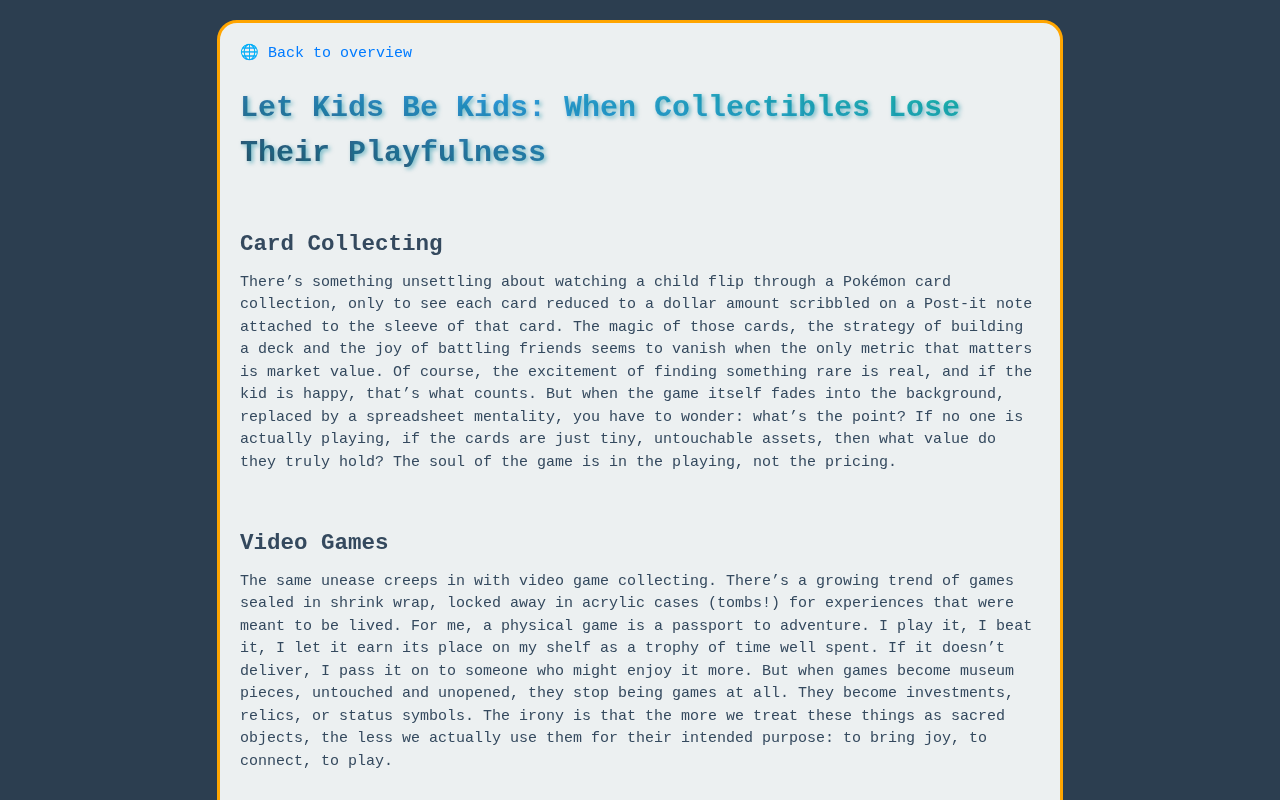
Recently, an article titled Let kids be kids: When collectibles lose their playfulness sparked discussion on Hacker News. The piece touches on a topic that seems lighthearted but is actually profound: toys and collectibles that once belonged to children are now being eroded by adult investment logic and market speculation, gradually losing the pure joy they were meant to carry.
While this topic isn't a typical cutting-edge tech issue, the shifts in consumer culture and the market's encroachment on childhood spaces it reflects share common underlying logic with tech phenomena like algorithmic recommendations and the attention economy. The Attention Economy is a concept proposed by Herbert Simon in 1971, who noted that "a wealth of information creates a poverty of attention." In the digital age, algorithmic recommendation systems maximize user dwell time through precisely targeted content, essentially selling human attention as a tradable commodity to advertisers. The investment-driven collectibles market and the attention economy share the same underlying logic—both transform things with intrinsic value (children's playtime, users' attention) into external resources that can be priced and traded by markets. Sociologist Shoshana Zuboff, in The Age of Surveillance Capitalism, calls this phenomenon "the extraction of behavioral surplus"—the continuous incorporation of non-commodified domains of human experience into market systems.
The Adult Turn in the Collectibles Market
From Playground to Trading Floor
Traditionally, collectibles—whether trading cards, blind boxes, limited-edition figures, or various merchandise—were designed primarily to bring surprise and companionship to children. In recent years, however, this space has undergone a significant adult-oriented shift.
A large number of collectibles are being repositioned as "alternative investment assets." Alternative investments refer to asset classes beyond traditional stocks and bonds, including real estate, private equity, hedge funds, and commodities. In recent years, under pressure from low interest rates and declining returns on traditional assets, the boundaries of alternative investments have continuously expanded. According to Knight Frank's Wealth Report, the total estimated value of the global collectibles market (including art, fine wine, classic cars, watches, jewelry, etc.) exceeded several trillion dollars in 2023. The rise of platforms like StockX (sneaker trading), Rally (fractionalized collectible investment), and Whatnot (live auction streaming) has made it possible for virtually any physical item to be tracked, priced, and traded like stocks. This infrastructure development is the technological prerequisite for collectibles transitioning from "hobby" to "asset class."
Rarity, print runs, and secondary market premiums have become the core of discussion, while questions like "Is it fun?" or "Would a child enjoy it?" take a back seat. When a toy's value is primarily measured by its resale price, its play attributes are thoroughly diluted.
How Scarcity Marketing Has Changed Collecting Culture
Manufacturers are well aware of the psychological effects of scarcity. Mechanisms like limited releases, randomized blind boxes, and hidden rare editions essentially create artificial scarcity and uncertainty. While these designs do stimulate consumer desire, they simultaneously transform the simple act of "owning a toy you like" into a speculative game.
These marketing strategies are grounded in solid behavioral economics. Nobel laureate Daniel Kahneman's "loss aversion" theory demonstrates that the pain of losing something is roughly twice as intense as the pleasure of gaining something of equal value. This means the anxiety of "missing a limited edition" far exceeds the satisfaction of "getting a regular version." Additionally, Robert Cialdini lists "scarcity" as one of the six principles of persuasion in his book Influence, noting that when people perceive something as scarce, they automatically assign it higher value. The blind box mechanism further layers on "variable ratio reinforcement"—the same reward mechanism as slot machines—where the unpredictability of rewards significantly increases repetitive behavior and addictiveness.
For adults, this might be an acceptable form of entertainment consumption. But when this logic permeates the children's market, kids are drawn from an early age into a value system where "rare = valuable," and the meaning of toys is completely redefined.
Why the Loss of Playfulness Deserves Attention
The Intrinsic Value of Play Itself
Developmental psychology has long established that free, unstructured play is crucial for children's cognitive, emotional, and social development. Developmental psychologist Jean Piaget categorized children's play into three stages: practice play (0-2 years), symbolic play (2-7 years), and rule-based play (7-12 years), with each stage serving different cognitive development functions. Vygotsky further proposed the "Zone of Proximal Development" theory, arguing that free play is the critical arena where children transcend their current developmental level and leap toward higher cognitive stages. A 2018 clinical report from the American Academy of Pediatrics explicitly states that reduced free play time correlates with rising rates of anxiety and depression in children.
A toy's value should not be reflected in its market price, but in whether it can spark imagination and bring joy and exploration. When toys transform from "open-ended play tools" into "investment pieces that must be kept in mint condition," children lose not just fun, but precious opportunities to develop cognitive abilities through disassembly, reassembly, and imaginative use.
When collectibles are dominated by investment logic, the signal children receive is: an object's meaning lies in its external valuation, not the experience it brings you. This early implantation of values may subtly shape the next generation's understanding of the relationship between material possessions and happiness.
Adult Anxiety Projected onto Children's World
This shift in the collectibles market is largely a projection of adult anxiety and speculative mentality. In an environment where preserving asset value is difficult and investment channels are limited, people try to find opportunities in various "alternative assets," and toy collecting gets swept up in the process.
In other words, it's the adult worldview that has changed how toys are positioned, not the toys themselves. The original article's title "Let kids be kids" is precisely a gentle appeal against this phenomenon—return to children the spaces that belong to them.
Reflections on Consumer Culture in the Age of Financializing Everything
Concerns of an Era Where Everything Is Tradable
From NFTs and digital collectibles to physical collectibles, we live in an era where "everything can be financialized." NFTs (Non-Fungible Tokens) are digital asset certificates based on blockchain technology that use smart contracts to ensure the uniqueness and traceability of each digital item. In 2021, NFT market trading volume briefly exceeded $40 billion, and digital artist Beeple sold a single work for $69 million. However, by 2023, according to a research report by dappGambl, over 95% of NFTs had become completely worthless. This journey from frenzy to collapse perfectly demonstrates the typical lifecycle of "financializing everything": new technology creates scarcity mechanisms → speculative capital floods in → price bubbles inflate → bubbles burst → original use value is reassessed. The fate of digital collectibles serves as a mirror for the physical collectibles market.
Technological tools allow scarcity to be artificially manufactured, tracked, and traded, with market tentacles extending into increasingly more domains that were once unrelated to commercial value.
The loss of playfulness in collectibles is merely one microcosm of this grand trend. It prompts us to consider: when everything is assigned a tradable value tag, are those values that cannot be quantified—joy, companionship, imagination—being systematically overlooked?
Revisiting the Original Purpose of Consumption
For product designers and manufacturers, this article raises a question worth pondering: while pursuing commercial success and manufacturing scarcity, should we preserve a product's original use value and emotional value?
For consumers, especially parents buying toys for their children, perhaps it's worth occasionally pausing to ask: Am I buying this because it's valuable, or because it brings joy?
Conclusion: Let Toys Be Toys Again
Let kids be kids is a short piece, but the issues it touches on are remarkably universal. The adult-ification and investment-ification of collectibles is a natural result of consumer society and market logic's constant expansion, but it also delivers a gentle yet important reminder:
Not everything needs to have a price, and not all happiness needs to be cashed in. Letting toys be toys again and letting children return to childhood is perhaps the purest thing we should protect in this highly commercialized age.
Related articles

Gaussian Process Bandit Optimization: Exploration Strategies and Inference Regret Guarantees
Cumulative regret guarantees in Bayesian optimization fail to reflect final recommendation quality. This article examines a new study that provides inference regret guarantees for Gaussian process bandit optimization through exploration query strategies and fill distance analysis, validated on hyperparameter optimization and control tasks.

The Most Detailed Codex Guide on Bilibili: From Installation to Real-World Practice
The most detailed Codex guide on Bilibili: from app store installation to daily work mode configuration, with a real coffee shop project demonstrating file organization, data extraction, dashboard creation, and other practical tasks. Learn to use Plan Mode and desktop pets to leverage Codex efficiently.

Appearance Compensation in Volume Rendering: Why RGB Accuracy Cannot Guarantee Density Correctness
Volume rendering research reveals that volumetric data perfectly reproducing external RGB views may still contain density errors: appearance compensation can double central density and keep external rays unchanged even when L2 error exceeds 14.52%. Density recovery depends on appearance capacity, spatial resolution, and measurement design.